University of Southern Punjab Publishes Comprehensive Faculty Development Workshop Booklet to Advance Teaching, Research and Digital Excellence
Posted 1 day ago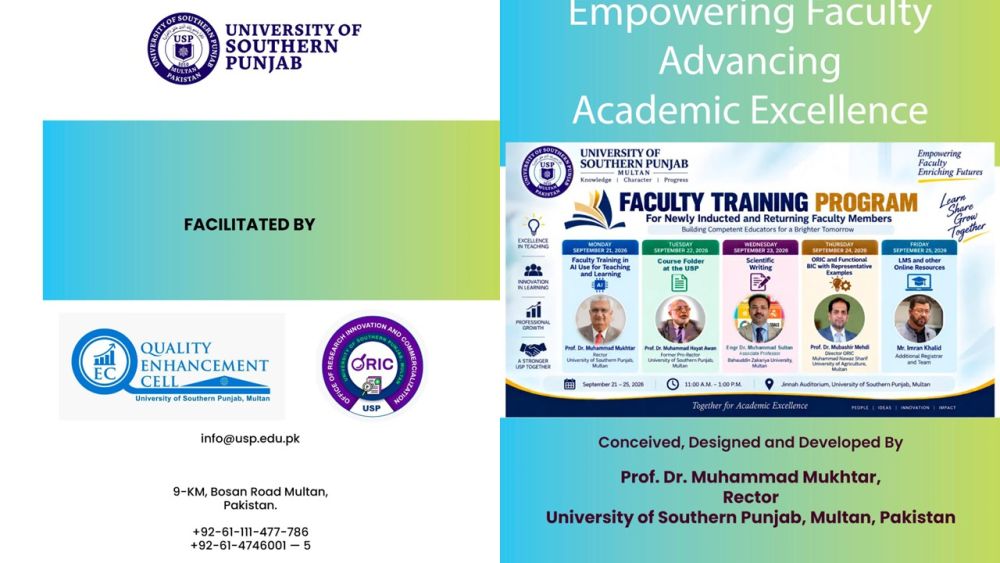
231/2026
The University of Southern Punjab (USP), Multan, has published a comprehensive Faculty Development Workshop booklet for Fall 2026, documenting a major professional development initiative to strengthen the capabilities of newly inducted and returning faculty members and to advance a culture of continuous learning, innovation, and academic excellence.
Conceived, designed, and developed by Prof. Dr. Muhammad Mukhtar, Rector of the University of Southern Punjab, Multan, Pakistan, the booklet compiles detailed workshop summaries, presentation slides, practical examples, and photographic glimpses, creating a valuable academic record and resource for faculty members. Its central theme, “Empowering Faculty, Advancing Academic Excellence,” reflects the University's emphasis on investing in educators as a pathway to improving student learning and institutional quality.
The program brought together five strategically selected areas of faculty development: Artificial Intelligence in Higher Education; Course Folder at USP; Scientific Writing; ORIC and Functional BIC with Representative Examples; and LMS and Other Online Resources. The booklet preserves both the substantive workshop discussions and the slides used during the sessions, enabling faculty to revisit the training and apply the concepts in their academic practice.
Preparing Faculty for an AI-Enabled University
The opening workshop, “Artificial Intelligence in Higher Education,” led by Prof. Emeritus Dr. Muhammad Mukhtar, explored AI’s expanding role in teaching, learning, assessment, research, and academic productivity. The training emphasized that AI should augment, not replace, teachers and human creativity, and highlighted the importance of AI literacy, critical thinking, academic integrity, responsible use, and prompt-engineering skills.
The accompanying slides moved from the fundamentals of AI and Generative AI to practical applications in lesson planning, personalized learning, assessment, research, and teaching assistance. The presentation also showcased emerging AI resources and examples of institutional approaches to AI adoption.
Transforming Course Folders into Evidence of Teaching Quality
The second workshop, “Course Folder at the University of Southern Punjab,” led by Prof. Dr. Hayat M. Awan and Prof. Dr. Muhammad Khurram Shahzad, focused on strengthening evidence-based academic documentation practices.
The training presented the course folder not merely as a collection of documents but as an academic evidence portfolio covering the full cycle of planning, teaching, assessment, analysis, reflection, and improvement. Faculty were guided through CLOs; PLOs mapping, assessment blueprints, 16-week teaching plans, lesson plans, student performance analysis, and Continuous Quality Improvement.
A particularly powerful message of the workshop was:
PLAN → TEACH → ASSESS → ANALYZE → REFLECT → IMPROVE
This approach positions the course folder as a living record of teaching quality and student learning rather than as routine paperwork.
Strengthening Research and Scientific Communication
The Scientific Writing Workshop, led by Engr. Dr. Muhammad Sultan, focused on strengthening faculty research and publication capabilities. Participants were guided through the research cycle, from identifying a meaningful research problem and reviewing the literature to research design, data analysis, drawing conclusions, and scholarly publication.
The workshop emphasized the IMRAD framework (Introduction, Methods, Results, and Discussion), along with effective titles and abstracts, research gaps, reproducible methodology, presentation of results, referencing, and journal requirements. Importantly, the workshop also addressed research integrity, including plagiarism, fabrication, falsification, inappropriate data manipulation, transparency, and accountability.
Connecting Research with Innovation and Entrepreneurship
The fourth workshop, “ORIC and Functional BIC with Examples,” led by Engr. Dr. Mubashir Mehdi, Mr. Asif Hayat Tipu, and Muhammad Bilal, highlighted how university research can move beyond publications to drive innovation, entrepreneurship, and societal impact.
The session featured practical examples. Mr. Asif Hayat Tipu presented the development of high-yield dwarf mango varieties through ORIC-supported research. At the same time, Muhammad Bilal shared his entrepreneurial journey of turning a research-based idea into a multigrain company that employs more than 20 people. These examples illustrate the potential pathway from research laboratories to farms, markets, enterprises, and employment.
Building a Digitally Enabled Academic Ecosystem
The fifth workshop, “LMS and Other Online Resources,” was led by Mr. Imran Khalid, Mr. Adnan Raza, Mr. Sajeel Nawazish, and Mr. Muzamil Imran.
The hands-on session introduced faculty to USP's integrated digital ecosystem, including the USP Teacher Portal (LMS), USP Face App, and USP Channel App. Faculty were guided through managing classes, academic calendars, learning materials, course folders, online classes, attendance, examination papers, evaluation, and electronic submission of results. The team also demonstrated the Research Portal for postgraduate research supervision.
The training further demonstrated the Face App's role in AI-enabled attendance management through authentication, facial recognition, and GPS. At the same time, the USP Channel App was presented as an institutional communication and workflow platform.
A Culture of Continuous Professional Development
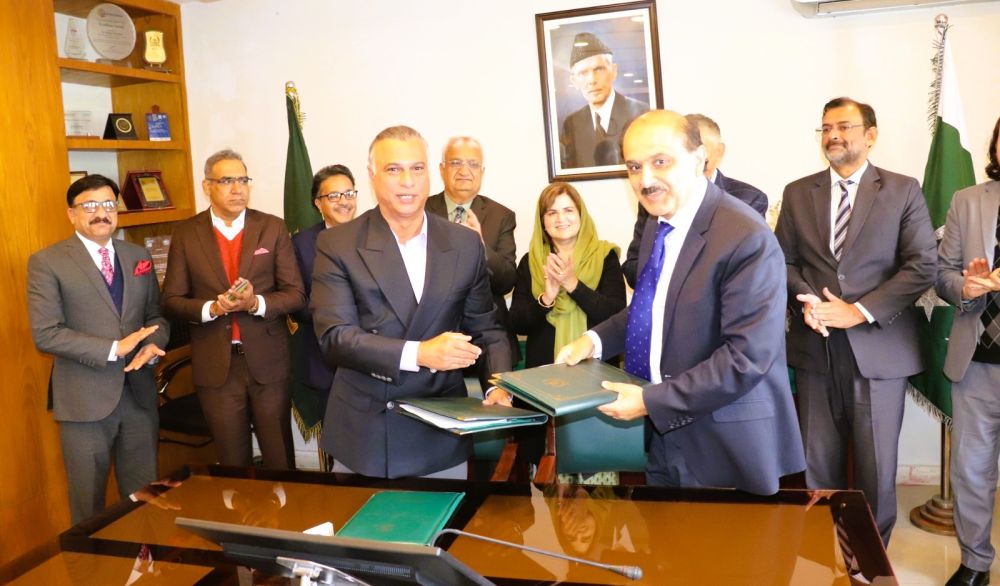
The Chairman of the Board of Governors, Mr. Asim Nazir Ahmed, commended USP for organizing the Faculty Training Program and emphasized that faculty development is essential to academic excellence. He highlighted the program's integrated focus on teaching, research, innovation, and digital competencies, noting that investing in faculty is investing in education quality and students' futures.
The newly published booklet therefore serves a purpose beyond documenting a workshop. By preserving the workshop briefs, presentation slides, practical examples, and glimpses of the sessions, it creates a reusable professional resource for faculty. It records USP's institutional commitment to continuous academic development.
The initiative reflects a broader vision of a modern university in which faculty development encompasses AI-enabled teaching, outcome-based education, scientific research, innovation and entrepreneurship, digital governance, and continuous quality improvement.
At the University of Southern Punjab, faculty development is not a one-time initiative; it is a continuous commitment to empowering educators, transforming teaching and research, inspiring innovation, and building a culture of enduring academic excellence.