University of Southern Punjab, Multan, Pakistan Launches Outcome-Based Education Week to Advance Excellence in Teaching and Learning
Posted 1 day ago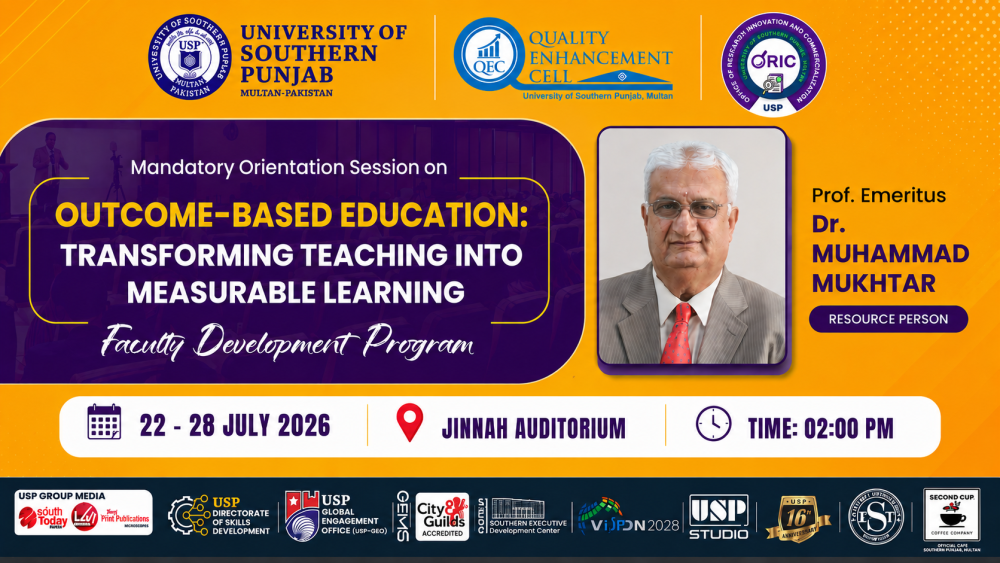
153/2026
To strengthen the quality of higher education, the University of Southern Punjab (USP), Multan, has launched a week-long Outcome-Based Education (OBE) Week, in line with the Higher Education Commission (HEC) of Pakistan's reform agenda. The initiative brings together the University's entire faculty each day for focused discussions on Outcome-Based Education, Bloom's Taxonomy, constructive alignment, and contemporary teaching and assessment practices, to enhance academic quality, promote student-centered learning, and foster a culture of continuous improvement across the institution.
Throughout the week, the entire faculty meets daily for dedicated interactive sessions focused on the principles and implementation of Outcome-Based Education (OBE), Bloom's Taxonomy, constructive alignment, learning outcomes, assessment strategies, and other internationally recognized models that promote effective teaching and meaningful student learning. The program fosters vibrant academic dialogue, collaborative learning, and the exchange of best practices among faculty members.
The sessions are facilitated by Prof. Dr. Muhammad Mukhtar, Rector of the University of Southern Punjab, whose extensive international academic experience enriches the discussions. Having taught and delivered academic programs in nearly 27 countries, Prof. Mukhtar shared that while his global exposure greatly broadened his educational perspective, he developed a deep understanding and practical appreciation of Outcome-Based Education during his academic service in Malaysia, a country internationally recognized for successfully implementing OBE across its higher education institutions.
Addressing the faculty, Prof. Mukhtar emphasized that Outcome-Based Education marks a fundamental shift in educational philosophy. He noted that effective teaching is no longer measured solely by what instructors teach, but by what students can know, do, and demonstrate upon completing a course. He stressed that clearly defined learning outcomes, constructive alignment of the curriculum, innovative teaching methodologies, and authentic assessment practices are essential to producing competent graduates capable of addressing contemporary societal and professional challenges.
He further highlighted that the success of OBE depends on a shared institutional commitment, with every faculty member actively contributing to improving student learning experiences and continuously refining teaching practices through reflection, assessment, and feedback.
The Outcome-Based Education Week reflects USP's commitment to aligning its academic programs with international quality standards while supporting HEC Pakistan's ongoing reforms to strengthen higher education through quality assurance, accreditation, and measurable learning outcomes. By investing in continuous faculty development and fostering a culture of educational innovation, the University of Southern Punjab is preparing graduates with the knowledge, skills, critical thinking, and professional competencies needed to excel in an increasingly dynamic global environment.
Through initiatives such as OBE Week, the University continues to reinforce its position as a forward-looking institution committed to academic innovation, educational excellence, and the development of future-ready graduates who can make meaningful contributions to Pakistan and the global community.
1- Outcome-Based Education (OBE): Focusing on Quality Rather Than Quantity
2. Competence: Beyond Qualifications Toward Real-World Performance
4. Learning Versus Teaching: Shifting the Focus from Content Delivery to Student Success
5. Understanding Outcome-Based Education: A Paradigm Shift from Teaching to Learning
6. Benefits and Challenges of Outcome-Based Education
7. Global Adoption of Outcome-Based Education: A Worldwide Transformation in Higher Education
8. Bloom's Taxonomy: A Foundational Framework for Learning, Teaching, and Assessment
9. The Cognitive Domain of Bloom's Taxonomy: From Remembering to Critical Evaluation
10. The Revised Bloom's Taxonomy: Evolution of the Cognitive Framework
11. Educational Goals, Assessment Practices, and Bloom's Taxonomy
12. Bloom's Taxonomy and National Competitiveness: The Foundation of Quality Education