ORIC Ranking as an Indicator for Higher Education Institutions in Pakistan
Posted 3 months ago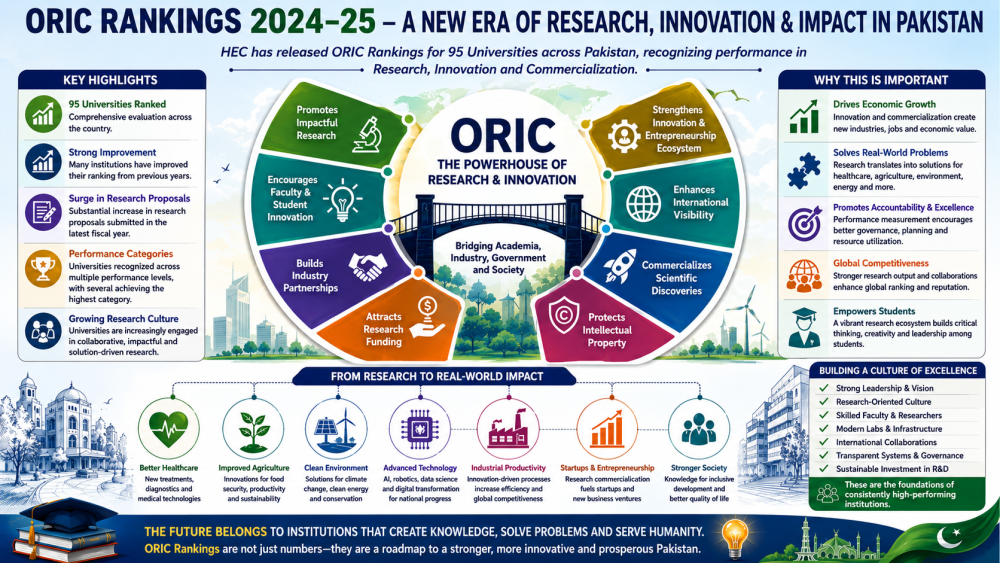
81/2026
The Higher Education Commission of Pakistan’s recent release of ORIC (Office of Research, Innovation and Commercialization) rankings for 95 universities across Pakistan marks an important milestone in the country’s academic journey. These rankings are more than numerical positions on a chart; they reflect a growing recognition that universities must evolve from traditional teaching institutions into dynamic centers of research, innovation, entrepreneurship, and societal impact.
In the contemporary knowledge-driven world, nations advance not only through natural resources or industrial capacity but also through the generation of ideas, technologies, and scientific solutions. Universities are expected to produce research that addresses national challenges, supports economic development, and contributes to global scientific advancement. ORICs play a central role in this transformation by bridging academia, industry, government, and society.
The latest rankings reveal encouraging signs of progress. Several institutions achieved the top performance categories, while many others improved their standing compared with previous years. A substantial increase in research proposals submitted during the fiscal year also indicates a rapidly growing research culture across Pakistan. This demonstrates that Pakistani universities are becoming more engaged in scientific inquiry, innovation, technology transfer, and collaborative research.
The importance of ORICs extends far beyond rankings. A strong ORIC system helps universities:
- Promote impactful research
- Encourage faculty and student innovation
- Build partnerships with industry
- Attract research funding
- Protect intellectual property
- Commercialize scientific discoveries
- Enhance international visibility
In practical terms, effective research commercialization can yield new technologies, startups, healthcare solutions, agricultural improvements, environmental innovations, and increased industrial productivity. This directly contributes to national economic growth and sustainable development.
Another significant aspect of these rankings is accountability and performance measurement. By evaluating research management systems, grant acquisition, innovation activities, and commercialization efforts, the rankings encourage institutions to strengthen governance structures and improve research quality. Healthy competition among universities often leads to better strategic planning, stronger research environments, and greater institutional efficiency.
The rankings also highlight an important reality: research excellence requires long-term investment. Universities that consistently perform well usually possess strong leadership, a research-oriented culture, trained faculty, modern laboratories, international collaborations, and transparent administrative systems. Therefore, these rankings should not be viewed as competition, but as indicators of institutional maturity and academic vision.
For students, the significance is equally profound. A university with a vibrant research ecosystem offers students opportunities for critical thinking, innovation, entrepreneurship, and exposure to real-world problem-solving. Such environments prepare graduates not only for employment but also for leadership in science, technology, healthcare, business, and public policy.
At the national level, strengthening research and innovation ecosystems is essential to Pakistan’s future. Countries that invest in research and development become leaders in technology, healthcare, artificial intelligence, renewable energy, agriculture, and economic resilience. Universities, therefore, serve as engines of national transformation.
The ORIC rankings in Pakistan send a powerful message: higher education can no longer remain confined to classrooms and examinations alone. The future belongs to institutions that create knowledge, solve societal problems, and contribute meaningfully to humanity. Pakistan’s growing emphasis on research and innovation is therefore a promising sign for the country’s academic and economic future.