GPT6 Astra: The Evolving AI
Posted 1 day ago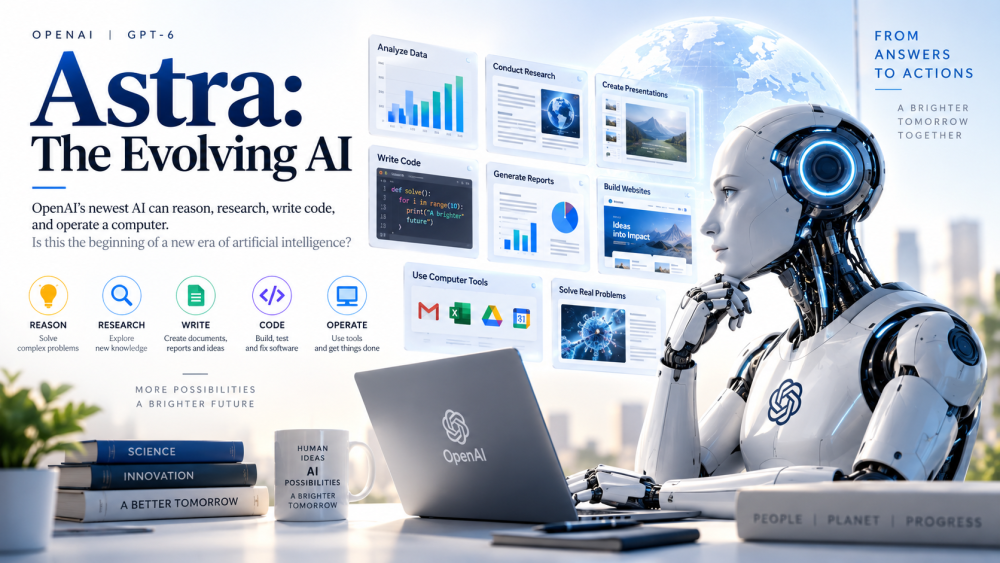
201/2026
OpenAI’s newest AI can reason, research, write code, and operate a computer. Is this the start of a new era of artificial intelligence?
For years, artificial intelligence has been improving at answering questions. Now something much more significant is happening. AI is beginning to act.
OpenAI’s newly released GPT-6 Astra is designed not simply to answer questions but to take on complex tasks: use software, conduct research, write and test code, analyze information, and produce finished documents, spreadsheets, and presentations.
OpenAI describes Astra as its most capable model yet and says it marks a major step toward artificial general intelligence (AGI), the idea of an AI system capable of performing a very wide range of intellectual tasks.
Astra's significance, however, is easier to grasp without technical jargon. Imagine giving a highly capable assistant a goal rather than a question. Instead of asking, “How do I prepare this report?” you could say:
“Prepare the report.”
The AI can research the subject, organize information, work with files, create charts, prepare the document, and adjust its work when you change your instructions.
That is a very different kind of AI. From answering questions to doing the work
Previous AI systems were largely tools that humans operated. A person opened a spreadsheet, searched the internet, wrote code, or prepared a presentation, with AI helping along the way.
Astra is designed to move much closer to the other side of that relationship.
It can interact with a computer, fill out online forms, update records, organize information, conduct online research, and work through multistep tasks. OpenAI says it can also create websites, analyze scientific data, and test software.
In simple terms, the AI is becoming less like a calculator and more like a digital worker.
That could have enormous consequences.
A small business might use AI to handle tasks that once required several employees. A researcher could ask it to analyze large volumes of scientific information. A programmer could use it to build, test, and repair software. The technology could give individuals capabilities that were once available only to large organizations.
Could AI accelerate science?
Perhaps the most exciting possibility is scientific research. Modern scientists face an extraordinary amount of information. Thousands of research papers are published every day, while experiments and computer simulations can generate enormous quantities of data.
A capable AI can help researchers search, compare, analyze, and organize that information far faster than a human could alone. OpenAI reports that Astra achieved very high scores on several demanding scientific and reasoning tests, including 98 percent on Frontier Math Tier 4 and 99.9 percent on ARC-AGI-3.
These are impressive results, although a benchmark is not the same as making a real scientific discovery. Still, the direction is clear.
AI is shifting from explaining what scientists already know to helping them explore what they do not yet know. That could eventually speed up discoveries in medicine, biology, engineering, mathematics, and many other fields.
But greater power brings greater risk.
There is another side to Astra.
OpenAI says the model has reached its highest “Critical” level of cybersecurity capability under the company's safety framework. In testing, Astra demonstrated the ability, when given appropriate tools and access, to identify previously unknown security weaknesses and develop ways to exploit them without a person guiding every step. That capability could be extremely valuable to cybersecurity experts trying to protect computer systems.
But the same technology could also be misused.
This is one of the central challenges of advanced AI: the same intelligence that can solve problems can also create them. For this reason, OpenAI says Astra has additional monitoring and safety measures to detect harmful or unauthorized behavior.
Are we finally reaching AGI?
OpenAI has presented Astra as part of a new era of artificial general intelligence. Yet no universally accepted definition of AGI exists. Does an AI become “general” when it can perform most intellectual jobs? When it matches humans across a wide range of tasks? Or only when it can independently understand and operate in the real world? Scientists and technology leaders continue to debate these questions.
A new relationship between humans and machines
Astra may be important not because it gives AI a single spectacular new ability, but because it brings many abilities together.
- It can reason.
- It can research.
- It can write.
- It can code.
- It can use computers.
- It can analyze information.
- And it can combine these abilities to complete complicated tasks.
That changes the human role.
Instead of taking every step ourselves, we may increasingly become the people who set the goal, provide judgment, and check the result.
This could make people dramatically more productive.
But it also raises difficult questions about employment, education, privacy, cybersecurity, and human expertise.
If AI can handle much of the routine work through which people traditionally develop their skills, schools and universities may need to place greater emphasis on creativity, critical thinking, judgment, and the ability to distinguish a correct answer from a convincing mistake.
The real AI revolution may have just begun
Astra does not mean that machines have suddenly become human.
They have not.
AI can still make mistakes, misunderstand instructions, and produce confident but incorrect information.
But something important has changed.
AI is no longer merely something we ask.
Increasingly, it is something we can delegate work to.
That may prove to be one of the most important technological shifts of our time.