10. The Revised Bloom's Taxonomy: Evolution of the Cognitive Framework
Posted 3 months ago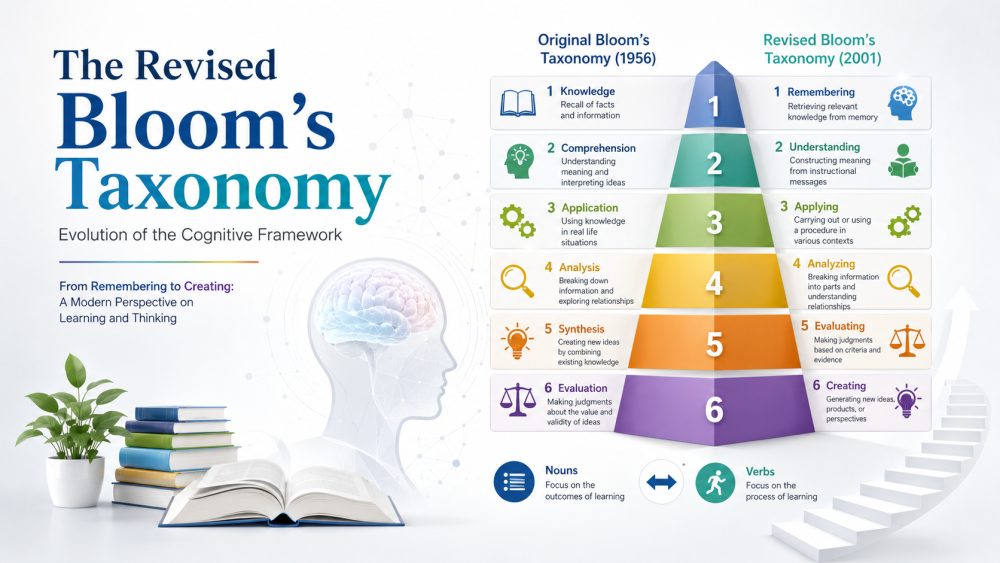
139/2026
Why Was Bloom's Taxonomy Revised?
The revised taxonomy was developed to align the framework more closely with modern educational practices that emphasize active learning, problem solving, and learner engagement. Rather than viewing learning as the accumulation of static knowledge, contemporary education recognizes it as a dynamic process in which learners actively construct, apply, and transform knowledge.
One of the most significant changes in the revised taxonomy was replacing noun-based category names with action-oriented verbs. This shift moved the focus from the products of learning to the cognitive processes learners engage in while acquiring and using knowledge. Consequently, taxonomy became more directly applicable to writing measurable learning outcomes, designing classroom activities, and constructing authentic assessments.
10.1 Changes in Terminology
The revised Bloom's Taxonomy retained the hierarchical structure of six cognitive levels but introduced new terminology reflecting observable learning behaviors.
The original category Knowledge became Remembering, emphasizing the learner's ability to retrieve previously acquired information. Comprehension was renamed Understanding to highlight the interpretation and explanation of ideas. Application became Applying, Analysis became Analyzing, and Evaluation became Evaluating. Likewise, the original category Synthesis was replaced with Creating, emphasizing the generation of new ideas, products, or solutions.
These changes transformed taxonomy into a more action-oriented framework, making it easier for educators to formulate measurable learning outcomes using verbs that describe observable student performance.
10.2 Reordering the Highest Levels
The most notable conceptual change in the revised taxonomy concerns the order of the final two cognitive levels. In Bloom's original taxonomy, Synthesis is the fifth level, and Evaluation is the highest level of cognitive achievement. Bloom regarded critical evaluation as the culmination of intellectual development because it requires learners to integrate knowledge, analysis, and creativity before making evidence-based judgments.
The revised taxonomy reverses these positions. Evaluation becomes the fifth level, while Creating is elevated to the highest cognitive level. This revision reflects the contemporary view that genuine creativity requires learners to integrate knowledge, evaluate existing ideas, and ultimately generate original products, innovative solutions, or new perspectives. According to this interpretation, Creating represents the most sophisticated form of cognitive processing because it builds on all preceding levels of learning.
10.3 Comparison of the Original and Revised Taxonomies
The evolution of Bloom's Taxonomy can be summarized as follows:
|
Original Bloom's Taxonomy (1956) |
Revised Bloom's Taxonomy (2001) |
|
Knowledge |
Remembering |
|
Comprehension |
Understanding |
|
Application |
Applying |
|
Analysis |
Analyzing |
|
Synthesis |
Evaluating |
|
Evaluation |
Creating |
This comparison highlights two key modifications: the adoption of action verbs and the reversal of the fifth and sixth cognitive levels.
10.4 Which Taxonomy Should Educators Use?
Both versions of Bloom's Taxonomy remain valuable educational frameworks. The choice depends largely on instructional philosophy, curriculum design, and assessment objectives.
The revised taxonomy has become especially popular in outcome-based education because its action verbs help develop measurable learning outcomes and support competency-based assessments. It aligns well with student-centered learning environments that emphasize innovation, collaboration, and problem-solving.
Nevertheless, the original taxonomy remains highly respected and is widely used in educational literature and curriculum development. Many educators value its conceptual clarity and regard evaluation as the ultimate intellectual achievement because sound judgment requires a comprehensive integration of knowledge, understanding, application, analysis, and creative thinking. From this perspective, creativity is a prerequisite for informed evaluation rather than its successor.
For this reason, many scholars and practitioners, including those who adopt the approach in this book, continue to use the original Bloom's Taxonomy while acknowledging the valuable contributions of the revised model.
10.5 Educational Significance of the Revision
The revision of Bloom's Taxonomy shows that educational frameworks must evolve alongside advances in research and pedagogy. Although the terminology and sequence of the higher cognitive levels differ between the two versions, their core purpose remains the same: to guide learners from basic knowledge acquisition to increasingly sophisticated levels of intellectual performance.
Whether educators adopt the original or the revised taxonomy, the core educational message remains the same. Effective teaching should not be limited to helping students remember information; rather, it should cultivate understanding, practical application, analytical reasoning, creativity, and sound judgment. These higher-order cognitive abilities prepare learners to address complex professional, scientific, and societal challenges with confidence and competence.
10.6 Summary
The 2001 revision of Bloom's Taxonomy modernized one of education's most influential frameworks by replacing noun-based categories with action verbs and repositioning Creating as the highest level of cognitive learning. While the revised taxonomy reflects contemporary views of active learning and creativity, the original taxonomy continues to hold considerable educational value and remains widely used throughout the world. Both frameworks share the objective of fostering progressively deeper intellectual development and provide educators with a systematic approach to designing meaningful teaching, learning, and assessment experiences. In this book, the original Bloom's Taxonomy is adopted for its enduring conceptual strength and continued relevance to educational practice across diverse disciplines.