Deskilling in the Digital Era: A New Challenge for Humanity
Posted 2 months ago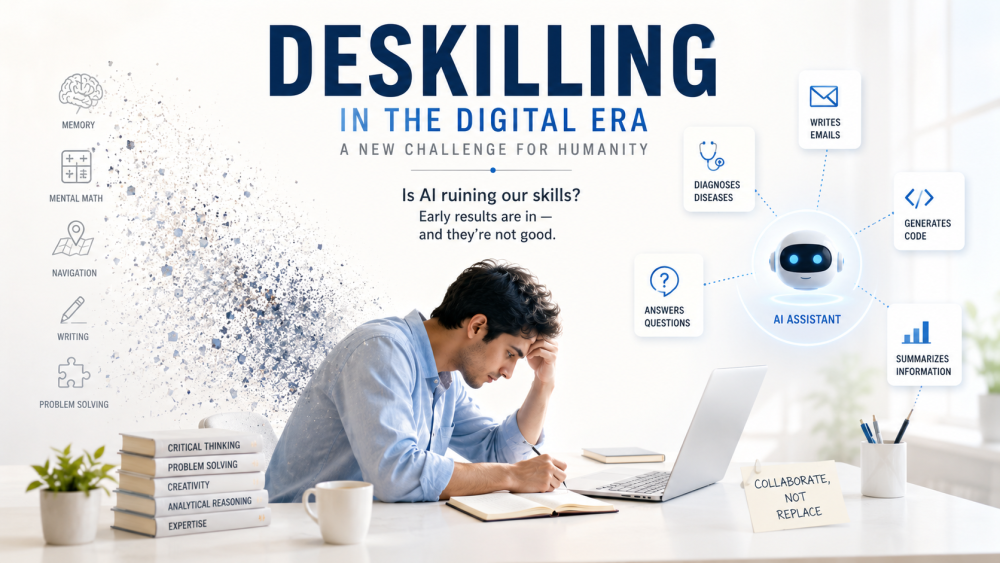
95/2026
A recent article in Nature has raised important questions: “Is AI ruining our skills? Early results are in - and they’re not good”
Artificial intelligence (AI) has become an indispensable assistant in our daily lives. It writes emails, diagnoses diseases, generates code, and answers questions in seconds. But as we increasingly rely on AI to think for us, an important question is emerging: Are we losing some of our own skills in the process?
Recent studies suggest the answer may be yes. Researchers have found that professionals who frequently rely on AI tools can experience a decline in their ability to perform complex tasks independently. Physicians using AI-assisted diagnostic systems were less effective at identifying medical conditions on their own, while software engineers who relied heavily on AI coding assistants showed weaker problem-solving skills when the tools were unavailable.
The phenomenon is not entirely new. People have always delegated tasks to technology. Calculators reduced the need for mental arithmetic, and GPS navigation weakened our ability to memorize routes. AI, however, goes a step further by taking over cognitive work—the very thinking processes that define expertise.
Experts warn that when people stop actively engaging with difficult problems, their knowledge and critical-thinking abilities can gradually erode. Skills improve with practice and weaken when unused. If AI consistently provides answers, users may lose opportunities to develop judgment, creativity, and analytical reasoning.
Yet AI itself is not the enemy. Like any powerful tool, its impact depends on how it is used. AI can enhance productivity, reduce routine workloads, and provide valuable support in education, medicine, and research. The challenge is to ensure that AI remains a partner rather than a substitute for human thinking.
The future may belong not to those who rely entirely on artificial intelligence, nor to those who reject it, but to those who learn to collaborate with it wisely. In an age of intelligent machines, the most important skill may be to preserve and strengthen our own intelligence.