6. Benefits and Challenges of Outcome-Based Education
Posted 3 months ago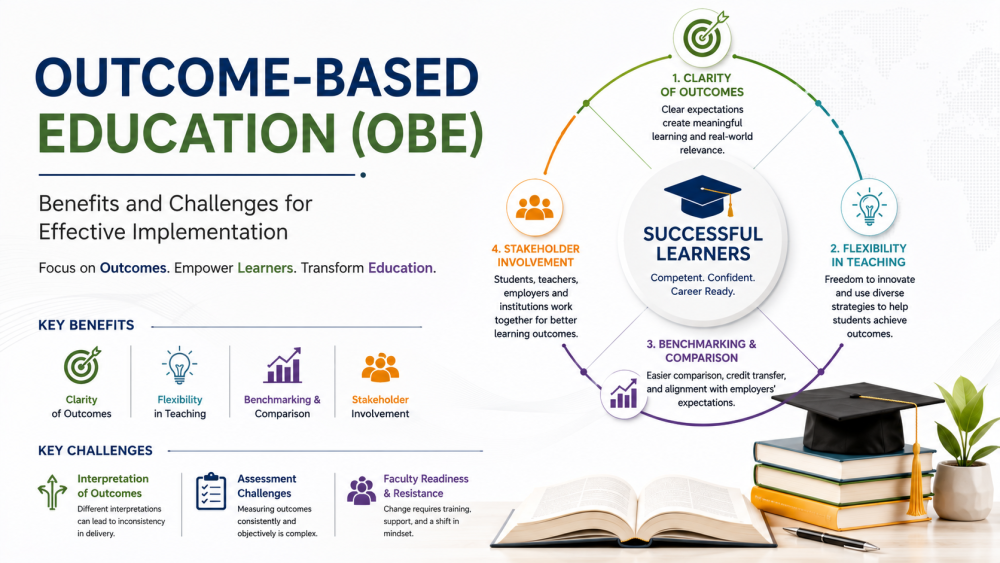
135/2026
This chapter examines the major benefits of Outcome-Based Education while also highlighting the practical challenges institutions may face during its implementation.
6.1 Clarity of Learning Outcomes
Perhaps the greatest contribution of Outcome-Based Education is the clarity it brings to the educational process. Traditional education often focuses on what teachers intend to teach. In contrast, OBE begins by clearly defining what students are expected to know, understand, demonstrate, and achieve by the end of a course, module, or academic program.
Clearly articulated learning outcomes set transparent expectations for everyone involved in education. Students understand the competencies they are expected to develop. Teachers gain clear instructional direction, and curriculum designers can organize learning experiences that directly support these intended outcomes. Employers and professional bodies also benefit because they know the capabilities graduates are expected to possess.
Outcome clarity transforms education from a content-centered process into a purpose-driven system in which every lecture, assignment, laboratory exercise, project, and assessment directly contributes to developing meaningful competencies. It also helps students appreciate the relevance of their studies by showing how classroom learning connects to professional practice and real-world applications.
Ultimately, clearly defined outcomes form the foundation on which curriculum design, instructional strategies, assessment methods, and quality assurance are built.
6.2 Flexibility in Teaching and Learning
Contrary to a common misconception, Outcome-Based Education does not prescribe a single teaching methodology. Instead, it encourages educators to adopt instructional approaches that most effectively help students achieve the intended learning outcomes.
This flexibility empowers teachers to become creative facilitators rather than merely content deliverers. Educators are free to employ lectures, discussions, collaborative learning, case studies, simulations, project-based learning, flipped classrooms, laboratory experiments, fieldwork, digital learning platforms, mentoring, peer instruction, and other pedagogical strategies based on the nature of the learning outcomes.
Because the emphasis is on student achievement rather than instructional routine, teachers are encouraged to continuously innovate and adapt their teaching to meet learners' diverse needs. Study guides, interactive activities, reflective exercises, teamwork, problem-solving sessions, and experiential learning become valuable tools for promoting deeper understanding and long-term retention.
This instructional flexibility enables institutions to foster engaging, learner-centered learning environments that are responsive to rapidly changing educational needs.
6.3 Benchmarking and Academic Comparability
Another major advantage of Outcome-Based Education is the standardization of educational expectations through clearly defined competencies. When institutions specify comparable learning outcomes, it becomes significantly easier to benchmark academic programs both nationally and internationally.
Such transparency supports student mobility between institutions by enabling receiving universities to evaluate previously completed coursework and more accurately determine appropriate credit transfers. Rather than comparing only course titles or credit hours, institutions can compare the competencies students have achieved.
Similarly, employers gain greater confidence in graduates because learning outcomes offer a clearer picture of their professional capabilities. Rather than relying solely on grades or institutional reputation, organizations can better assess the knowledge, technical skills, communication abilities, ethical standards, and practical competencies graduates are expected to possess.
Benchmarking also promotes continuous improvement by enabling institutions to compare their educational performance with national standards, international accreditation requirements, and global best practices.
6.4 Greater Stakeholder Engagement
Outcome-Based Education fosters stronger collaboration among all stakeholders in education. Students, teachers, administrators, employers, accreditation agencies, professional organizations, parents, alums, and industry partners become active participants in defining and achieving educational quality.
Students are more motivated because they clearly understand what is expected of them throughout their academic journey. Instead of studying merely to pass examinations, they work toward developing competencies that will benefit them throughout their professional careers.
Teachers likewise become more engaged because their responsibility extends beyond delivering lectures to ensure that meaningful learning occurs. Curriculum committees collaborate more closely to align learning outcomes, teaching strategies, and assessment methods, while employers contribute valuable insights into the competencies required in contemporary workplaces.
This collaborative approach strengthens the relevance, quality, and accountability of educational programs while fostering stronger connections between educational institutions and society.
6.5 Continuous Improvement and Quality Assurance
Although often overlooked, one of the most valuable contributions of Outcome-Based Education is its focus on continuous quality improvement.
Because student achievement is measured against predefined learning outcomes, institutions can gather meaningful evidence of educational effectiveness. Assessment data help identify strengths, weaknesses, learning gaps, curriculum deficiencies, and opportunities for improvement.
Faculty members can revise teaching methods, curriculum committees can redesign courses, and administrators can allocate resources more strategically, guided by evidence rather than assumptions. This systematic process of evaluation and refinement fosters a culture of continuous improvement that enhances educational quality over time.
Consequently, OBE aligns naturally with modern accreditation systems that require institutions to demonstrate measurable evidence of student learning and institutional effectiveness.
Challenges in Implementing Outcome-Based Education
Despite its many advantages, implementing Outcome-Based Education is not without challenges. Successful adoption requires institutional commitment, faculty development, consistent assessment practices, and strong academic leadership.
6.6 Diverse Interpretation of Learning Outcomes
One of the greatest implementation challenges stems from the interpretation of learning outcomes themselves.
Even when institutions adopt identical outcome statements, different teachers, departments, or academic programs may interpret them in different ways. Terms such as critical thinking, problem-solving, professional competence, or effective communication may carry different meanings for different educators.
Such variations can lead to inconsistent teaching approaches, differing expectations, and unequal student learning experiences across courses or departments.
To minimize these inconsistencies, institutions should establish common guidelines, conduct faculty training workshops, develop detailed outcome descriptors, and encourage collaborative curriculum planning. A shared understanding among educators is essential to ensure consistency and maintain educational quality.
6.7 Challenges in Assessment
Assessing learning outcomes poses another significant challenge.
Competencies such as analytical reasoning, teamwork, leadership, communication, creativity, ethical judgment, and professional behavior are often more difficult to evaluate than factual knowledge. Different instructors may apply varying grading standards or interpret assessment criteria differently, leading to inconsistent evaluations of student performance.
Addressing this challenge requires carefully designed assessment rubrics, explicit performance criteria, moderation processes, peer review of assessments, and ongoing faculty calibration. Institutions must regularly review assessment practices to ensure fairness, reliability, validity, and consistency across academic programs.
Only through objective and transparent assessment can Outcome-Based Education fulfill its intended purpose.
6.8 Faculty Readiness and Resistance to Change
Perhaps the most significant challenge in implementing Outcome-Based Education is the transformation required of educators themselves.
Traditional teaching often emphasizes completing syllabi and delivering lectures. Outcome-Based Education requires teachers to assume broader responsibilities, including designing learning outcomes, developing learner-centered instructional strategies, conducting authentic assessments, analyzing learning data, and continuously improving teaching practices.
Many educators initially perceive these additional responsibilities as increasing their workload. Others may resist changing long-established teaching habits or feel uncertain about new assessment methodologies.
Successful implementation, therefore, depends on comprehensive faculty development, institutional support, mentoring, professional training, recognition of teaching excellence, and strong academic leadership. When educators understand the educational value of OBE and receive appropriate support, resistance gradually gives way to innovation and continuous improvement.
6.9 From Educational Reform to Educational Transformation
Outcome-Based Education should not be viewed merely as another curriculum model or an accreditation requirement. It represents a fundamental transformation in educational philosophy.
Its success depends not on documentation or compliance but on genuine commitment to improving student learning. Institutions must move beyond measuring teaching activities to measuring educational impact. Faculty members must evolve from transmitters of knowledge to facilitators of learning. Students must become active participants in constructing their own understanding rather than passive recipients of information.
When implemented thoughtfully and consistently, Outcome-Based Education creates graduates who are not only academically qualified but also professionally competent, ethically responsible, socially engaged, and capable of lifelong learning.
Conclusion
Outcome-Based Education provides a powerful framework for improving educational quality by emphasizing clear expectations, learner-centered teaching, meaningful assessment, stakeholder engagement, and continuous improvement. At the same time, it requires institutions to address challenges in interpreting outcomes, ensuring assessment consistency, and building faculty readiness.
The success of OBE ultimately depends on recognizing that education is measured not by the number of lectures delivered or examinations conducted, but by the competencies graduates bring to their professions and the positive contributions they make to society. In this sense, Outcome-Based Education is not merely a reform of teaching practices but a transformation of the very purpose of education.