Are Male Teenagers really in crisis? What science says in the age of the manosphere
Posted 5 months ago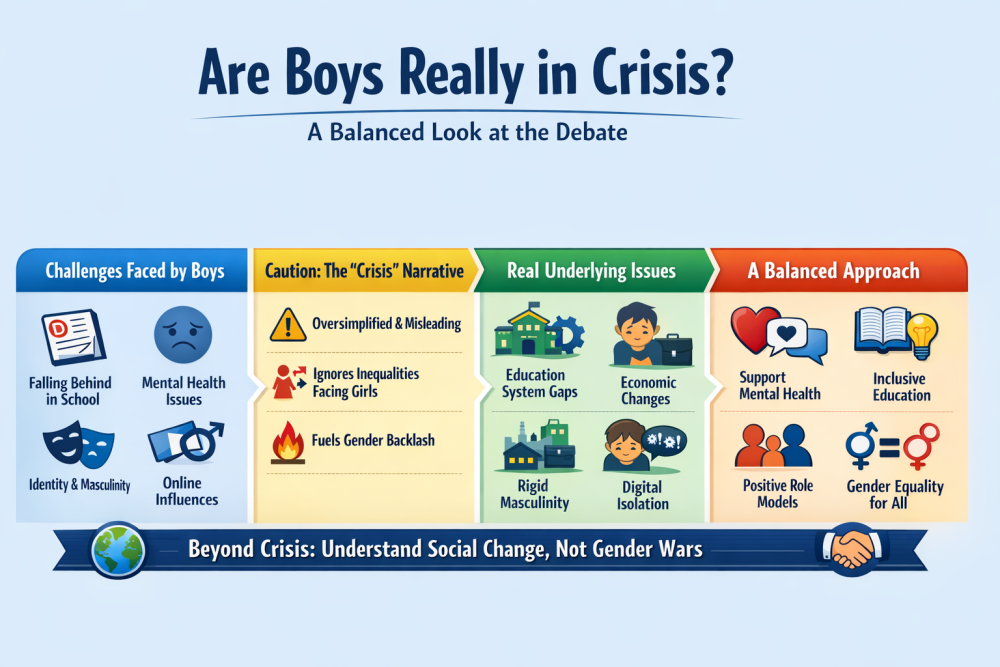
49/2026
Are Boys Really in Crisis? A Critical Narrative Summary
A Growing Concern in Public Discourse
In recent years, a compelling narrative has emerged across media, policy discussions, and online platforms: that boys and young men are in crisis. The Nature article “Are boys really in crisis? What the science says in the age of the manosphere” approaches this heated topic cautiously, questioning whether the concern reflects reality or is an overstatement.
The article acknowledges that some real problems do exist:
• Boys, on average, are lagging in school performance.
• They are more prone to facing mental health challenges, such as loneliness.
• Many people struggle with identity and expectations surrounding masculinity.
• Social media spaces, often called the “manosphere,” influence how young men think about gender and society.
At first glance, the argument seems convincing. In many countries, boys are underperforming in school, are less likely to pursue college or higher education, and often report feeling more disengaged. Along with growing concerns about mental health, loneliness, and identity, the overall situation looks concerning. It's no surprise that some interpret these trends as evidence of a systemic failure affecting boys.
What Evidence Actually Shows?
The article in the Nature journal acknowledges that many boys are indeed struggling, especially in structured academic environments. On average, boys tend to fall behind girls in reading and writing and are more likely to leave school early. At the same time, emotional well-being becomes a major concern. Boys and young men often report having fewer close friendships and are less inclined to seek help for psychological issues.
However, the article urges readers to avoid broad generalizations. These challenges are not universal or evenly distributed. Socioeconomic background, family environment, and resource access have a much larger impact than gender alone. Many boys, especially those from stable and privileged backgrounds, continue to succeed academically and socially.
The Danger of a Simplified “Crisis” Narrative
Where the article becomes especially important is in its analysis of the “boys in crisis” narrative itself. It suggests that portraying the problem as a widespread societal bias against males is both misleading and potentially damaging.
Such a narrative risks:
• Simplifying complex social and educational dynamics
• Ignoring the ongoing structural inequalities faced by women and girls
• Fueling reactionary movements, particularly in online spaces
The emergence of the so-called “manosphere,” a loosely connected network of online communities discussing masculinity, has intensified this conversation. While some of these spaces provide support, others foster resentment and hostile views on gender relations. The article points out that science does not support the idea that boys are being systematically harmed by gender equality.
Understanding the Real Underlying Issues
Instead of framing it as a gender-based crisis, emphasizing societal and cultural shifts can help the audience feel a collective responsibility to understand and adapt to these changes, fostering a sense of shared engagement.
At the same time:
• Education systems might not effectively address all learning styles
• Economic changes have shifted traditional male roles.
• Digital environments can strengthen isolation instead of fostering connection.
In this way, the challenges boys face reflect wider structural and cultural shifts, rather than intentional neglect.
A More Balanced Way Forward
The article ultimately advocates for a more nuanced and constructive response. Supporting boys doesn't mean portraying them as victims of progress. Instead, it requires:
• Promoting emotional awareness and openness
• Rethinking educational methods to promote inclusiveness
• Addressing mental health without stigma.
• Promoting healthier and more adaptable models of masculinity
Crucially, these efforts should occur alongside, not in opposition to, ongoing progress toward gender equality.
A Critical Reflection Beyond the Article
Although the article is careful and evidence-based, it is also largely shaped by Western contexts. In Muslim countries, including Pakistan, where cultural expectations and gender norms differ greatly, the discussion can take on different aspects. Here, boys may face pressures related to economic responsibility and social conformity, while girls still encounter systemic barriers in education and mobility.
Therefore, the 'crisis' question cannot be answered universally; it requires a context-specific analysis based on local realities, ensuring the discussion remains relevant and nuanced.
Beyond Crisis, Toward Understanding
According to Professor Emeritus Dr. Muhammad Mukhtar, Editor in Chief of the HunarNama, the main point of the article is clear:
Yes, some boys are struggling, but calling it a widespread “crisis” is an oversimplification that isn't very helpful.
The real challenge isn't choosing between boys and girls, but understanding how evolving societies are shaping the lives of both boys and girls. Addressing these changes calls for careful thought, not slogan-evidence, not ideology, and, above all, a commitment to supporting young people in all their diversity.