Could Waqf Drive a New Era of Knowledge in the Muslim World?
Posted 1 day ago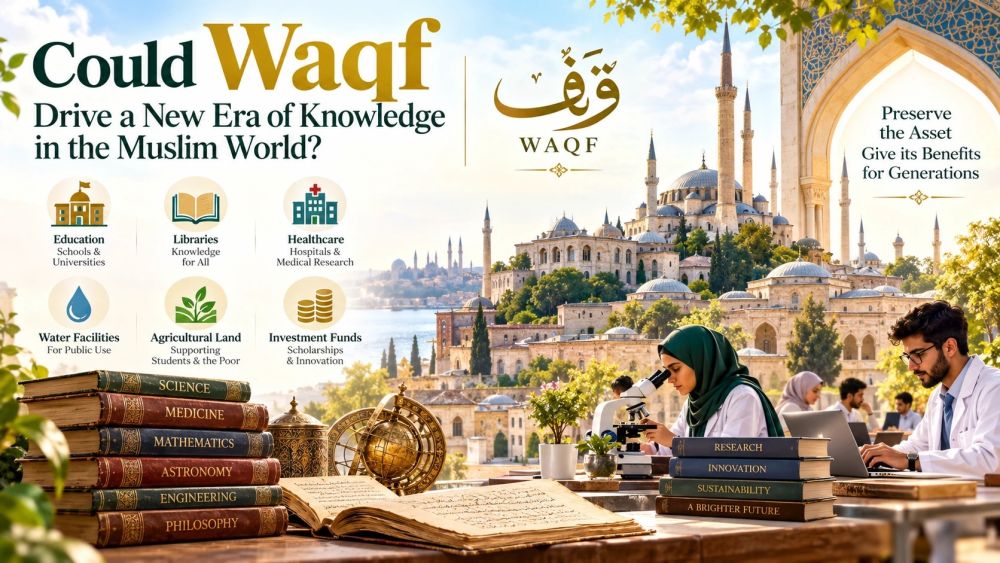
229/2026
Waqf (وقف) in Islam is a permanent charitable endowment in which a person dedicates an asset or wealth for a beneficial purpose while preserving the underlying asset.
For example, someone may establish a waqf by dedicating:
- 🏫 Land or a building for a school or university
- 📚 A library for public education
- 🏥 A hospital for healthcare
- 💧 A water facility for public use
- 🌾 Agricultural land whose income supports students or the poor
- 💰 An investment fund whose returns finance scholarships or research
The classical principle is often summarized as “preserve the asset and give its benefits.” The original property is retained for the designated purpose, while its income or use provides ongoing benefit.
Historically, waqf played a major role in supporting schools, universities, libraries, hospitals, and scientific institutions throughout the Muslim world.
This makes the concept especially compelling for modern philanthropy: a “Knowledge Waqf” could use a permanent endowment to fund scholarships, laboratories, and research and innovation for generations.
A recent example from North America: a $1 billion gift from Nike co-founder Phil Knight to his alma mater offers a striking lesson: the most consequential philanthropy may be the kind that builds institutions, not merely programs.
When Phil Knight, Nike's co-founder, and his wife, Penny, pledged $1 billion to the University of Oregon this month, they did more than make one of the largest university gifts in American history. They made a statement about what private wealth can accomplish when directed toward knowledge, scientific research and the education of future generations.
The gift will establish a new engineering college at the University of Oregon, where Mr. Knight graduated in 1959. The university says the new college will educate engineers and applied scientists in fields including bioengineering, recruit researchers, and help move discoveries from laboratories into technologies, therapies, and companies. The pledge will be paid over 10 years and is intended to support facilities, faculty, and long-term operations.
The history of the Muslim world shows that waqf was far more than an instrument of private charity. For centuries, it served as a major public welfare institution, supporting education, healthcare, water supply, food distribution, infrastructure, and assistance to people experiencing poverty.
In the Ottoman period, for example, waqf foundations financed many of the everyday public services in cities. The Cambridge History of Turkey notes that vakıfs (waqfs) substantially supported the construction and maintenance of educational institutions, water systems, bridges, and services for people experiencing poverty.
The Süleymaniye Complex in Istanbul, established by Sultan Suleiman the Magnificent, exemplifies the model's extraordinary breadth. Its waqf-supported institutions brought together education, medical care, food assistance, and other public services. Historical research describes the complex as including a hospital, medical education, schools, a public kitchen, accommodations, and other facilities.
Healthcare was another major field of waqf-supported welfare. Ottoman Darüşşifas provided medical treatment and, in some cases, served as centers for medical education and training. Recent research on Ottoman healthcare waqfs finds that some provided free treatment regardless of religion and supported medical education, training, and research.
This history offers an important lesson for contemporary Muslim philanthropy. The challenge today is not to replicate the past but to adapt its enduring principle to the needs of the 21st century.