Why Universities Are Abandoning AI Detection Tools?
Posted 1 month ago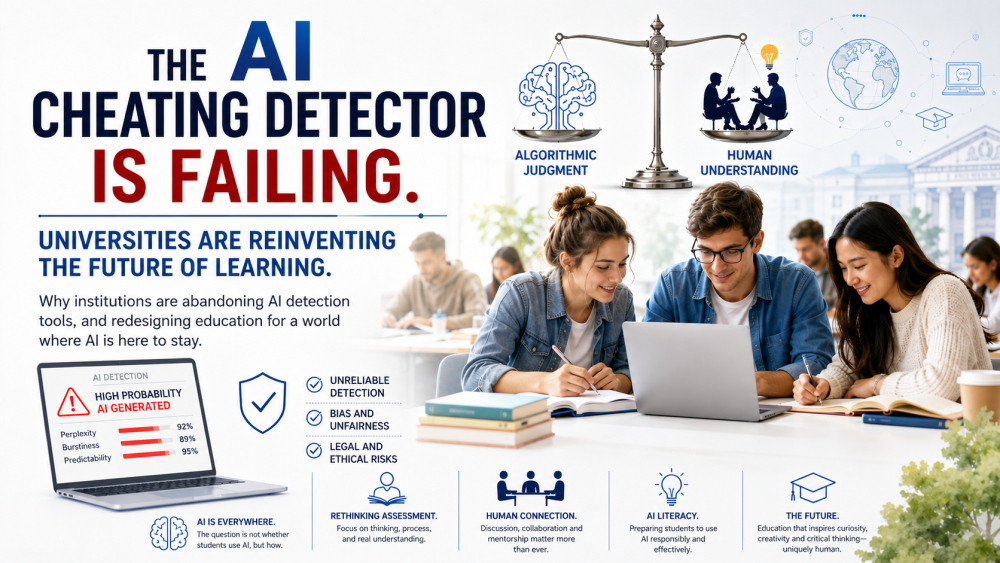
159/2026
The next frontier in higher education may not be catching students who use artificial intelligence; it may be redesigning education for a world where AI is ubiquitous.
For nearly three years, universities around the world have been locked in an arms race against artificial intelligence. As tools such as ChatGPT, Gemini, and Claude became capable of producing polished essays in seconds, educators turned to AI detection software as their first line of defense. These programs promised to identify whether an assignment was written by a human or generated by a machine.
Now, that strategy is rapidly unraveling.
A report in the Financial Times suggests that a growing number of universities, including prestigious institutions in North America, Europe, Africa, and Australia, are scaling back or abandoning AI detection software after evidence showed that these systems are often unreliable, legally risky, and sometimes unfair to students.
The shift marks one of the most significant changes in higher education since generative AI entered classrooms in late 2022. More importantly, it reflects a deeper realization: the future of education cannot depend on software that struggles to distinguish human creativity from machine-generated prose.
When an Innocent Student Is Flagged
Imagine spending weeks writing an assignment, only to be told that a computer believes your work was AI-generated.
That scenario is no longer hypothetical.
One widely discussed legal case involved a university student who was accused of academic misconduct after an AI detector reported his essay was "100 percent AI-generated." The student insisted he had written the paper himself and presented evidence from other detection tools suggesting otherwise. A court later ruled that the university had failed to provide a fair disciplinary process, highlighting the dangers of relying too heavily on algorithmic judgments.
Cases like this have become a wake-up call for universities.
Rather than serving as digital judges, AI detectors increasingly resemble weather forecasts: they may estimate probabilities, but they cannot establish certainty.
Why AI Detectors Struggle
Generative AI learns from billions of words written by humans. Its goal is to mimic natural writing patterns so effectively that readers cannot tell the difference. Ironically, the better AI becomes at writing like humans, the harder it becomes for software to detect its output.
Detection systems search for statistical fingerprints, subtle patterns in vocabulary, sentence complexity, predictability, and writing rhythm. But human writing varies enormously.
A concise scientific writer, an international student using straightforward English, or someone writing in a formal academic style may unintentionally produce text that sounds like AI-generated language.
Conversely, AI can often evade detection simply by rewriting, paraphrasing, or mixing human edits with machine-generated content.
Independent research has repeatedly demonstrated that today's AI detectors generate both false positives incorrectly accusing human writers and false negatives missing AI-generated work altogether. Studies also show that simple paraphrasing techniques dramatically reduce detection accuracy.
The Hidden Bias Problem
Perhaps the most troubling concern is fairness.
Several studies have found that AI detection tools disproportionately flag writing by non-native English speakers. Their simpler sentence structures, predictable grammar, and more formal vocabulary can resemble the statistical patterns that some detection algorithms associate with AI-generated text.
That means students already facing language barriers may be more likely to face accusations they do not merit. For universities committed to equity and inclusion, this poses a serious ethical dilemma. None of the institutions want an algorithm to become an unintended source of discrimination.
From AI Police to AI Literacy
Instead of asking, “Can we catch every student using AI?” universities are beginning to ask a more productive question:
“How should students learn at an age when AI is everywhere?”
This represents a profound philosophical shift.
Rather than banning AI outright, many institutions are redesigning assessments to make learning visible.
Students may now be asked to:
- explain how they reached their conclusions;
- submit research notes and multiple drafts;
- defend their ideas through oral presentations;
- solve real-world problems unique to their local context;
- reflect on how AI, if used, contributed to their work.
These approaches evaluate thinking rather than typing.
AI can generate text.
It cannot easily demonstrate genuine understanding, defend original reasoning, or respond thoughtfully in live discussion.
The Classroom Is Being Reinvented
The disappearance of AI detectors does not mean universities have surrendered to cheating.
Instead, many educators are acknowledging that traditional take-home essays once considered the gold standard of assessment may no longer measure what they once did.
Future classrooms are likely to place greater emphasis on authentic learning experiences:
- project-based assignments;
- collaborative problem solving;
- laboratory and field work;
- reflective portfolios;
- supervised writing sessions;
- oral examinations;
- continuous assessment.
These methods make it much harder to outsource genuine learning to an AI chatbot while preparing students for workplaces where AI assistance will be routine.
AI Is Becoming a Calculator for Writing
History offers an interesting parallel.
When calculators first entered classrooms, many educators feared that students would forget mathematics.
Instead of banning calculators permanently, schools changed what they assessed. Students still learned arithmetic, but they were increasingly evaluated on mathematical reasoning rather than manual computation.
Generative AI may force a similar transformation.
Writing remains essential, but universities may increasingly assess critical thinking, creativity, judgment, ethical reasoning, and communication rather than simply the ability to produce grammatically correct prose.
The educational question evolves from "Who wrote these words?" to "Who generated these ideas?"
A Lesson Beyond Universities
The collapse of confidence in AI detection software offers a broader lesson about artificial intelligence. As AI becomes embedded in medicine, finance, law, hiring, and public administration, society will increasingly rely on algorithms to support important decisions.
Yet the university experience illustrates an important principle: AI should inform human judgment, not replace it.
Algorithms can estimate probabilities. They cannot understand context, intent, fairness, or nuance with the reliability required for high-stakes decisions.
Human oversight remains indispensable.
The Future of Learning
Artificial intelligence has not broken higher education.
It has exposed long-standing assumptions about how learning should be measured.
The real challenge is no longer detecting AI-generated essays. It creates educational systems that reward curiosity, originality, collaboration, and critical thinking qualities that remain uniquely human.
Ironically, universities abandoning AI detection tools may not be retreating from technology at all. They may simply be recognizing that the best response to artificial intelligence is not better surveillance but better education.
According to Professor Dr. Muhammad Mukhtar, Rector of the University of Southern Punjab, Multan, "The dilemma surrounding AI detection is no longer confined to a single university or even a single country; it is a global challenge confronting higher education. As artificial intelligence continues to transform how students learn, write, and solve problems, institutions worldwide are grappling with the same questions about fairness, academic integrity, and educational quality. No university should have to navigate this complex landscape in isolation. There is an urgent need for international organizations that shape educational standards, particularly UNESCO, alongside other global and regional bodies, to convene universities, educators, technology developers, students, and parents to establish a shared framework for the responsible use of AI in education. Such a framework should uphold academic integrity while embracing innovation, ensuring that technology strengthens learning rather than undermines trust. Only through broad international dialogue and consensus can we develop standards that are equitable, practical, and acceptable to all stakeholders in the global education community."