USP Faculty Development Program Focuses on Course Design, Learning Outcomes and Academic Quality
Posted 1 day ago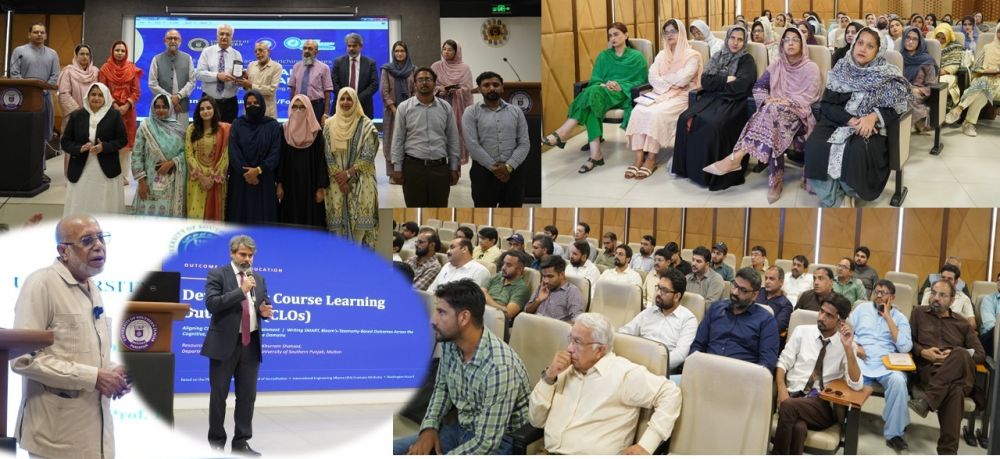
223/2026
The University of Southern Punjab (USP), Multan, convened its faculty for a professional development session to strengthen one of the most consequential yet often overlooked elements of university education: how teaching is planned, documented, assessed, and improved.
The faculty development program featured sessions led by Prof. Dr. Hayat M. Awan and Dr. Khurram Shahzad, who addressed two closely related aspects of contemporary higher education: effectively developing and maintaining course folders and formulating and assessing Course Learning Outcomes (CLOs).
In his session on the USP Course Folder Manual, Prof. Dr. Hayat M. Awan presented the course folder as more than an administrative requirement. He described it as an academic evidence portfolio that demonstrates how a course is planned, taught, assessed, reviewed, and improved. The manual emphasizes a continuous cycle: Plan, Teach, Assess, Analyze, Reflect, and Improve.
The session placed particular emphasis on the relationship among course objectives, CLOs, Program Learning Outcomes, teaching activities, and assessment. The manual calls for measurable learning outcomes and evidence that assessments genuinely measure what students are expected to learn.
In a complementary session, Dr. Khurram Shahzad discussed Course Learning Outcomes and their role in outcome-based education. The discussion emphasized the need to clearly define what students should be able to demonstrate upon completing a course and to ensure that classroom teaching and assessment remain aligned with those intended outcomes.
Together, the sessions underscored a central principle of effective university education: quality cannot be demonstrated by documentation alone. It must be evident in the alignment of what a university intends to teach, what faculty members actually teach, what students can demonstrate, and how the institution responds to evidence of learning.
Similarly, the USP Course Folder Manual emphasizes that a course folder should reflect actual academic practice rather than paperwork compiled retrospectively at the end of a semester.
Prof. Emeritus Dr. Muhammad Mukhtar, Rector of the University of Southern Punjab, appreciated both resource persons for sharing their expertise and experience with the university's faculty. He said that faculty development is not a one-time activity but an ongoing process through which universities strengthen teaching, assessment, and academic quality.
“Our ultimate responsibility is not simply to complete a course but to ensure meaningful learning takes place. Faculty development provides the opportunity to reflect on what we teach, how we teach, and, most importantly, what our students learn,” Prof. Dr. Mukhtar said.
At the conclusion of the sessions, Prof. Dr. Muhammad Mukhtar presented Shields of Appreciation to Prof. Dr. Hayat M. Awan in recognition of Prof. Dr. Awan's contribution to the professional development of USP faculty.
The event reflected the university's ongoing emphasis on building a culture where teaching is evidence-based, learning outcomes are clearly defined, and assessment aligns with educational goals. Academic practice is subject to continuous reflection and improvement.