University of Toronto: Advancing Teaching and Learning with Generative AI
Posted 9 hours ago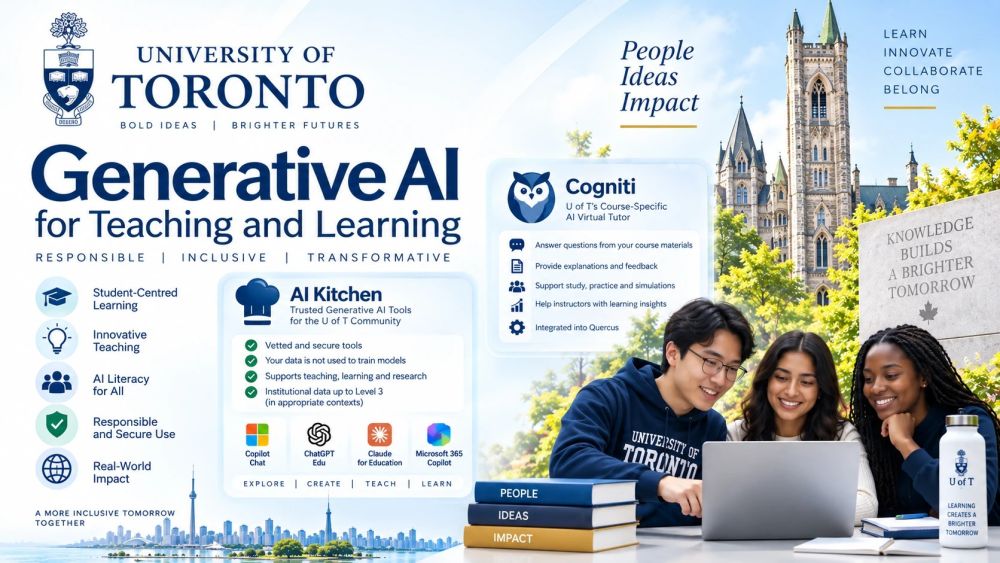
219/2026
The University of Toronto (U of T) is taking a structured, student-centered approach to integrating Generative Artificial Intelligence into teaching and learning. Rather than treating AI merely as a productivity tool, the university is building an institutional ecosystem that integrates AI literacy, responsible use, academic integrity, privacy, accessibility, and meaningful learning. Principles of student-centered design, transparency, equitable access, and respect for academic freedom guide its approach.
At the heart of this strategy is the “AI Kitchen,” a secure environment where selected AI tools are vetted for privacy and security. U of T states that prompts and student data in these supported tools are not used to train AI models, while institutional data up to Level 3 may be used in appropriate contexts.
A particularly notable initiative is Cogniti, U of T’s course-specific AI virtual tutor. Integrated into Quercus, the university’s learning management system, Cogniti can be grounded in course materials and customized to support diverse pedagogical objectives. It can serve as a virtual tutor or study assistant, facilitate role-play and simulations, provide formative feedback, and enable students to develop AI-powered learning experiences. Instructors can also review aggregated themes from student interactions and use that feedback to improve the learning experience.
U of T also offers Microsoft Copilot Chat as an accessible entry point to build basic AI literacy. Students and instructors can use it to brainstorm, draft and revise, summarize concepts, and generate discussion questions. Other licensed tools, including Claude for Education, ChatGPT Edu, and Microsoft 365 Copilot, offer additional capabilities for course preparation, professional work, and advanced applications.
Importantly, U of T emphasizes that AI should enhance, not replace, human thinking. Faculty are encouraged to design learning activities that foster metacognition, creativity, critical thinking, analysis, and synthesis. The university also recognizes that AI-generated content can be inaccurate or biased, making critical evaluation an essential component of AI literacy.
The university places strong emphasis on responsible governance. When instructors consider non-vetted external AI tools, they must address privacy, intellectual property, student consent, accessibility, and alternative arrangements for students who choose not to use such platforms.
The University of Toronto’s model offers an important lesson for higher education: the future is not simply about giving students access to AI; it is about creating an institutional culture in which faculty and students learn to use AI intelligently, critically, ethically, and creatively. Its combination of secure infrastructure, course-specific AI tutoring, faculty support, and responsible-use principles provides a compelling framework for universities preparing graduates for an AI-enabled world.