The Attention Crisis in Academic Leadership: Why Prof. Dr. Muhammad Mukhtar Is Concerned About Distracted Minds and Poor Decisions
Posted 1 day ago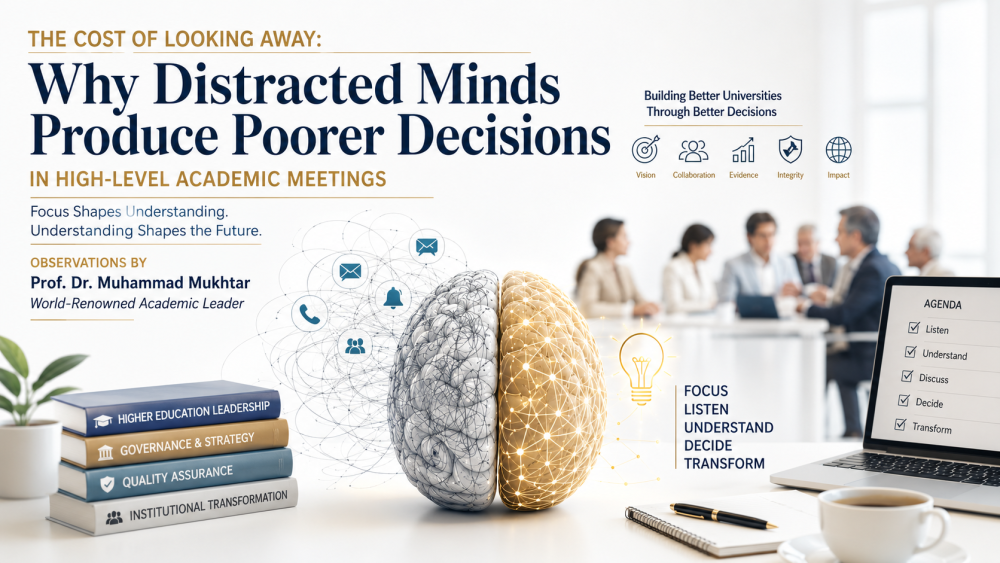
170/2026
At universities, ministries, accreditation bodies, and governing boards worldwide, countless decisions are made daily that shape the future of institutions, research, and society. Yet an invisible threat often accompanies these deliberations, not a lack of intelligence or expertise, but a lack of attention.
Recent discussions in Nature Journal on the science of attention and distraction reinforce a growing body of evidence that the human brain is not designed to sustain uninterrupted focus in environments saturated with competing stimuli. Digital notifications, multitasking, internal thoughts, and environmental interruptions all compete for our limited cognitive resources. The consequence is not merely momentary distraction; it is diminished comprehension, weaker judgment, and poorer decision-making.
Having participated in hundreds of high-level academic meetings over several decades as a Vice Chancellor, Rector, and member of national and international policy forums, I have repeatedly observed a phenomenon that receives surprisingly little attention. Many participants are physically present yet cognitively absent.
They repeatedly glance at their phones. They reply to messages while complex policy issues are debated. They draft responses before fully listening to others. Some become preoccupied with side conversations or administrative concerns. Others let their minds wander.
The result is predictable !!!!!!!!!!!!!!
Participants often request that earlier discussions be repeated. Questions arise that have already been answered. Decisions require reconsideration because critical nuances were overlooked. In many cases, misunderstandings generate unnecessary disagreement not because participants hold fundamentally different opinions, but because they never developed a common understanding of the issue.
This pattern reflects a fundamental aspect of human cognition. Attention serves as the brain's gateway to understanding. Information that never receives focused attention rarely integrates into working memory, making thoughtful analysis and long-term retention far less likely. Research consistently shows that multitasking and technology-driven interruptions reduce comprehension and learning, even among highly educated individuals.
The implications for university governance are profound.
Academic meetings frequently address curriculum reforms, quality-assurance frameworks, financial planning, faculty recruitment, research strategies, student welfare, and institutional transformation. These multidimensional issues require participants to connect evidence, evaluate alternatives, anticipate consequences, and build consensus.
Partial attention is simply incompatible with these demands.
When attention fragments, collective intelligence fragments as well. The meeting runs longer, decisions become less coherent, and implementation becomes more difficult because participants leave with different interpretations of what was actually agreed.
Fortunately, attention is not merely an individual responsibility; it can be cultivated at the institutional level.
High-performing organizations increasingly recognize that meeting design matters as much as meeting content. Clear agendas, concise presentations, purposeful facilitation, structured opportunities for discussion, limited digital interruptions, and periodic summaries help preserve collective attention. Spoken dialogue also tends to promote deeper understanding than fragmented written exchanges alone, reinforcing the value of active discussion in academic leadership.
Based on my experience, the most productive academic meetings share several characteristics. Participants arrive prepared, electronic distractions are minimized, every member listens before speaking, differing perspectives are welcomed, and conclusions are summarized before moving to the next agenda item. Such meetings are noticeably shorter, intellectually richer, and far more effective at producing implementable decisions.
The future of higher education will undoubtedly be shaped by artificial intelligence, digital governance, and increasingly sophisticated analytical tools. Yet no technological innovation can replace disciplined human attention.
The most valuable resource in any leadership meeting is not the agenda, the presentation, or even the expertise present.
It is the collective ability of participants to focus on one another with full intellectual presence.
Universities have long invested in laboratories, libraries, and digital infrastructure. Perhaps the next frontier in academic excellence is far simpler: cultivating a culture in which attention is treated as a strategic institutional asset.
Because every transformative decision begins with one essential act: the willingness to listen truly.