The Ig Nobel Prize Story: Funny Science with Serious Impact
Posted 6 months ago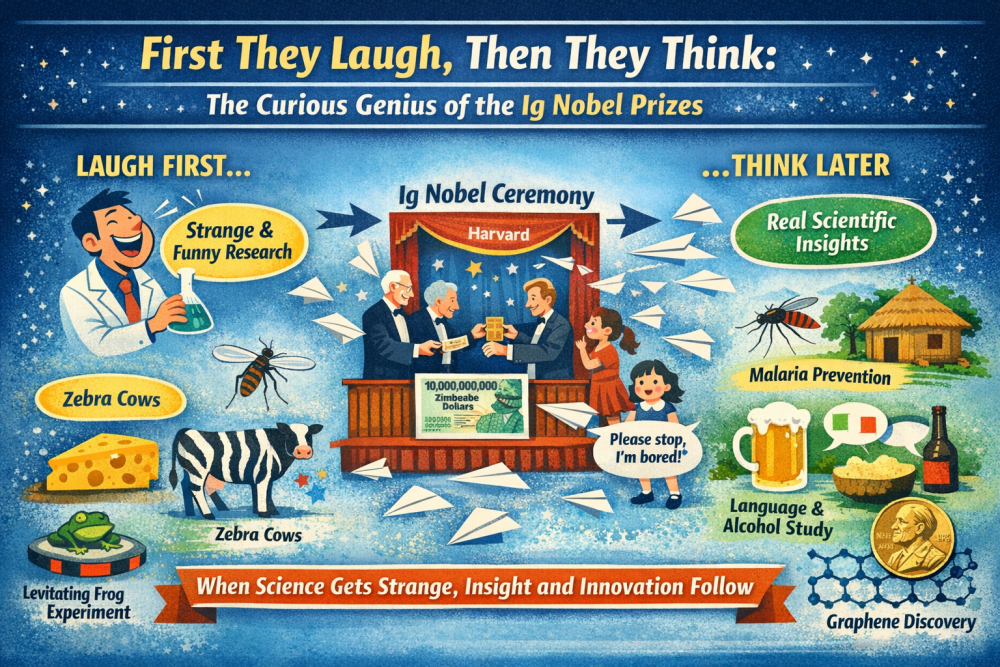
47/2026
Science is often linked to complex equations, labs, and serious discoveries. However, there is a unique scientific award that recognizes curiosity, creativity, and even humor in research: the Ig Nobel Prize. Unlike traditional awards that focus only on groundbreaking discoveries, the Ig Nobel Prize shines a light on research that might seem strange or funny at first but often provides valuable scientific insights.
This unusual award has become one of the most entertaining traditions in the scientific world, attracting global attention each year.
What Are the Nobel Prizes?
The Ig Nobel Prize is an annual award that recognizes scientific research that “first makes people laugh and then makes them think.”
The prize is a humorous parody of the Nobel Prize, but the research recognized is typically genuine, peer-reviewed scientific work conducted by real researchers. The name “Ig Nobel” is a pun on the word ignoble and the renowned Nobel Prize.
These awards were established in 1991 by Marc Abrahams, editor and co-founder of the science humor magazine Annals of Improbable Research.
The goal is not to mock science but to stimulate curiosity, showcase unconventional ideas, and involve the public in scientific thinking.
The Idea Behind “Funny Science”
At first glance, many Ig Nobel-winning studies seem absurd. However, the core idea of the award is that unexpected or unusual research can lead to valuable insights.
For example, a well-known study found that mosquitoes carrying malaria are attracted to the smell of Limburger cheese, which resembles human foot odor. This seemingly humorous discovery eventually helped researchers create mosquito traps to combat malaria in Africa.
The Ig Nobel Prize reminds us that science progresses not only through major discoveries but also through curiosity-driven exploration, which can inspire the public and reshape society's view of scientific research.
How does the Ceremony Work?
The Ig Nobel ceremony itself is just as unconventional as the research it honors.
Traditionally hosted at Harvard University and organized by Annals of Improbable Research, the event attracts scientists, students, and curious spectators.
Several quirky traditions make the event well known:
• Actual Nobel laureates present the awards.
• Audience members toss paper airplanes onto the stage.
• A child named “Miss Sweetie Poo” interrupts lengthy speeches by saying: “Please stop, I’m bored!”
Each winner also gives a brief lecture explaining their research in layman’s language.
Interestingly, the monetary prize is often just a 10-trillion-Zimbabwean-dollar bill, worth only a few cents but prized as a collectible.
Categories of the Awards
Every year, approximately 10 Ig Nobel Prizes are awarded across various scientific fields. These may include:
• Physics
• Chemistry
• Medicine
• Biology
• Economics
• Peace
• Engineering
• Public Health
• Psychology
• Interdisciplinary Science
The categories might change based on the research acknowledged in a specific year.
Some Unusual Ig Nobel Prize Discoveries
Over the years, the Ig Nobel awards have recognized some genuinely unusual scientific studies. Here are a few memorable examples:
1. Painting Cows Like Zebras
Researchers found that painting cows with zebra-like stripes lessens fly bites, providing a pesticide-free method to protect livestock.
2. Alcohol and Language Skills
A study found that a small amount of alcohol helped people pronounce foreign languages slightly better, likely because it lowered anxiety.
3. The Physics of Pasta Sauce
Scientists studied why cheese sometimes clumps in the Italian dish “cacio e pepe.” Their research showed how temperature impacts the sauce's texture.
4. Long-Term Nail Growth
One researcher monitored his own fingernail growth for over 35 years, showing that nail growth decreases with age.
These studies might seem funny, but they show how scientific curiosity can investigate even the most surprising questions.
When Ig Nobel Meets Nobel
One of the most interesting aspects of the Ig Nobel awards is that they sometimes highlight research that leads to real scientific breakthroughs, like Andre Geim's magnetic levitation of a frog, which eventually contributed to Nobel-winning work on graphene.
Physicist Andre Geim won the Ig Nobel Prize in 2000 for levitating a frog using magnetic fields. A decade later, he received the 2010 Nobel Prize in Physics for pioneering research on graphene.
He remains the only scientist to win both an Ig Nobel and a Nobel Prize, demonstrating that unconventional ideas can lead to significant scientific breakthroughs.
Why the Ig Nobel Prizes Matter?
Despite the humorous tone, the Ig Nobel Prize has several important purposes.
1. Encourages curiosity
It reminds scientists and students that asking unusual questions can lead to discoveries.
2. Improves science communication
By presenting research in entertaining ways, the awards make science accessible to the public.
3. Celebrates creativity in research
Science thrives on imagination, experimentation, and sometimes even playful exploration.
4. Inspires future scientists
Many students discover their scientific curiosity through the surprising topics celebrated by the Ig Nobels. These awards illustrate that science can be both humorous and intellectually meaningful.
The Future of the Ig Nobel Awards
Since their inception in 1991, the Ig Nobel Prizes have gained worldwide recognition. The ceremony draws global media attention and participation from researchers worldwide. More importantly, the awards serve as a reminder that science can be creative, unexpected, and enjoyable.
The Ig Nobel Prize celebrates the fun side of scientific discovery while still having a deeper purpose. By honoring research that makes people laugh first and think later, the awards showcase the creative spirit of science.
In a world where scientific challenges ranging from climate change to global health are becoming more complex, the Ig Nobel Prize delivers a simple yet powerful message: curiosity and creativity are at the core of all discovery.