Pakistan’s Next Generation of Entrepreneurs Finds a National Platform
Posted 1 day ago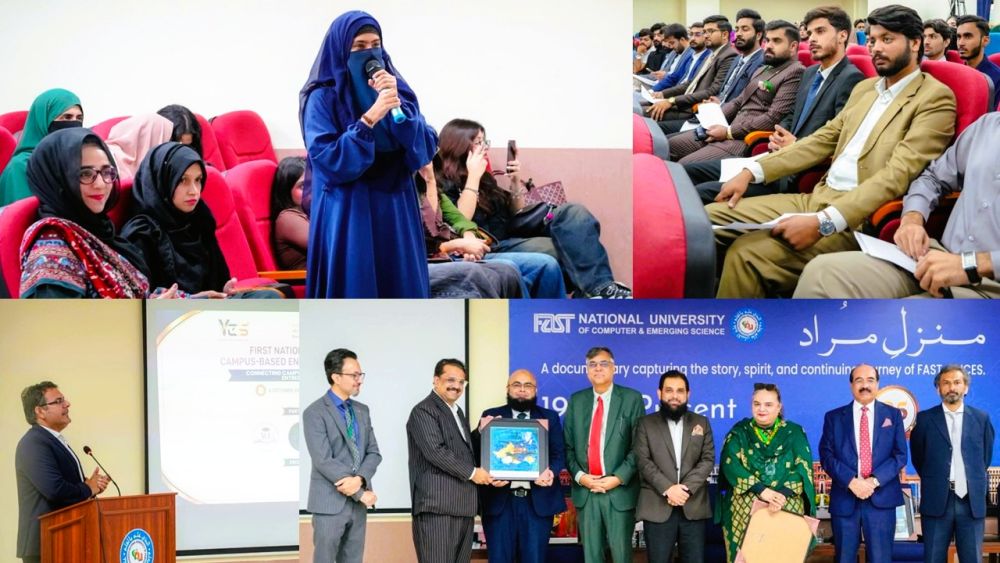
236/2026
First National Convention of Campus-Based Entrepreneurial Societies brings together students, universities, industry, and policymakers in Islamabad.
Pakistan’s universities are beginning to rethink what it means to prepare young people for the future. A degree may open a door, but in an economy hungry for innovation and jobs, the more consequential question is whether universities can help young people build their own doors.
That idea took center stage at the First National Convention of Campus-Based Entrepreneurial Societies, held at FAST National University of Computer and Emerging Sciences (FAST-NUCES), Islamabad, which brought together student entrepreneurs, faculty advisers, and representatives of entrepreneurial societies from around 30 leading universities across Pakistan.
The convention marked an important step toward creating a nationwide ecosystem where university students can transform ideas into enterprises and connect with the people and institutions that can help those enterprises grow.
Prof. Dr. Habib Boukhari, Member, Research & Development and Academics, Higher Education Commission (HEC), served as the chief guest. The distinguished guests of honor included Prof. Dr. Ali Nasir, Advisor, HEC; Dr. Abdul Basit, Chancellor, Preston University; Prof. Dr. Tayyaba Zarif, Vice Chancellor, Rawalpindi Women University; Mr. Rizwan Khaleel Shamsi, Chief Manager, State Bank of Pakistan, Rawalpindi Office; and Dr. Awais Mehmood, Dean, Faculty of Management Sciences, Bahria University Islamabad.
Welcoming the participants, Prof. Dr. Wasim Shahzad, Director of FAST-NUCES Islamabad Campus, emphasized the importance of creating an environment where students can move beyond conventional academic learning and transform innovative ideas into sustainable ventures.
Muhammad Murtaza Noor, National Coordinator of IUCPSS and Founder of YES-Pakistan, highlighted the convention's objectives and called for a robust national network of campus-based entrepreneurial societies. He emphasized that such a network can connect young entrepreneurs with universities, incubation centers, industry, investors, and financial institutions.
The convention's keynote session, “From Campus Innovation to Global Impact: Building Pakistan’s AI-Driven Entrepreneurial Future,” was delivered by Bilal Faruqi, Founder of MindHYVE.ai, underscoring artificial intelligence’s growing role in reshaping entrepreneurship and opening new avenues for innovation.
The program also featured discussions on women's entrepreneurship, student success stories, corporate engagement, high-impact entrepreneurial societies, and university-industry collaboration. These discussions reflected a changing reality in higher education. Universities are no longer expected merely to produce graduates for existing jobs. Increasingly, they are being called upon to cultivate innovators, entrepreneurs, and problem-solvers who can create new economic opportunities.
Prof. Dr. Muhammad Mukhtar, Rector of the University of Southern Punjab, Multan, congratulated FAST-NUCES, HEC, IUCPSS, YES-Pakistan, the participating universities, faculty advisers, and, above all, the young entrepreneurs on successfully organizing the landmark convention. He described the initiative as an important step toward developing a national culture of entrepreneurship and innovation within Pakistan’s universities. He emphasized that universities should prepare students not only to seek employment but also to create it, especially as artificial intelligence and digital technologies rapidly change the nature of work.
The convention was organized as part of the activities leading up to YES-Pakistan 2026, the Young Entrepreneurs, CEOs and Innovators Summit, Expo & Awards, scheduled for October 20–22, 2026, in Islamabad.