Oxford University’s AI Transformation: From Experimentation to Institutional Adoption
Posted 8 hours ago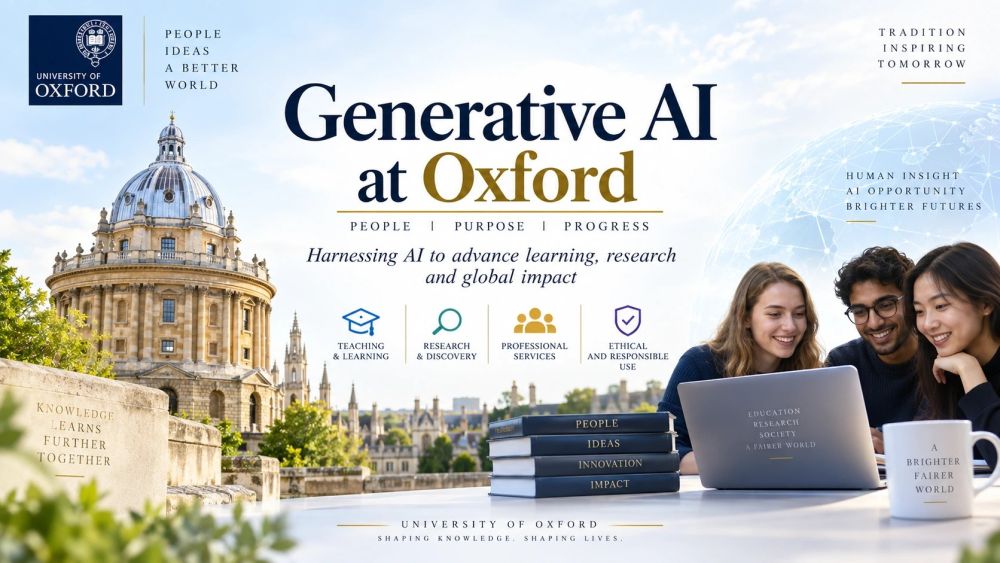
218/2026
The University of Oxford’s approach to Generative Artificial Intelligence (GenAI) offers a compelling example of how one of the world’s oldest universities is responding to one of the defining technologies of the digital age. Rather than treating AI merely as a technological tool, Oxford is developing an institutional ecosystem in which access, innovation, skills, ethics, security, and human judgment work together.
A particularly significant step is Oxford’s decision to provide ChatGPT Edu to all staff and students, alongside Microsoft Copilot, Google Gemini and NotebookLM, within a secure university environment. Oxford describes this as an inclusive provision, supported by Single Sign-On, institutional policies, training and technical assistance. This approach moves AI adoption beyond individual experimentation toward university-wide digital transformation.
The most important lesson is that Oxford does not present AI as a replacement for teachers, researchers, or students. Its educational philosophy emphasizes human involvement, critical thinking, originality, and professional judgment. Students are encouraged to understand and use GenAI responsibly while upholding academic integrity, transparency, and intellectual independence. Oxford has also contributed to the Russell Group principles on generative AI in teaching and assessment.
In teaching and learning, GenAI is being explored to enhance study, support educators, and prepare students for an AI-enabled world. Oxford has developed workshops, introductory courses, and specialist guidance to help academics determine where AI can genuinely add educational value. Importantly, the University recognizes that appropriate AI use varies across disciplines and academic contexts.
In research, Oxford identifies potentially transformative applications: analyzing vast datasets, generating hypotheses, visualizing complex results, synthesizing information, and modeling intricate systems. These possibilities span science, medicine, engineering, the humanities, and the social sciences, suggesting that GenAI is becoming an important component of the modern research environment.
AI is also being applied to professional and administrative services, where Oxford sees opportunities to simplify processes, improve productivity, reduce routine workloads, and free staff capacity for higher-value activities. Thus, AI is being considered not merely as an academic innovation but as an institutional productivity and service-enhancement technology.
Perhaps the most remarkable aspect of Oxford’s model is its emphasis on AI literacy and governance. The University has established an AI Competency Center, training programs, AI Ambassadors, specialist support, and an AI Governance Group. This reflects an important principle: successful AI transformation requires not only access to powerful tools but also people who can use them intelligently, ethically, and securely.
According to Prof. Emeritus Dr. Muhammad Mukhtar, Rector of the University of Southern Punjab, Multan, Pakistan, Oxford’s experience offers a powerful message for universities worldwide: the future of higher education will not be defined by simply adopting AI, but by developing an institutional culture capable of using AI responsibly to amplify human creativity, scholarship, discovery, and service.