Global Research Leaders Convene in Pakistan for Chemical Sciences Conference
Posted 4 months ago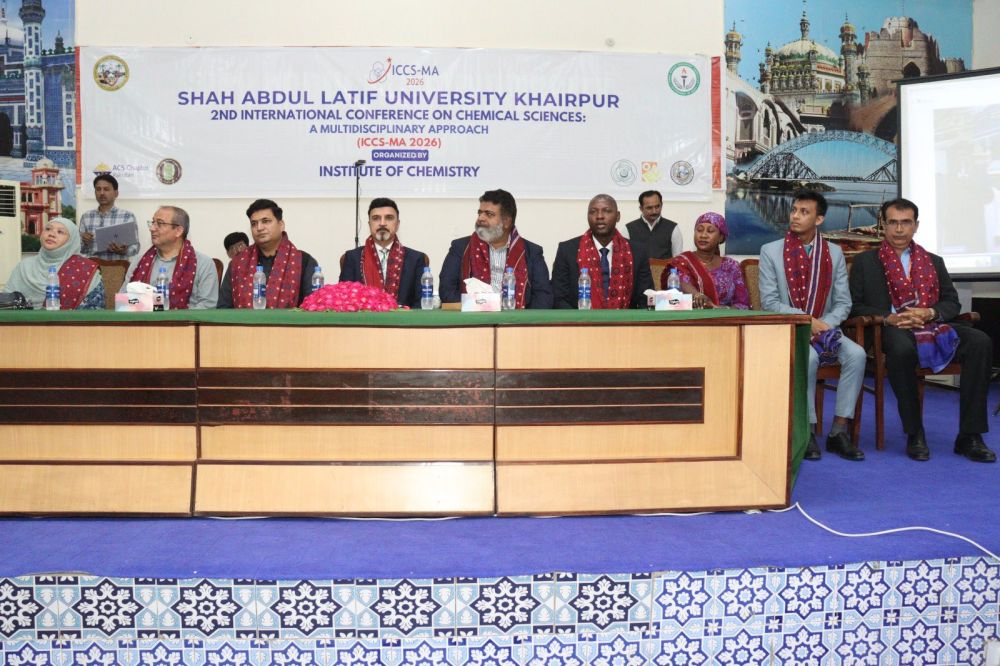
69/2026
In the historic and culturally rich city of Khairpur, a remarkable celebration of science, innovation, and international collaboration took place this week, as leading researchers and scholars from more than 10 countries gathered at Shah Abdul Latif University for the opening of the 2nd International Conference on Chemical Sciences: A Multidisciplinary Approach (ICCS-MA 2026), highlighting Pakistan’s growing role in global scientific research and academic excellence.
At a time when universities across the developing world are grappling with shrinking research budgets, climate pressures, and widening technological gaps, the gathering was something increasingly rare in Pakistan’s academic landscape: a confident assertion that scientific collaboration can still transcend borders, politics, and economic uncertainty.
Organized by the university’s Institute of Chemistry in collaboration with the ACS Pakistan Chapter, COMSTECH, and other academic partners, the three-day conference brought together scholars from the United States, Germany, Italy, Turkey, China, Brazil, Malaysia, Saudi Arabia, Bangladesh, Benin, and universities across Pakistan.
The conference themes reflected the changing priorities of global science itself. Discussions moved far beyond traditional laboratory chemistry into areas now central to the future of economies and societies: clean energy, sustainable materials, climate resilience, advanced electrolytes, and environmentally responsible technologies.
Opening the conference, Shah Abdul Latif University’s Vice Chancellor, Meritorious Professor Dr. Yousuf Khushk, described the chemical sciences as central to addressing humanity’s most urgent challenges, including healthcare, water purification, agriculture, and sustainable energy. He argued that universities must move beyond conventional teaching institutions and become engines of practical innovation capable of shaping national development.
That vision was echoed throughout the inaugural session.
Cemil Alkan of Tokat Gaziosmanpaşa University presented research on advanced thermal energy storage systems using microencapsulated phase-change materials — technologies increasingly viewed as critical to future energy efficiency and sustainability. Meanwhile, researchers from the University of Malaya showcased biodegradable starch-based electrolytes for next-generation energy storage, highlighting how environmentally sustainable materials may transform future battery technologies.
Yet beyond the technical presentations, the conference's symbolism may matter just as much.
In recent years, Pakistan’s universities have often been discussed in terms of rankings, financial constraints, and institutional crises. ICCS-MA 2026 offered a different narrative: one of international engagement, interdisciplinary collaboration, and scientific optimism emerging from a region often absent from global research conversations.
Speakers repeatedly stressed that the future of science would increasingly depend on multidisciplinary cooperation. Climate change, food insecurity, and sustainable development, participants argued, cannot be solved within isolated academic silos.
For younger researchers attending the conference, the message was equally important. Scientific progress is no longer confined to elite Western institutions. Increasingly, innovation networks are global, collaborative, and interconnected, and universities in Pakistan are seeking a place within them.