Global Experts Highlight Human-Centered AI for Career Guidance and the Future of Technical and Vocational Education
Posted 1 day ago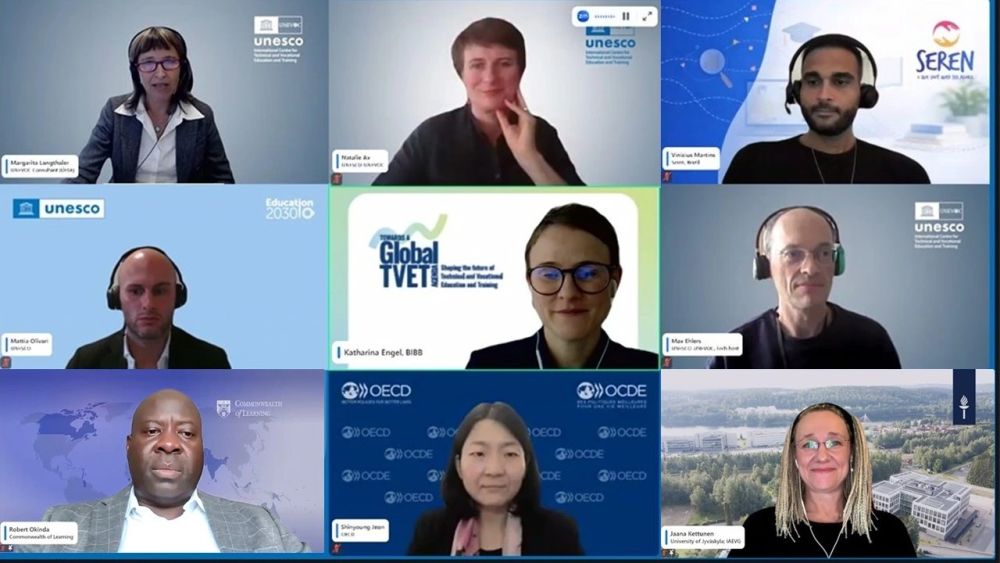
249/2026
UNESCO/UNEVOC webinar explores how artificial intelligence, labor-market intelligence, and digital learning can expand career opportunities while ensuring equitable access and human oversight.
International experts in education, skills development, and employment have underscored the growing importance of artificial intelligence (AI), digital technologies, and evidence-based career guidance in preparing learners for rapidly changing labor markets. They stressed that while AI can improve access to career information, identify emerging skills, and support lifelong learning, human judgment, critical thinking, and inclusive policies must remain central to career decisions.
The insights emerged during an international webinar organized under the Towards a Global TVET Agenda (TGTA) initiative, which brought together specialists from UNESCO-UNEVOC, the Organization for Economic Co-operation and Development (OECD), the Commonwealth of Learning, Brazil’s education technology sector, and Germany’s Federal Institute for Vocational Education and Training (BIBB).
The discussions focused on how digital transformation is reshaping technical and vocational education and training (TVET), career counseling, skills development, and the transition from education to employment.
AI Should Support, Not Replace, Human Guidance
Professor Jaana Kettunen, an internationally recognized expert in career guidance , President of the International Association for Educational and Vocational Guidance (IAEVG), and Deputy Director of the Finnish Institute for Educational Research at the University of Jyväskylä, emphasized the need to integrate AI literacy into career guidance and lifelong learning. She noted that people increasingly consult AI tools before seeking advice from career counselors. While these tools can offer useful suggestions, they may overlook individual circumstances, family responsibilities, local employment conditions, and personal aspirations.
She identified three critical challenges: the accuracy of AI-generated information, its tendency to reinforce existing assumptions, and the risk of perpetuating inequalities through biased recommendations. In vocational education, inaccurate information about qualifications, admission requirements, professional licensing, or recognition of prior learning can have serious consequences for individuals and their families.
Professor Kettunen emphasized that career practitioners must help learners question AI-generated recommendations, verify information, and consider alternatives rather than simply accepting automated advice. She called for institutional policies that protect privacy, ensure informed consent, and maintain human oversight.
Her central message was that AI may help draft a possible future, but career guidance enables individuals to shape and author their own pathways.
Generative AI Opens New Possibilities for Skills Development
Robert Okinda, a TVET and skills development specialist with the Commonwealth of Learning, presented practical approaches to integrating AI into learning resource development and career guidance.
Drawing on work in Kenya, Jamaica, Nigeria, and Ghana, he explained how TVET practitioners, subject specialists, industry experts, and quality assurance professionals developed AI-assisted learning materials and e-books for occupational training. The initiative combined AI tools with human expertise to align learning resources with national occupational standards, curricula, and industry requirements. The process included self-review, peer review, industry assessment, and regulatory quality assurance to verify the materials' relevance and reliability.
The approach also incorporated career mapping, multiple learning pathways, and employability skills, recognizing that technical competence alone is insufficient in a rapidly evolving workplace.
Mr. Okinda reported that the initiative showed potential to reduce the time and costs associated with developing learning resources. He also emphasized the importance of controlled data sources, professional mentoring, quality assurance, and responsible AI use.
He advocated scaling up these approaches so more TVET institutions can develop relevant learning materials, strengthen professional capacity, and share successful practices nationally and internationally.
OECD Calls for Evidence-Based and Equitable Digital Career Services
Shinyoung Jeon, a policy analyst at the OECD Center for Skills, explained how AI and digital technologies are reshaping the relationship among labor market demand, vocational education, and career decision-making. She highlighted AI's potential to analyze large volumes of information, identify emerging skill requirements, and help learners navigate increasingly complex vocational pathways.
Examples included digital career guidance platforms, career chatbots, online career exploration tools, and systems that link occupational profiles to skills forecasts and individual capabilities. She also cited the OECD Observatory on Digital Technologies in Career Guidance for Youth, which compiles international examples of technology-enabled career services. However, she cautioned that greater access to information does not automatically lead to better decisions. Learners need foundational skills to evaluate information, compare alternatives, and make informed choices.
Ms. Jeon stressed that evidence on the long-term effectiveness of specific AI-based career guidance approaches remains limited. She called for greater attention to critical thinking, sound judgment, foundational learning, and AI literacy, especially for learners who face the greatest barriers to accessing career support.
Digital Inclusion Must Begin with Disadvantaged Communities
Vinicius Martins, co-founder and chief technology officer of CERE, a Brazil-based TVET technology company, presented a practical framework for using AI throughout the career journey, from identifying personal strengths and exploring occupations to preparing applications and staying engaged with learning opportunities.
He argued that AI can expand the reach of career services, particularly in areas where access to professional counselors is limited. However, he warned that unequal access to connectivity and digital services can deepen existing inequalities.
His proposed approach prioritized accessible, affordable services; offline functionality where feasible; local languages; human involvement; and active community outreach. He also identified key risks, including algorithmic bias, inaccurate information, privacy violations, opaque recommendations, and excessive dependence on automated systems.
He called for safeguards to be built into the design and delivery of AI-powered career services rather than treating these concerns as reasons to avoid technological innovation.
UNESCO Introduces Global Skills Tracker
Mattia Olivari, a program specialist in UNESCO’s Education Sector, presented the Global Skills Tracker, a tool UNESCO developed to analyze skills demand using online job postings.
The platform provides insights into skill requirements across countries, industries, and occupations, allowing users to examine trends and emerging demand in areas such as digital technologies, artificial intelligence, and green skills.
By linking labor market intelligence to education and training decisions, the tool can help policymakers and education providers make more informed choices about curriculum development, program planning, and career guidance.
Mr. Olivari noted that online job postings provide timely, detailed insights but do not capture every segment of the labor market equally. In countries where informal employment is widespread, including many developing economies, researchers must supplement the data with traditional research and other locally appropriate sources.
He emphasized the need to adapt labor-market analysis to national circumstances and strengthen the evidence available to guide skills development.
A Shared Global Agenda for Lifelong Learning
In her closing remarks, Katharina Engel of Germany’s Federal Institute for Vocational Education and Training highlighted four priorities emerging from the webinar series: empowering individuals to understand their strengths and navigate changing careers; connecting education to the world of work; supporting the recognition of skills and qualifications; and adopting digital technologies without losing sight of the human dimension.
She situated the discussions within the broader Towards a Global TVET Agenda initiative, which brings together UNESCO-UNEVOC, the International Labor Organization (ILO), the OECD, and the European Training Foundation (ETF). Germany’s Federal Ministry of Education funds the initiative, and BIBB coordinates its implementation.
The webinar reinforced a shared international message: the future of career guidance will depend not only on adopting new technologies but also on combining reliable labor market information, relevant vocational training, responsible AI, professional expertise, and equitable access to learning.
Among several other attendees, Professor Emeritus Dr. Muhammad Mukhtar, Rector of the University of Southern Punjab, Multan, Pakistan, participated in the webinar and appreciated the international experts and partner organizations for their valuable contributions to advancing AI-enabled career guidance and technical and vocational education and training. He noted that responsibly integrating artificial intelligence into education and skills development offers significant opportunities to strengthen employability, expand access to learning, and prepare young people for emerging labor-market demands. He emphasized that technological innovation must be matched with human oversight, ethical responsibility, digital inclusion, and evidence-based policies to ensure no learner is left behind. He further underscored the importance of strengthening collaboration among universities, TVET institutions, industry, and international organizations to develop future-ready skills, promote lifelong learning, and create meaningful pathways from education to employment.
As economies and occupations continue to evolve, institutions will need to prepare learners not only for their first job but also for repeated transitions throughout their careers. A balanced approach—one that uses technology to expand opportunity while preserving human agency—will be essential to building more inclusive, responsive, and future-ready TVET systems.