AI-Powered Personalized Learning: Understanding Different Types of Learners
Posted 1 day ago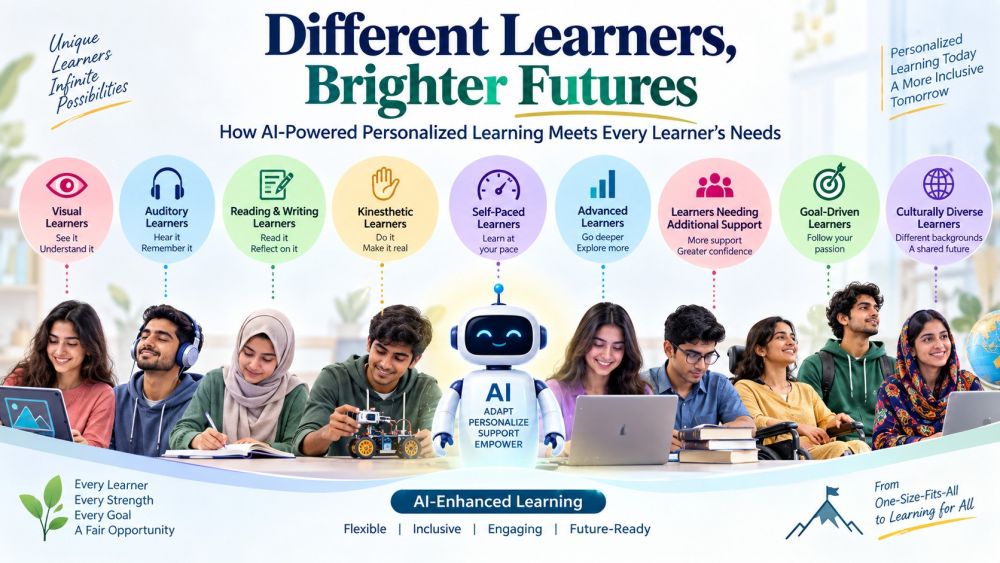
209/2026
Learners, whether in or outside the classroom, are never homogeneous. They differ in how they prefer to receive information, how quickly they learn, what motivates them, what they already know, and what support they need. The following is a brief overview of the types of learners:
Types of Learners in Personalized Learning
1. Visual Learners
Visual learners understand and retain information more effectively when concepts are presented through diagrams, charts, illustrations, infographics, animations, and videos. For abstract or complex topics, visual representations can clarify relationships and processes. Generative AI can generate or recommend visual explanations tailored to the learner's level of understanding.
2. Auditory Learners
Auditory learners prefer to learn by listening. Lectures, discussions, podcasts, recorded explanations, and spoken instructions may work better for them than lengthy written material. AI can convey the same concepts through audio explanations, discussions, or conversational interactions, allowing learners to revisit difficult ideas at their own pace.
3. Reading and Writing Learners
Some learners learn best through reading and writing. They benefit from textbooks, articles, notes, summaries, written explanations, reflective writing, and written exercises. Generative AI can tailor reading materials to their knowledge level and generate questions, summaries, examples, and writing activities that reinforce understanding.
4. Kinesthetic or Experiential Learners
Kinesthetic learners prefer learning by doing. They benefit from experiments, demonstrations, simulations, projects, practical exercises, and real-world problem-solving. AI can offer practice activities and simulated scenarios that let learners apply concepts rather than study them theoretically.
5. Self-Paced Learners
Learners also differ in how quickly they learn. Some need more time, repetition, and practice, while others are ready to move quickly to more challenging material. AI-powered systems allow learners to progress at their own pace rather than forcing everyone to follow the same timetable.
6. Advanced and Experienced Learners
Learners enter educational settings with varying levels of prior knowledge, experience, and expertise. An advanced learner may find introductory material repetitive, whereas a beginner may need extensive explanation. AI can assess learners' existing knowledge and adjust the difficulty, depth, examples, and challenges accordingly.
7. Learners Needing Additional Support
Some learners face specific challenges, limitations, or knowledge gaps. They may need alternative explanations, additional examples, guided practice, or repeated opportunities to reinforce concepts. Generative AI can identify areas of difficulty and provide customized support without requiring the entire class to move at the same pace.
8. Goal- and Interest-Driven Learners
Learners also differ in their interests, aspirations, goals, and circumstances. A learner who is highly motivated by a particular subject or career goal may benefit from examples and projects aligned with that interest. AI can personalize learning activities around individual objectives, making learning more meaningful and motivating.
9. Culturally and Linguistically Diverse Learners
Cultural background, language proficiency, and technical proficiency can significantly influence how learners understand concepts and interact with educational technologies. AI can offer varied explanations, examples, languages, levels of technical complexity, and forms of instructional support, making learning more accessible to diverse populations.
These categories should not be treated as rigid labels. A learner may be visual in one situation, prefer reading in another, and benefit from hands-on practice when developing a practical skill. Similarly, a learner's needs can change as knowledge, confidence, motivation, and circumstances change.
AI-based teaching and learning, rather than designing a single learning experience for an entire class, allow educators to analyze individual learning patterns, identify strengths and weaknesses, customize content and assessments, offer alternative explanations, create appropriate challenges, enable self-paced practice, and deliver real-time feedback.
The ultimate objective is not merely to classify learners but to understand each learner as an individual. AI-enhanced personalized learning shifts education from a one-size-fits-all model to a flexible learning environment in which content, pace, methods, practice, and support can continuously adapt to the learner. In doing so, it fosters independent thinking, deeper conceptual understanding, and greater ownership of the learning journey.