AquaEye Pro: How Artificial Intelligence and Sonar Technology Are Transforming Water Rescue
Posted 18 hours ago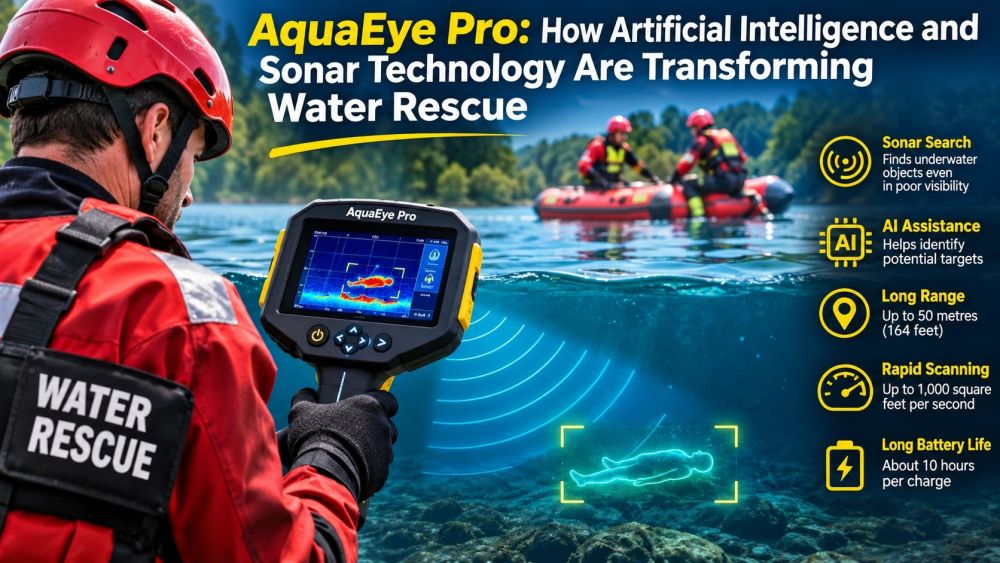
266/2026
AquaEye Pro is a new handheld sonar tool that helps emergency responders more easily locate potential drowning victims.
When someone goes underwater, every second counts. Now, a new sonar-and-artificial-intelligence tool gives emergency responders a faster, more effective way to find people. Drowning is a serious global problem, causing hundreds of thousands of deaths each year. Rivers, lakes, canals, pools, and coastal waters all pose risks, especially where rescue equipment and trained teams are limited. One of the hardest parts of a drowning emergency is finding the missing person underwater. Poor visibility, vegetation, strong currents, darkness, and unclear search areas can turn rescue efforts into a race against time.
AquaEye developed this device to use active sonar and artificial intelligence to help spot underwater objects. Traditional underwater searches rely mostly on sight, but sonar sends sound waves into the water and reads the echoes from objects. This lets rescuers search underwater even when visibility is poor.
The way it works is simple. AquaEye Pro sends out high-frequency sound pulses into the water. When these waves hit something, they bounce back as echoes. The device processes these signals and helps identify possible targets, including people underwater. It then shows this information to the operator so that rescuers can focus on the most important areas.
The device is portable but still powerful. The manufacturer says it can scan up to 50 meters (164 feet) and cover 1,000 square feet per second in good conditions. It uses AI to help sort targets, has a full-color display, and can store up to 100 scans. It’s tough, waterproof, and built for tough rescue jobs, and the battery lasts about ten hours.
A real-life example comes from Lake Travis, Texas. After a swimmer went missing near Bob Wentz Park, the first rescue team searched for about 15 minutes using standard methods. When a second team arrived with AquaEye, they found a possible target about 40 meters away in less than a minute. Another scan confirmed the spot. Rescue swimmers reached the person at about 12 feet deep and brought them up within five minutes using AquaEye. The victim had a weak pulse, and CPR was started. Sadly, even with medical help, the person later died in the hospital. This case shows how the device can speed up finding victims but also reminds us that quick detection does not always mean survival.
aquaeye.com
One promising feature is that several AquaEye Pro devices can be used at the same time. With the Command Hub platform, rescue teams can share sonar data and see scans on a shared map of the search area. This teamwork could help in big emergencies by letting teams cover more ground and avoid repeating work.
This technology is useful far beyond the United States. Several countries often deal with water emergencies in rivers, canals, reservoirs, floods, and accidental drownings. Many times, responders work in murky water with little specialized equipment. Still, AquaEye Pro is a tool to help, not a rescue system on its own. Sonar can’t always confirm whether an object is a person, and its effectiveness depends on water conditions, currents, plants, and other factors. Rescue divers, trained teams, CPR, and good medical care are still essential.
AquaEye Pro is a good example of how artificial intelligence and engineering can help people in need. Its value isn’t just in its technical features, but in how it can help rescue teams make quicker, smarter choices during emergencies. As technology advances, combining smart sonar with drones, digital maps, emergency networks, and disaster management systems could make water rescues even more effective.
What matters most about technology is how well it helps people. When someone is missing underwater, every second is important. Tools like AquaEye Pro show that science, when used to save lives, can make a real difference.