5. Understanding Outcome-Based Education: A Paradigm Shift from Teaching to Learning
Posted 3 months ago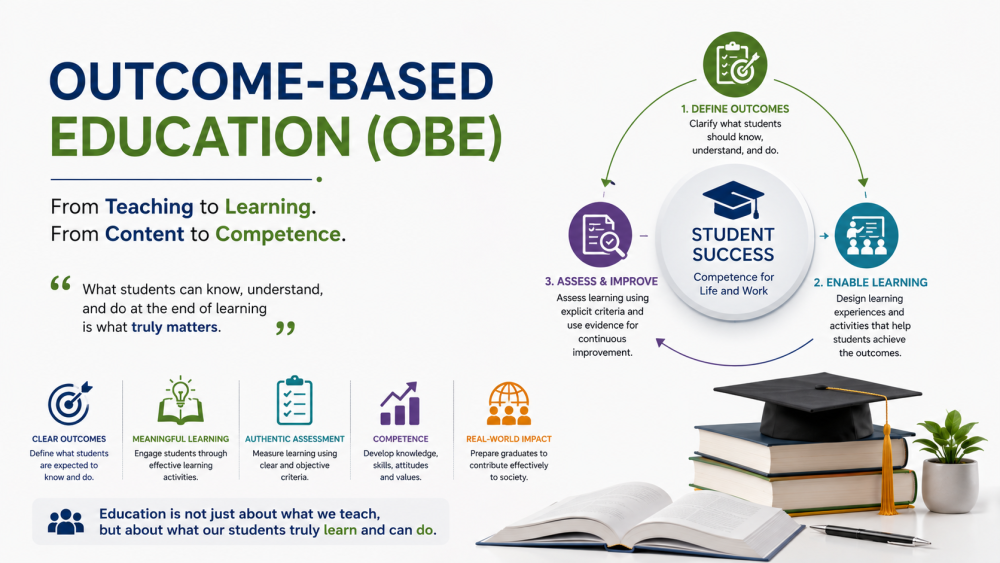
134/2026
Outcome-Based Education is one of the most significant reforms in modern education because it redefines the purpose of teaching, learning, curriculum design, and assessment. Rather than focusing on instructional inputs, OBE focuses on measurable learning outcomes, the competencies students are expected to demonstrate upon completing a course or academic program.
What Is Outcome-Based Education?
Outcome-Based Education is an educational philosophy that organizes every component of the teaching and learning process around clearly defined learning outcomes. According to widely accepted definitions, OBE designs the curriculum, teaching methods, learning experiences, and assessment strategies so that, by the end of the educational journey, every learner has achieved predetermined goals.
Unlike traditional education, Outcome-Based Education does not prescribe a single teaching methodology or assessment technique. Instead, it gives educators the flexibility to use diverse instructional approaches, innovative classroom practices, experiential learning opportunities, and authentic assessments if these methods enable students to achieve the intended outcomes effectively.
This learner-centered philosophy recognizes that students learn in different ways and at different paces. Therefore, educational strategies should be selected not for their conventionality but for their effectiveness in helping students develop the required competencies.
The European Perspective on Outcome-Based Education
The European Higher Education Area (EHEA) further strengthens the concept of Outcome-Based Education by centering student learning in educational practice. Its framework emphasizes three interconnected principles.
First, educational institutions should clearly define learning outcomes that specify what students are expected to know, understand, and be able to do after completing a learning experience. These outcomes provide transparency for students, educators, employers, accreditation bodies, and society.
Second, teaching and learning activities should be intentionally designed to help students achieve these outcomes. Lectures, laboratory work, discussions, case studies, projects, internships, simulations, collaborative learning, and research activities are not ends in themselves; they are carefully selected learning experiences that support competency development.
Third, assessment must measure the extent to which students have achieved the intended outcomes. Rather than relying solely on traditional examinations, Outcome-Based Education promotes assessment methods that evaluate authentic performance against explicit, transparent, and objective criteria.
Together, these three principles create constructive alignment among intended outcomes, teaching strategies, and assessment methods, ensuring that every component of education directly contributes to meaningful student learning.
Moving Beyond Traditional Education
Traditional education has long emphasized teaching over learning. Curriculum planning often begins with selecting content, organizing lectures, and completing prescribed syllabi. Teachers are expected to deliver information, while students are expected to absorb and reproduce it on examinations.
Grades, rankings, and comparisons among students are commonly used to measure academic success. Expectations are often based on historical practices rather than on the evolving needs of society, industry, or professional practice.
Although this model has successfully transmitted knowledge across generations, it has often placed relatively little emphasis on whether students genuinely understand, retain, or can apply what they have learned beyond the classroom.
Therefore, completing a curriculum does not necessarily guarantee meaningful learning.
Outcome-Based Education addresses this limitation by asking a more fundamental question:
What should students be able to do after completing their education?
This simple question transforms the entire educational process.
Learning Becomes the Central Goal
One of the defining characteristics of Outcome-Based Education is its unwavering focus on student learning rather than on teacher activity.
In traditional classrooms, educational success is often measured by the amount of content instructors present. In OBE, success is measured by the competencies learners develop.
The role of teachers evolves from information providers to facilitators, mentors, coaches, and designers of meaningful learning experiences. Likewise, students move from passive recipients of information to active participants who construct their own understanding through inquiry, collaboration, reflection, experimentation, and problem-solving.
Learning, therefore, becomes an active process rather than a passive experience.
Flexibility in Teaching and Assessment
A common misconception is that Outcome-Based Education requires a standardized teaching method. OBE encourages educational flexibility.
Different disciplines, institutions, teachers, and learners may require distinct instructional approaches. Some learning outcomes may be best achieved through lectures, while others may require laboratory experiments, fieldwork, project-based learning, simulations, clinical practice, industrial placements, collaborative learning, or independent research.
Similarly, assessment methods should be selected based on the nature of the intended outcomes. Written examinations remain valuable for assessing conceptual understanding. Still, competencies such as communication, leadership, teamwork, innovation, creativity, ethical reasoning, and professional practice require broader assessment approaches, including presentations, portfolios, practical demonstrations, case analyses, workplace evaluations, and authentic projects.
The emphasis is therefore not on how education is delivered, but on whether meaningful learning has occurred.
Transparency and Accountability
Outcome-Based Education also promotes greater transparency in the educational system.
Clearly articulated learning outcomes help students understand what is expected of them before learning begins. Faculty members develop a shared understanding of curriculum objectives, while employers receive graduates whose competencies align with professional expectations.
This transparency strengthens institutional accountability. Universities are no longer evaluated merely by graduation rates or examination results but by evidence that graduates possess the knowledge, skills, attitudes, and professional competencies required by society.
Educational quality thus becomes measurable through learning achievement rather than instructional activity alone.
Preparing Graduates for the Twenty-First Century
The modern world demands graduates who can adapt to rapidly changing technologies, solve complex interdisciplinary problems, communicate effectively, collaborate, think critically, and continue learning throughout their careers.
These expectations cannot be met through memorization alone.
Outcome-Based Education provides a framework that aligns curriculum, teaching, learning, and assessment with emerging societal needs. It ensures that graduates leave educational institutions not only with academic qualifications but also with the practical competence, ethical values, professional confidence, and lifelong learning skills needed to thrive in an increasingly complex global environment.
The Future of Educational Excellence
Outcome-Based Education is far more than a curriculum reform; it is a fundamental transformation in educational philosophy. It shifts the emphasis from teaching to learning, from content delivery to competency development, and from measuring instructional effort to measuring educational impact.
Ultimately, education achieves its highest purpose not when teachers complete a syllabus, but when learners can apply knowledge wisely, solve meaningful problems, make ethical decisions, and contribute positively to society.
The defining question of modern education is therefore no longer "What did we teach?" but rather "What can our graduates actually do?" Answering this question is at the heart of Outcome-Based Education and the future of educational excellence.