How Australia's ATTEN Model is Shaping the Future of Digital Learning?
Posted 3 months ago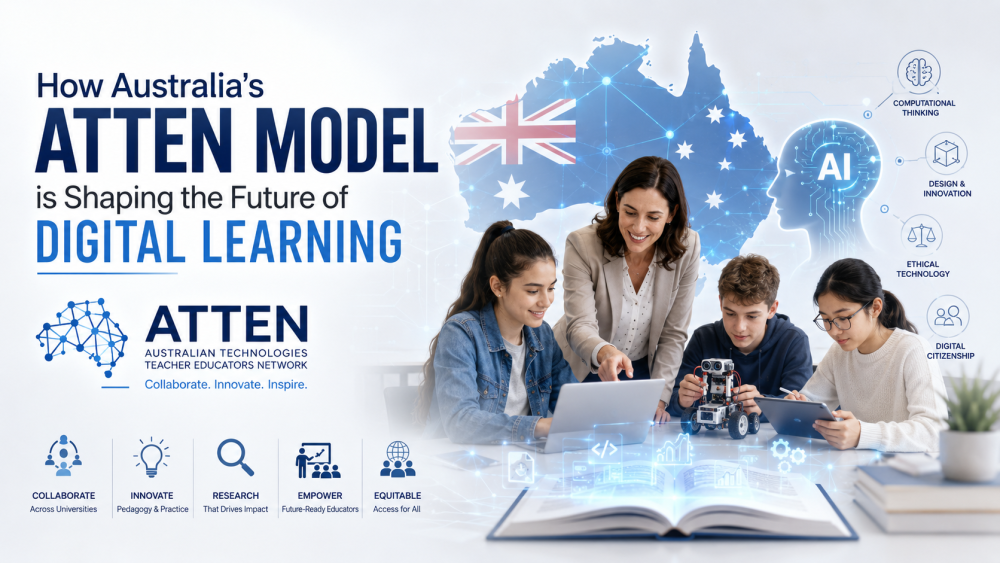
120/2026
Australia's Australian Technologies Teacher Educators Network (ATTEN) offers a clear example of how universities can collectively address this challenge. Established in 2019 with support from the Australian Council of Deans of Education, ATTEN brings together technology teacher educators from universities across the country to strengthen initial teacher education, promote collaborative research, and improve the quality of Digital Technologies and Design & Technologies education in schools.
Artificial intelligence has transformed the global conversation about education. Universities are racing to launch AI programs, schools are experimenting with generative technologies, and governments are investing billions in digital infrastructure. Yet amid this technological acceleration, one uncomfortable reality remains: technology alone cannot transform education. Teachers do.
The greatest challenge facing higher education is therefore not merely producing graduates with digital skills but preparing educators who can confidently teach, adapt, and lead in a world where technological change is constant.
Australia's ATTEN provides a blueprint for teacher education in the age of artificial intelligence.
Its significance extends well beyond Australia.
From isolated expertise to collective intelligence
Universities have traditionally treated teacher education as an institutional responsibility. Each faculty develops its own curriculum, conducts its own research, and prepares its own graduates.
Such independence has advantages, but it also fragments innovation. As digital technologies evolve at unprecedented speed, no single university can remain at the forefront of every emerging discipline—from artificial intelligence and cybersecurity to computational thinking, robotics, and digital design.
ATTEN recognizes that technological disruption requires collaboration rather than competitive leadership. By creating a national community of practice, ATTEN enables academics to share pedagogical innovations, co-design teaching resources, conduct collaborative research, and collectively address emerging educational challenges.
The model reflects a broader shift in higher education: excellence increasingly depends on networks rather than on individual institutions.
Teacher education deserves the same innovation as technology itself
Public debate about digital education is often centered on devices, software platforms, or artificial intelligence applications. These discussions often overlook the human infrastructure that determines whether technology succeeds in classrooms.
Effective technology education requires teachers who understand far more than digital tools. They must cultivate computational thinking, design processes, creativity, systems thinking, ethical reasoning, and responsible digital citizenship.
Preparing such educators requires universities to integrate technology, pedagogy, and disciplinary knowledge in ways that continually evolve with technological change.
This marks a profound departure from traditional teacher education, in which technological competence was often treated as an optional enhancement rather than a foundational professional capability.
Research that shapes practice
One of ATTEN's distinguishing characteristics is its emphasis on linking research directly to classroom practice.
Its research agenda focuses on teacher quality, pedagogy in digital and design technologies, equitable access, computational thinking, teacher readiness, and emerging educational technologies. Importantly, research findings are translated into practical improvements for teacher preparation programs rather than remaining confined to academic journals. (Atten)
This research-to-practice approach has become increasingly important as universities confront rapidly changing educational environments in which curriculum reform often struggles to keep pace with technological innovation.
Artificial intelligence changes the role of the teacher—not its importance
Generative AI has prompted widespread speculation about the future of teaching. Some predict that automation will diminish teachers' significance. Experience suggests the opposite.
Artificial intelligence amplifies the need for educators capable of exercising professional judgment, fostering critical thinking, addressing ethical dilemmas, and helping students distinguish reliable knowledge from algorithmic output.
Teachers are no longer merely transmitters of information. They are becoming designers of learning experiences, facilitators of inquiry, and mentors for responsible engagement with increasingly intelligent technologies.
Preparing educators for these expanded responsibilities requires universities to rethink teacher education from first principles.
Equity cannot be an afterthought.
Digital transformation also exposes longstanding inequalities.
Students' opportunities to engage with emerging technologies continue to vary by geography, socioeconomic status, and institutional resources. Teacher preparation, therefore, carries a responsibility not only to develop AI capability but also to ensure equitable access to high-quality learning experiences.
ATTEN explicitly incorporates equity into its research priorities, recognizing that digital inclusion is essential for technological advancement to benefit society as a whole rather than deepen existing educational divides.
A lesson for universities everywhere
Higher education systems worldwide are investing heavily in artificial intelligence, digital infrastructure, and future skills initiatives. Yet sustainable educational transformation depends less on the sophistication of the technology than on the quality of those who teach it.
Australia's ATTEN demonstrates that preparing future-ready teachers requires national collaboration, research-informed practice, and continuous professional learning rather than isolated institutional initiatives.
As universities reconsider their role in an AI-driven world, they would do well to remember that every technological revolution ultimately succeeds or fails in the classroom.
The future of education will not be determined by algorithms alone. It will be shaped by the educators who know how to use them wisely.