11. Educational Goals, Assessment Practices, and Bloom's Taxonomy
Posted 3 months ago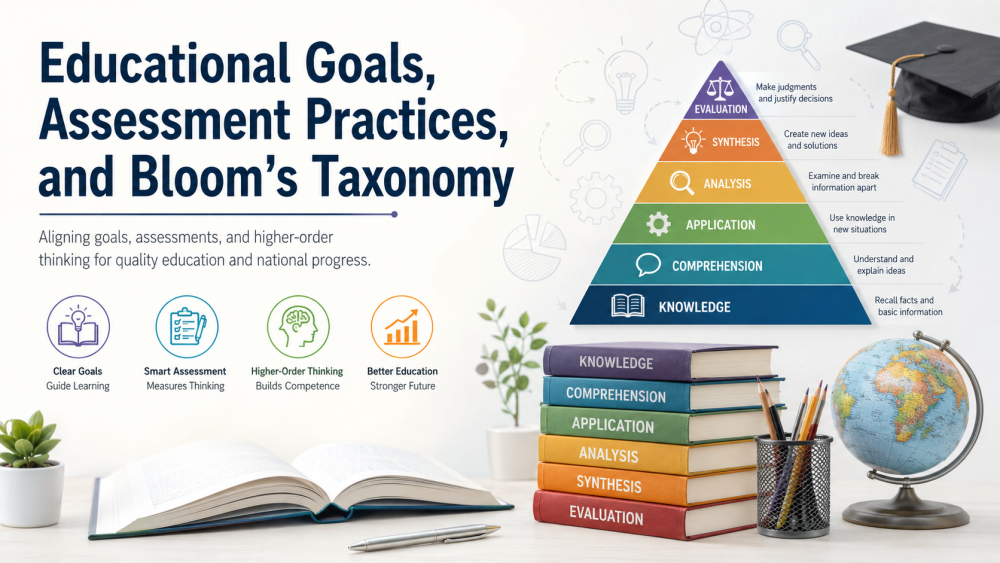
140/2026
Introduction
The quality of an educational system is determined not merely by the quantity of knowledge it imparts but by the level of thinking it cultivates among learners. From primary to higher education, the educational goals set by governments, accreditation agencies, and academic institutions shape the direction of teaching, learning, and assessment. These goals influence curriculum design, classroom instruction, assessment strategies, and ultimately the competencies of graduates entering professional life.
If an education system primarily emphasizes factual knowledge and information recall, students may become proficient at memorizing content without developing the ability to understand, analyze, apply, or create new knowledge. Such graduates often struggle to solve complex real-world problems despite having extensive theoretical knowledge.
In contrast, educational systems that emphasize higher-order cognitive skills produce graduates capable of innovation, critical thinking, research, leadership, and evidence-based decision-making. Consequently, the quality of educational goals directly influences scientific advancement, technological innovation, economic competitiveness, and national development.
Educational Goals and National Development
Educational objectives shape the intellectual capacity of a nation's workforce. Countries that focus primarily on memorization often face significant challenges, even with considerable natural or financial resources.
11.2 Characteristics of knowledge-centered educational systems
- Heavy emphasis on memorization.
- Limited conceptual understanding.
- Minimal problem-solving skills.
- Weak critical thinking.
- Poor creativity and innovation.
- Limited interdisciplinary learning.
- Teacher-centered instruction.
- Examination systems based mainly on recall.
Possible consequences
- Reduced technological innovation.
- Limited industrial competitiveness.
- Weak research culture.
- Low entrepreneurial capacity.
- Slow social development.
- Dependence on imported technologies.
- Difficulty addressing complex societal problems.
Numerous countries possess abundant natural resources and financial wealth, yet continue to experience limited scientific and technological progress because their educational systems do not adequately develop higher-order cognitive abilities.
11.1 Bloom's Taxonomy as a Guide for Assessment
One of the most practical applications of Bloom's Taxonomy is in designing classroom questions and examination papers. The wording of assessment questions often reflects the cognitive level expected from students.
A useful rule of thumb is that the instructional verbs used in examination questions indicate the cognitive domain being assessed.
11.2 Common Action Verbs for Each Cognitive Level
1. Knowledge
Questions at this level assess factual recall.
Common action verbs
- Define
- List
- Name
- State
- Identify
- Recall
- Enumerate
- Describe
- Label
- Recognize
Typical student task
Recall information exactly as learned.
2. Comprehension
Questions require students to demonstrate understanding of concepts.
Common action verbs
- Explain
- Interpret
- Summarize
- Illustrate
- Generalize
- Compare
- Contrast
- Conclude
- Translate
- Discuss
Typical student task
Explain concepts in one's own words.
3. Application
Students apply knowledge to solve practical problems.
Common action verbs
- Apply
- Calculate
- Compute
- Solve
- Demonstrate
- Organize
- Use
- Develop
- Operate
- Perform
Typical student task
Use learned knowledge in unfamiliar situations.
4. Analysis
Students examine relationships among ideas.
Common action verbs
- Analyze
- Infer
- Distinguish
- Differentiate
- Identify causes
- Examine
- Categorize
- Compare
- Investigate
- Outline
Typical student task
Break information into components and determine relationships.
5. Synthesis
Students combine ideas to create something new.
Common action verbs
- Design
- Create
- Develop
- Compose
- Construct
- Formulate
- Modify
- Plan
- Invent
- Propose
Typical student task
Generate original ideas or products.
6. Evaluation
Students make judgments using established criteria.
Common action verbs
- Evaluate
- Justify
- Defend
- Criticize
- Recommend
- Assess
- Judge
- Argue
- Prioritize
- Appraise
Typical student task
Support decisions using logical reasoning and evidence.
11.3 Assessment Reflects Educational Philosophy
Assessment is one of the strongest determinants of student learning. Teachers naturally teach according to what is assessed, while students learn according to what is examined.
If examinations primarily assess:
- Definitions
- Lists
- Facts
- Terminology
- Formulae
- Dates
Students are likely to focus on memorization.
If examinations assess:
- Problem solving
- Critical thinking
- Application
- Data interpretation
- Creativity
- Evaluation
Students develop higher-order thinking skills.
Therefore,
Assessment drives learning.
Case Study 1: Secondary School Chemistry Examination
An analysis of a high school chemistry examination revealed that most questions required simple factual recall.
Examples of examination questions
- Define radical.
- Define the modern periodic law.
- Define a double covalent bond.
- Define a triple covalent bond.
- What is the degree of ionization?
- Define solution.
- State the effect of an electric field.
Bloom's Taxonomy analysis
- Knowledge: 85%
- Comprehension: 15%
- Application: 0%
- Analysis: 0%
- Synthesis: 0%
- Evaluation: 0%
Major observation
The examination largely rewarded memorization rather than conceptual understanding or scientific reasoning.
Case Study 2: Medical College Pathology Examination
A pathology examination in a medical college demonstrated a similar pattern.
Sample questions
- Name the parasites.
- Briefly describe the pathogens.
- Enumerate organisms.
- Define dietary hypersensitivity.
- Enumerate clinical disorders.
- Describe pathological changes.
Only one question required conceptual thinking:
- How can meningitis be diagnosed?
Bloom's Taxonomy analysis
- Knowledge: 90%
- Comprehension: 10%
- Application: 0%
- Analysis: 0%
- Synthesis: 0%
- Evaluation: 0%
Major observation
Most questions measured memory rather than clinical reasoning or diagnostic ability.
11.4 Designing Better Assessments
Effective examinations should distribute questions across multiple cognitive levels.
A balanced assessment should include:
- Knowledge-based questions for foundational learning.
- Comprehension questions for conceptual understanding.
- Application questions for practical competence.
- Analysis questions for critical thinking.
- Synthesis questions for creativity.
- Evaluation questions for professional judgment.
Such assessments encourage deeper learning and better prepare graduates for professional practice.
Key Points
- Educational goals determine the quality of teaching and learning.
- Bloom's Taxonomy provides a systematic framework for designing assessments.
- Action verbs indicate the cognitive level being assessed.
- Examination questions reveal the educational philosophy of an institution.
- Overemphasis on memorization limits innovation and critical thinking.
- Higher-order assessment promotes creativity, problem-solving, and lifelong learning.
- Balanced examinations should include questions from all six cognitive levels.
11.5 Summary
Educational assessment is far more than a mechanism for assigning grades; it is a powerful instrument that shapes how students learn and how teachers teach. Bloom's Taxonomy offers educators a scientifically grounded framework for designing assessments that extend beyond factual recall to foster comprehension, application, analysis, synthesis, and evaluation. The analysis of chemistry, pathology, psychology, and geography examination papers presented in this chapter demonstrates that many educational systems continue to rely heavily on lower-order cognitive skills, with most questions assessing only knowledge and basic comprehension. To prepare graduates capable of innovation, leadership, and evidence-based decision-making, educational institutions must redesign assessments to encompass the full spectrum of cognitive learning. When assessment aligns with higher educational goals, it becomes a catalyst for meaningful learning, professional competence, and sustainable national development.