The UK Freelance Education Framework: A Model the World Must Replicate for Emerging Job Markets
Posted 5 months ago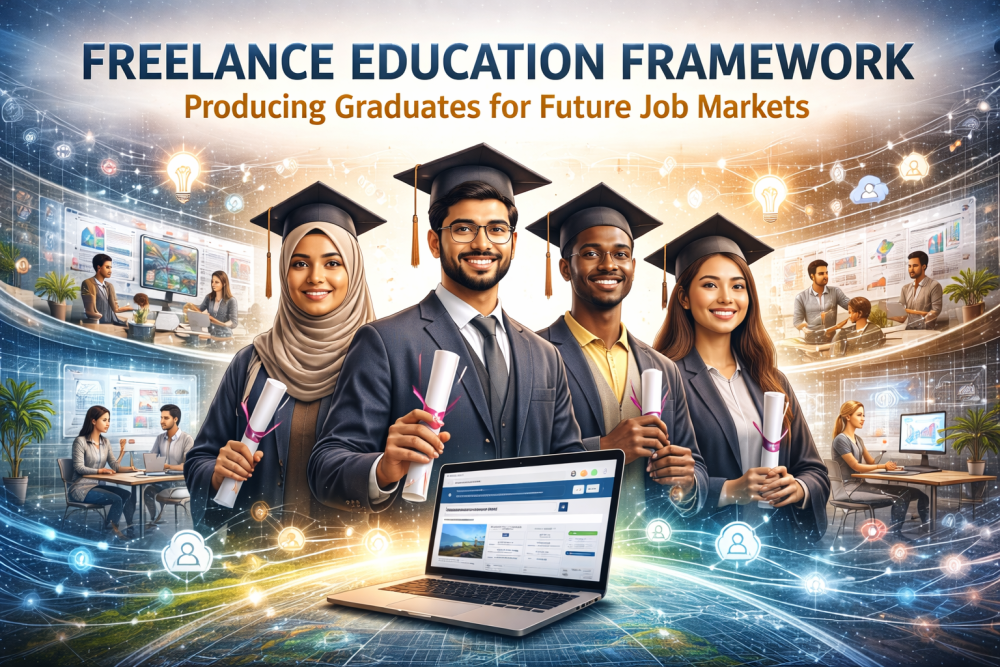
51/2026
By any measure, the nature of work has changed more in the past decade than in the previous half-century. Stable, linear careers, once the guiding principle of education systems, are quietly giving way to more flexible options, such as freelancing and self-directed work. In the United Kingdom, policymakers and educators have started to face this reality with unusual clarity. Countries like Pakistan should pay attention not someday, but now.
This week, Britain introduced the Freelance Education Framework (FEF), a national standard designed to incorporate freelance career paths into higher and adult education. The initiative recognizes what many universities have long overlooked: that students are already earning, learning, and developing careers outside traditional employment models.
This is more than just a policy tweak; it's a conceptual shift.
For decades, education systems, especially in developing countries, have focused on a single promise: study hard, graduate, and get a job, although work-study programs have been very promising for hardworking young professionals. But what happens when “the job” is no longer the main goal?
A Quiet Revolution in How Work Happens
The rise of freelancing is not just anecdotal; it is structural. In the United States, many students now participate in some form of freelance or side work during their studies. Worldwide, the concept of a “portfolio career” with multiple income streams, flexible engagements, and self-managed work is quickly becoming common.
Still, education systems, especially in South Asia and Africa, are falling behind. Curricula are designed for jobs, not entrepreneurship. Career services focus on creating résumés, not business models. Degrees confirm knowledge but rarely show the ability for self-employment.
The result is a widening mismatch between what graduates know and how they must survive.
What the UK Has Understood
The British framework does something surprisingly straightforward: it legitimizes freelancing as a top-tier career path.
It provides:
- A structured framework for integrating freelance skills into curricula
- A common language among institutions for assessing freelance results
- A three-level accreditation system to monitor institutional progress
- A cross-sector strategy aligning academia with industry realities
Essentially, it turns freelancing from a casual, unsupported activity into a recognized, measurable, and teachable field.
This reflects earlier UK initiatives, such as national occupational standards and professional frameworks, which have long defined competencies across sectors. The difference now is that the “sector” is not a traditional industry; it is the future of work itself.
Pakistan must strengthen its Freelancing Ecosystem.
Fortunately, Pakistan has both the National Qualification Framework (NQF) and the National Vocational Qualifications Framework (NVQF)Programs. Although the Higher Education Commission of Pakistan mainly considers the NQF, the NVQF is emerging as a new reality in education. Universities such as the National Skills University Islamabad and the National University of Technology, both located in Islamabad and Rawalpindi, respectively, are giving relatively greater weight to the NVQF. Many students from these institutions are earning even during their learning phase. Likewise, the National Vocational and Technical Training Commission (NAVTTC)'s efforts in line with the NVQF standards are commendable. On several occasions, the founding Vice Chancellor of the National Skills University, Islamabad, apprised the HEC and the Federal Ministry of Education and Professional Training to assimilate/merge the NVQF into the NQF religiously so that students across the country could be provided with skills aligned with their field of study and could work either as interns or on a part-time basis in various relevant job markets. Importantly, the Punjab Information Technology Board’s freelance training initiatives have already demonstrated that young people can earn globally from local settings.
Universities in Pakistan still largely measure success by graduate employment rates rather than entrepreneurial resilience. Freelancing is seen as a fallback, not a frontier. This is a strategic mistake.
Consider the country’s demographic facts: a youth bulge, limited official job opportunities, and rising digital connectivity. The conditions for a freelance economy already exist. What’s missing is a clear national framework that connects these realities to the education system.
Why a Framework Matters
Without structure, freelancing risks becoming exploitative, unstable, and unfair. With structure, it turns into a strong engine of inclusion.
A national freelance education framework in countries like Pakistan could:
- Integrate digital and entrepreneurial skills across various disciplines
- Award official recognition for freelance accomplishments, as in the UK.
- Standard training, mentoring, and quality assurance processes.
- Align universities with global digital labor markets
Most importantly, it would shift the narrative—from “job seekers” to “value creators.”
The Stakes Are Higher Than Employment
This isn't just about careers; it's about economic sovereignty.
Developing countries have long faced challenges in joining global value chains. Freelancing, especially in digital fields, provides a rare chance to overcome traditional obstacles. A student in Multan or Mardan can work for clients in London or New York without ever leaving home.
But without institutional support, this potential stays underdeveloped and unevenly spread.
Frameworks build ecosystems. Ecosystems enable scale.
A Call for Leadership
What the UK has done isn't perfect or applicable everywhere. But it's clear and firm. It recognizes that education must keep up with the economy, not fall behind.
Countries like Pakistan, Nigeria, and Bangladesh face a choice: adapt their education systems to the realities of freelance and digital work, or keep producing graduates for jobs that no longer exist.
The way forward is clear:
- Education Ministries should recognize freelancing as a legitimate career option.
- Higher education authorities should establish national standards and accreditation frameworks
- Universities should integrate freelance skills into their curricula and assessments.
- Industry partners should collaborate to develop training and mentorship ecosystems.
This is not a marginal reform. It is a redefinition of what it means to be educated.
The Future Is Already Here
Freelancing is no longer on the fringes. As one architect of the UK framework noted, it has shifted from being “misunderstood” to becoming a main way of earning and learning.
The question isn't whether this shift will reach the developing world. It already has.
In the global economy of the 21st century, the countries that teach their students to work for themselves may ultimately shape the future of work for everyone else.
Last but not least, initiatives like MySkillsFuture and SkillsFuture Singapore have been doing the same as described above at a broader level, with an impressive track record of success.