Will Robot Scientists Replace Human Scholars? The Debate That’s Reshaping Research
Posted 6 months ago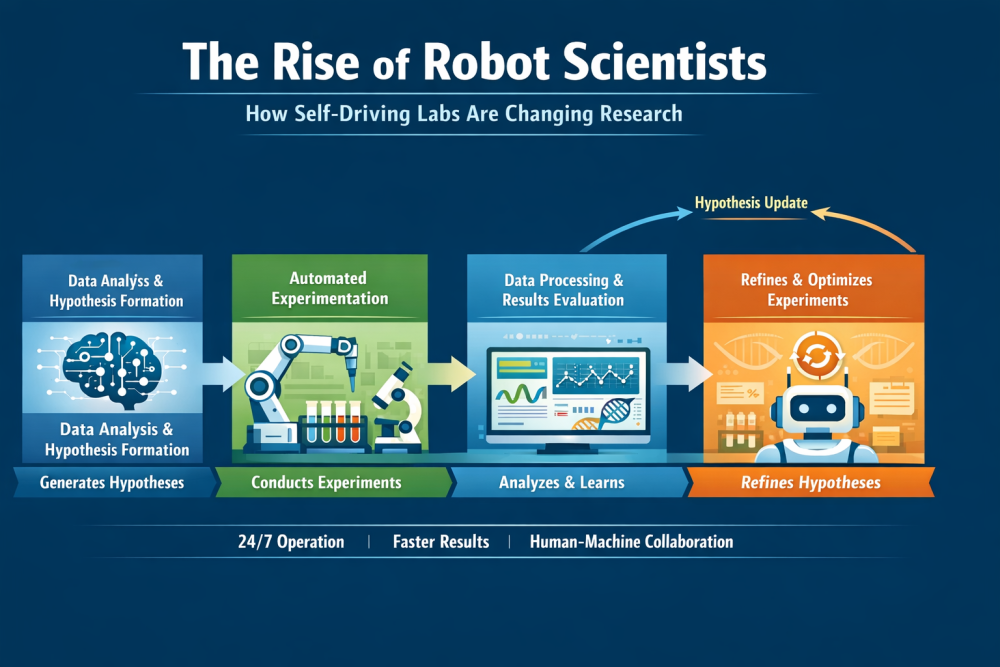
33/2026
In the rapidly changing world of 21st-century science, automation and artificial intelligence (AI) are transforming not just tools but the entire scientific process. The latest advances in “robot scientists” and self-driving laboratories indicate a major shift in how research is done, speeding up discovery, changing human roles, and sparking debate about the future of scientific work.
What Are Robot Scientists?
Robot scientists are autonomous systems that combine advanced AI with robotic laboratory hardware to conduct meaningful scientific research with minimal human input. Unlike traditional automation that only speeds up tasks like pipetting or data collection, robot scientists think, decide, experiment, and learn. They can:
- Generate hypotheses based on data
- Design experiments to test those hypotheses
- Conduct experiments in physical laboratory environments using robotics.
- Analyze results and iteratively refine hypotheses in a closed feedback loop.
This concept isn’t a futuristic theory; it has been actively developed for years and represents a new frontier in computational science and laboratory automation.
The Rise of Self-Driving Labs
The Nature article on robot scientists highlights how AI-driven automated labs are beginning to perform tasks that, until recently, required extensive manual work and expert supervision. These systems, sometimes called self-driving laboratories, combine:
- AI decision engines that interpret experimental data in real time
- Robotic manipulators and instruments that carry out procedures
- Integrated feedback systems that adjust protocols on the fly
The result? Experiments that run nonstop, around the clock, producing data and adjusting in ways only human researchers could previously achieve.
Real-World Results: Faster, More Extensive, and More Automated
Although the Nature article emphasizes biological sciences, robot scientists have already demonstrated influence across various fields. For example:
- AI–robot labs like the A-Lab have independently synthesized dozens of new materials in just weeks, a process that could take human teams months or years.
- Autonomous synthetic chemistry systems are being used to explore vast “chemical spaces” at unmatched speed and efficiency.
- Earlier prototypes developed years ago, autonomously discovered genetic relationships in biological systems, showing that such machines can generate new scientific knowledge.
These advances show how robot scientists are more than just tools; they are collaborators in the research process.
Human Researchers Still Essential - But Roles Are Changing
Although robots might seem poised to replace biologists, scientists highlight that human expertise remains essential. Robot scientists are good at scaling experiments, optimizing workflows, and analyzing large data sets, but they don’t replace human creativity, insight, or ethical judgment. Instead, they:
- Take over repetitive, time-consuming tasks
- Reduce human error
- Accelerate hypothesis testing
- Enable researchers to focus on strategy, interpretation, and big-picture thinking
Many experts argue that such setups will create hybrid intelligence, a collaboration where human intuition complements machine speed and precision.
Challenges and Debate
The emergence of robot scientists raises important questions:
- Trust and reproducibility: How can we ensure autonomous systems produce credible, reproducible science?
- Accountability: Who is responsible if a robot scientist produces flawed or harmful results?
- Equity: Will access to robotics and AI widen the gap between well-funded and under-funded research institutions?
These debates are crucial as the scientific community addresses the ethical and practical issues of extensive automation.
The Future: A New Paradigm for Discovery
The trajectory of robot scientists points toward a future where:
- Scientific discovery becomes highly accelerated and massively parallel.
- AI and robotics are becoming essential partners in research.
- Human researchers concentrate on big-picture design, interpretation, and innovation.
Instead of replacing scientists, self-driving labs and robot scientists are set to redefine what is possible in science, opening new horizons in biology, materials science, chemistry, and beyond.
According to Professor Dr. Muhammad Mukhtar, automated robot scientists are no longer just a concept; they are emerging tools transforming the practice of science itself. They promise faster discoveries, deeper exploration of uncharted experimental spaces, and a future where human and machine intelligence collaborate seamlessly. As these systems develop, so will our understanding of discovery, innovation, and the essence of scientific inquiry.