Why Emerging Technologies Can't Thrive Without Humanities?
Posted 2 months ago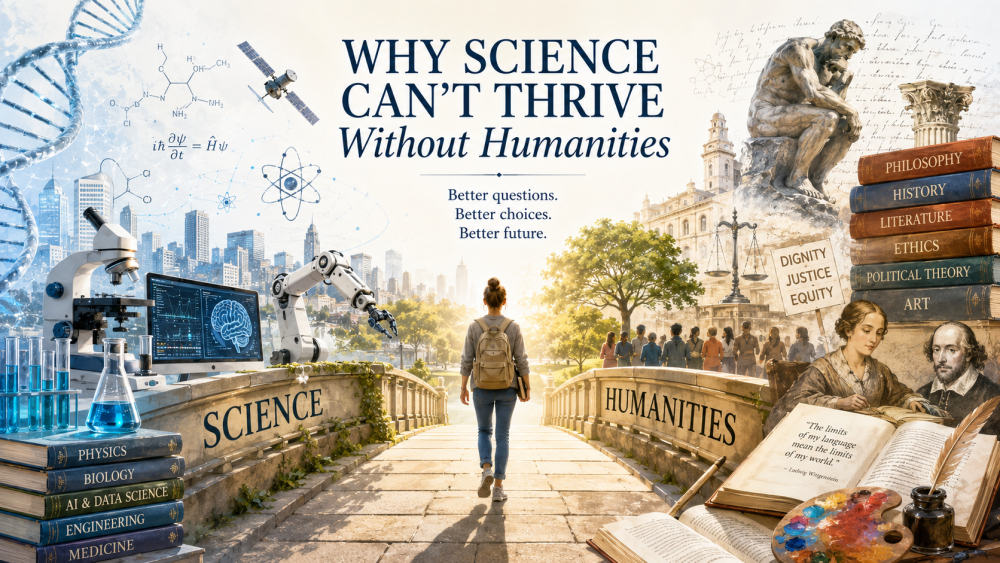
104/2026
According to an article published in Nature Journal "Higher education should not just develop students’ technical skills but also foster judgement, creativity, ethical awareness and character."
Artificial intelligence can diagnose diseases. Gene-editing tools can rewrite the code of life. Quantum computers promise unimaginable computational power. Humanity has never had such extraordinary scientific capabilities. Yet the greatest challenge of the twenty-first century may not be inventing these technologies; it will be deciding how to use them wisely.
For decades, science and the humanities have often been treated as separate worlds. Students are encouraged to become engineers, historians, computer scientists, or philosophers. But the problems created by modern technology refuse to stay within academic boundaries. They demand answers that are not only scientifically correct but also morally, culturally, and socially responsible.
Consider artificial intelligence. Engineers can build increasingly powerful systems, but they cannot determine on their own what constitutes fairness, privacy, accountability, or human dignity. Those questions belong as much to philosophers, legal scholars, psychologists, historians, and sociologists as to programmers.
The same is true of biotechnology. Gene editing can eliminate inherited diseases, but should it also be used to enhance intelligence or physical appearance? Scientists can explain what is technically possible. Society must decide what is ethically acceptable.
History repeatedly reminds us that technological revolutions reshape civilizations in unexpected ways. Nuclear physics brought clean energy and devastating weapons. Social media connected billions while also accelerating misinformation and polarization. These lessons show that innovation without thoughtful reflection can have unintended consequences.
The humanities provide tools for anticipating those consequences. Philosophy helps distinguish what we can do from what we should do. History reveals how societies responded to earlier technological revolutions. Literature and the arts cultivate empathy by helping us understand lives unlike our own. Political science and economics explain how new technologies affect power, employment, and inequality.
Scientific discovery is not merely a technical enterprise; it is profoundly human. Every invention ultimately affects people's lives, relationships, values, and aspirations. Ignoring these dimensions risks building technologies that are efficient yet inequitable, powerful yet untrustworthy.
Universities, therefore, have a unique responsibility. Rather than educating specialists who rarely cross disciplinary boundaries, they should cultivate graduates who combine scientific expertise with ethical reasoning, communication skills, and cultural understanding. Engineers should study ethics. Medical students should study philosophy. Computer scientists should study law, psychology, and public policy. Likewise, humanities students should develop scientific literacy so they can participate meaningfully in debates about emerging technologies.
The future will belong not to those who know only the most science, nor to those who understand only society, but to individuals capable of bridging both worlds.
Scientific progress has transformed humanity's capacity to understand nature. The humanities remind us why that understanding matters. Together, they ensure that innovation serves not only human curiosity but also human flourishing.