What Employers Really Want in the Age of Intelligent Machines?
Posted 1 month ago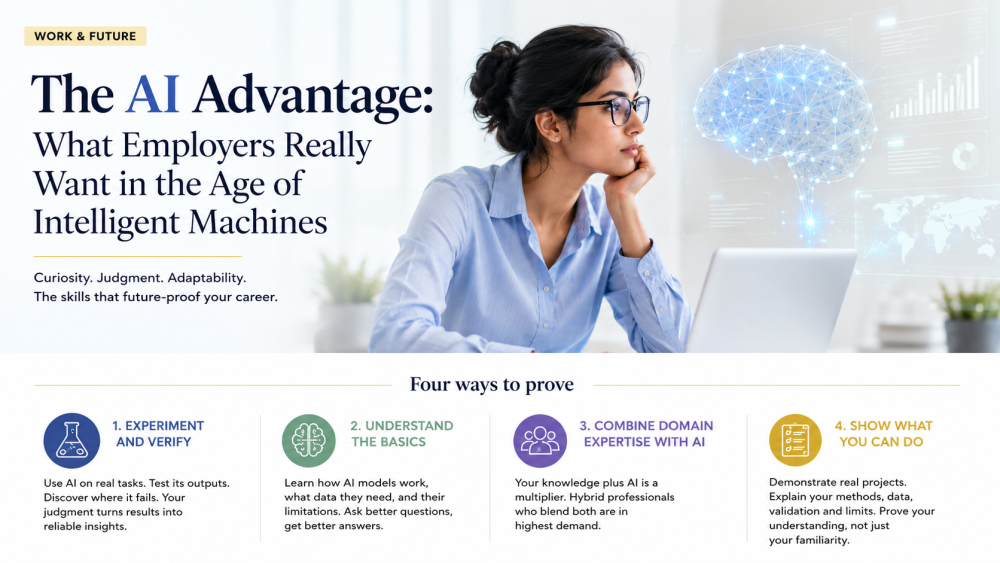
193/2026
Curiosity, critical thinking, and the ability to learn may matter more than mastering any single AI tool.
Artificial intelligence is reshaping the workplace faster than almost any technology in modern history. Yet employers' message is surprisingly human: they are not simply looking for people who know how to use AI. They want people who can think with it, question it, and know when not to trust it.
That distinction could define the careers of the next generation.
Data compiled by the job site Indeed shows that science positions requiring AI as a skill have risen sharply in the United States and across the globe, even as the overall number of science jobs has declined. At research institutions, AI and machine learning are increasingly useful even in fields that might appear far removed from computer science, including food science, biology, and medicine.
The result is a new professional equation: expertise + AI literacy + human judgment.
1. EXPERIMENT & NEVER STOP QUESTIONING
The best way to learn AI is not to watch it from a distance. It is to use it. Ask an AI tool to explain a difficult concept. Give it a dataset to analyze. Ask it to write code. Use it to organize ideas for a research project.
Then do something even more important:
Check the answer.
AI systems can produce remarkably convincing responses that are incomplete, misleading, or simply wrong. They can generate references that do not exist, misinterpret data, or present uncertain conclusions with impressive confidence.
That is why employers increasingly value curiosity over familiarity with a specific AI platform. Specific tools can become obsolete quickly; the ability to learn new ones does not. Researchers interviewed by Nature emphasized that candidates who demonstrate a willingness to explore, experiment, and learn may have an advantage over those who list AI tools on their résumés.
2. LEARN ENOUGH TO UNDERSTAND HOW AI WORKS
You do not need to become a computer scientist to work effectively with AI, but you should understand its fundamentals.
AI systems learn patterns from data. Their predictions depend on the quality and relevance of that data, the model used, and the circumstances in which it is applied. A result that appears precise is not necessarily accurate.
Consider an AI system that reports an 80 percent probability that a medical image shows cancer. That number sounds reassuringly scientific. But what does 80 percent mean? Has the model been properly tested? Was it trained on people like the patient? Does the probability remain reliable when the system encounters a different population?
These are not technical details reserved for programmers. They are questions that doctors, scientists, managers and policymakers increasingly need to understand.
3. COMBINE AI WITH WHAT YOU ALREADY KNOW
The future is unlikely to belong exclusively to AI specialists. It may belong to hybrid professionals instead.
A biologist who understands machine learning can ask different questions of biological data. A physician who understands AI can better evaluate an algorithm's clinical recommendations. An engineer who can work with generative AI may explore designs more quickly. A scientist who knows both experimental methods and computational tools can move more efficiently from hypothesis to evidence.
- The machine supplies speed and pattern recognition.
- The human supplies context, experience, and judgment.
- That combination can be extraordinarily powerful.
Researchers at pharmaceutical companies, for example, are already using AI to identify promising experimental parameters and guide further investigation. However, such systems still require human researchers to corroborate their recommendations using other methods.
AI is therefore less like a replacement for expertise than an amplifier of it.
4. SHOW WHAT YOU CAN ACTUALLY DO
One final lesson for students, researchers, and job seekers: do not merely claim AI expertise; demonstrate it. A portfolio that shows how you used AI to solve a real problem is far more convincing.
Employers and research funders increasingly want evidence that applicants understand the methods they propose to use. Simply writing “we will use AI” in a research proposal is unlikely to be persuasive without explaining how the technology will be applied, what data it requires, and its limitations.
A small project can therefore be valuable.
Analyze a public dataset. Build a simple predictive model. Use AI to assist with coding, then understand the code yourself. Document what worked, what failed, and how you verified the result.
That demonstrates something much more important than technological familiarity:
THE HUMAN ADVANTAGE
A paradox lies at the heart of the AI revolution.
As machines become better at generating information, human judgment may become more valuable.
When everyone can generate a report, someone must determine its accuracy. When everyone can produce computer code, someone must decide whether it is safe. When everyone can generate scientific hypotheses, someone must determine which are worth testing. And when everyone can ask AI a question, the person who knows which question to ask may have the greatest advantage.
As such, the prospective future worker will not necessarily be the person who knows the most AI tools. It may be the person who combines deep knowledge, curiosity, critical thinking, and technological adaptability.