The Higher Education Commission, Pakistan Policy on Dual, Double, and Joint Degree Programs: A Global Comparative Analysis
Posted 4 months ago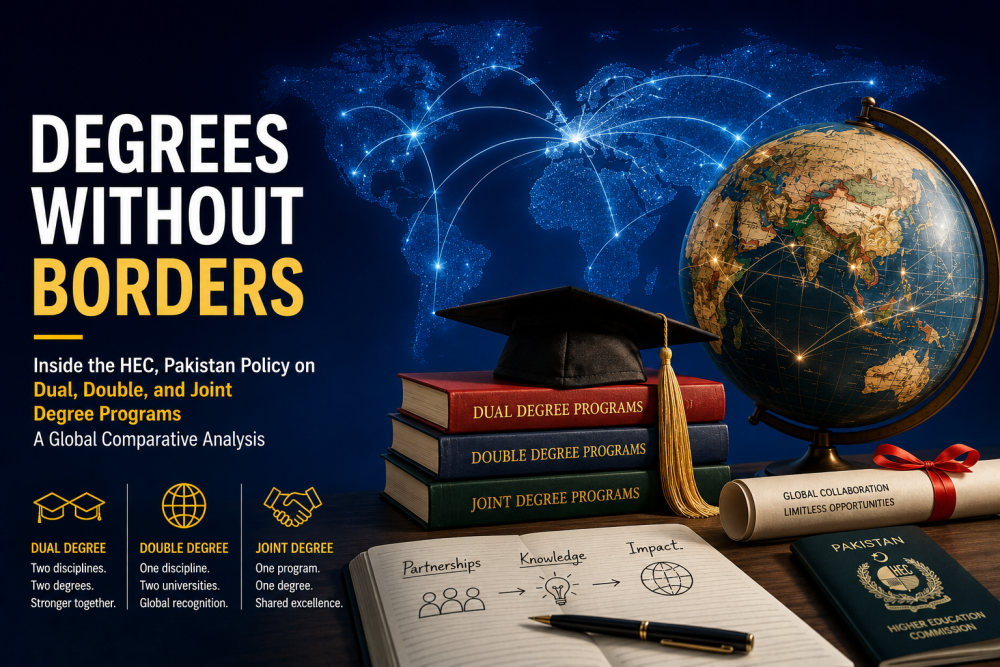
71/2026
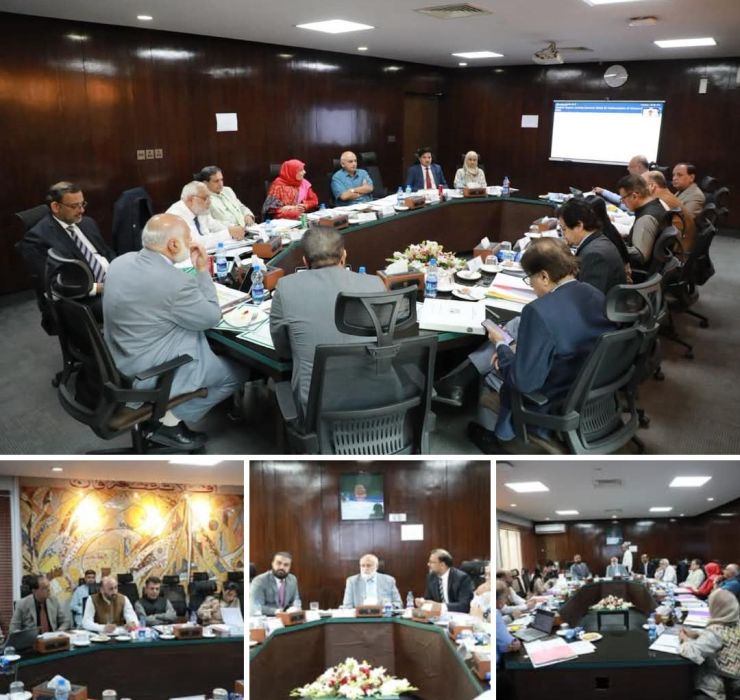
The Higher Education Commission, Pakistan’s recent approval of a policy framework for dual, double, and joint degree programs marks a transformative moment in the evolution of Pakistan’s higher education system. The initiative signals a strategic shift from a traditionally inward-looking academic structure toward a globally interconnected university ecosystem. Around the world, universities increasingly collaborate across borders to provide students with multidisciplinary exposure, international mobility, research integration, and globally recognized qualifications. By introducing a formal regulatory framework for collaborative degree pathways, Pakistan is seeking to align itself with international trends in higher education internationalization.
The policy has emerged in response to several global developments, including the rapid globalization of higher education, rising student mobility, expanding academic partnerships among universities, and the demand for graduates with interdisciplinary and international competencies. Similar collaborative degree structures have operated successfully for decades in Europe, North America, Australia, China, Singapore, and the Gulf region. Through this initiative, Pakistani universities are expected to build stronger academic linkages with reputable foreign institutions, improve curriculum quality, foster research collaboration, and enhance international visibility.
The framework approved by the HEC recognizes three major forms of academic collaboration:
- Dual-degree programs,
- Double-degree programs, and
- Joint-degree programs.
Dual Degree Programs
A dual degree program is an academic arrangement in which a student studies two related but distinct disciplines and receives two separate degrees upon completion. The two qualifications are typically awarded in complementary areas of study that together enhance the graduate’s interdisciplinary competence. For example, a student may complete a program combining business administration with data analytics, engineering with management sciences, or law with public policy. In such arrangements, the curricula are coordinated to reduce duplication and allow students to complete both qualifications in a shorter timeframe than if pursuing the degrees independently.
Globally, dual-degree programs have become increasingly common because modern economies require graduates with expertise across multiple disciplines rather than a narrow specialization. In the United States, universities have long employed dual-degree programs to prepare professionals for complex leadership roles. Harvard University offers several highly regarded dual-degree pathways, including combinations such as JD/MBA and MD/PhD programs, that integrate professional education with advanced research or management training. Similarly, the University of Pennsylvania has pioneered interdisciplinary education through integrated programs combining engineering, finance, healthcare management, and entrepreneurship. These programs emerged from the recognition that the challenges of the twenty-first century increasingly demand cross-sectoral expertise.
In Europe, the expansion of dual-degree programs accelerated after the Bologna Process, an initiative launched in 1999 to harmonize higher education systems across Europe. Institutions such as Sciences Po and the London School of Economics have developed dual-degree partnerships with universities across multiple countries. These programs allow students to study in two academic environments while gaining exposure to different educational systems, cultures, and policy perspectives. European universities particularly emphasized interdisciplinarity in areas such as international relations, economics, public administration, and global governance.
Asian universities have also aggressively embraced dual degree structures as part of their internationalization strategies. The National University of Singapore offers numerous dual degree combinations in engineering, law, medicine, business, and computing. Likewise, Tsinghua University has established interdisciplinary partnerships with institutions in the United States and Europe to strengthen innovation and research-oriented education.
The attractiveness of dual-degree programs lies largely in their ability to produce graduates with broader analytical capabilities and stronger employability prospects. Employers increasingly value graduates who can integrate technical expertise with management, policy, communication, or entrepreneurial skills. For universities, these programs improve curriculum relevance and facilitate collaboration across departments and institutions. However, dual degree arrangements are academically demanding and administratively complex. Universities must ensure careful curriculum mapping, effective credit transfer mechanisms, and alignment of academic standards to avoid overburdening students or compromising educational quality.
Double Degree Programs
Double-degree programs differ from dual-degree structures primarily because they involve the award of two degrees in the same discipline by collaborating institutions. Under this model, students complete a jointly designed curriculum that meets the academic requirements of both universities, resulting in two separate qualifications in a single field of study. The emphasis here is less on interdisciplinarity and more on international recognition and academic mobility.
This model has become especially popular in engineering, business administration, computer science, and international relations. Students typically spend part of their study period at each partner institution and complete integrated coursework approved by both universities. At the conclusion of the program, they receive two diplomas, one from each institution.
Europe has been one of the leading regions in promoting double degree education. The European Union actively encouraged such collaborations through the Erasmus and Erasmus Mundus initiatives, which were designed to facilitate student mobility and strengthen European academic integration. Universities such as the Technical University of Munich and Sorbonne University have developed highly respected double-degree arrangements in engineering and management sciences. These programs not only improved academic cooperation but also enhanced graduates' employability in the European labor market.
China has similarly invested heavily in double-degree partnerships as part of its strategy to internationalize higher education and strengthen its global competitiveness. Institutions such as Shanghai Jiao Tong University and Zhejiang University maintain collaborative degree pathways with universities in Australia, the United Kingdom, and the United States. Chinese policymakers view these partnerships as mechanisms for technology transfer, research collaboration, and global academic visibility.
Australia has also become a major hub for double-degree education. Universities, including the University of Melbourne and Monash University, offer numerous integrated programs that combine engineering, information technology, commerce, law, and the social sciences. Australian institutions often market double-degree programs as pathways to enhance employability while enabling students to acquire broader intellectual and professional skills in a relatively efficient timeframe.
For Pakistan, double-degree programs may significantly enhance international recognition of local qualifications. Pakistani graduates often face challenges related to degree equivalency and global employability. Through partnerships with internationally reputable institutions, universities in Pakistan could enhance academic credibility and improve graduate mobility. Nevertheless, successful implementation requires sophisticated regulatory oversight, especially regarding curriculum equivalence, accreditation compatibility, and quality assurance procedures.
Joint Degree Programs
Among the three models introduced by the HEC policy, joint degree programs represent the deepest and most integrated form of academic collaboration. In a joint degree arrangement, participating institutions collectively design and deliver a single program that culminates in a single, jointly awarded qualification. The degree certificate typically bears the names, seals, and signatures of all collaborating institutions.
Joint degrees require extensive institutional coordination because the participating universities share responsibility for curriculum design, admissions standards, assessment mechanisms, supervision, and quality assurance. Students often study at multiple campuses and may complete research projects under joint supervision by faculty from different universities.
Europe is widely regarded as the global leader in joint degree education, largely due to the Bologna Process and the European Higher Education Area framework. Universities such as the University of Bologna, KU Leuven, and the University of Barcelona have participated extensively in joint master’s and doctoral programs supported by Erasmus Mundus funding. These programs were designed to strengthen European academic integration and enhance the international attractiveness of European higher education.
The Nordic countries have also played a pioneering role in the development of joint degrees. Institutions, including the University of Helsinki and Lund University, have established cross-border programs that emphasize collaborative research, sustainability studies, innovation, and global governance. These programs reflect the Nordic tradition of academic cooperation and shared educational standards.
In the Gulf region, universities have increasingly adopted joint degree models to establish world-class educational environments. Institutions such as New York University Abu Dhabi and Hamad Bin Khalifa University collaborate closely with major Western universities to deliver internationally recognized programs. These partnerships are part of broader national strategies aimed at developing knowledge economies and reducing dependence on oil revenues.
Joint degree programs are academically prestigious because they symbolize genuine integration between institutions rather than simple franchising or branch-campus arrangements. However, they are also the most difficult to administer. Differences in grading systems, accreditation procedures, academic calendars, and legal regulations can create significant challenges. Consequently, successful joint programs require strong governance mechanisms and long-term institutional commitment.
Implications for Pakistan’s Higher Education System
The HEC policy carries major implications for the future of Pakistani higher education. First, it represents an important move toward the internationalization of universities. Historically, many Pakistani institutions have operated within relatively isolated academic ecosystems with limited global engagement. Collaborative degree programs can help integrate Pakistani universities into international knowledge networks and expose students and faculty to global academic standards.
Second, the initiative has the potential to modernize curricula and improve educational quality. International partnerships often encourage outcome-based education, interdisciplinary learning, research collaboration, and industry alignment. These developments are particularly important for emerging fields such as artificial intelligence, biotechnology, climate sciences, cybersecurity, renewable energy, and digital economies.
Third, the policy may strengthen Pakistan’s research ecosystem. Joint supervision, faculty exchanges, and collaborative research projects could increase publication output, improve citation impact, and enhance access to international research funding. Countries such as China and Singapore successfully used international academic partnerships to accelerate research productivity and institutional rankings.
Fourth, collaborative degree structures may improve graduate employability. Employers increasingly seek graduates who possess international exposure, cross-cultural competencies, and multidisciplinary skills. Students participating in dual, double, or joint degree programs are likely to develop stronger communication skills, adaptability, and professional networks.
Despite these opportunities, the policy also presents significant challenges. Quality assurance remains perhaps the most critical concern. International experience demonstrates that poorly regulated collaborative programs can deteriorate into commercial ventures with limited academic rigor. The HEC will therefore need robust monitoring systems to ensure that partnerships involve accredited institutions and maintain high academic standards.
.
Another major challenge concerns credit transfer and qualification equivalency. Many countries operating successful collaborative degree systems rely on sophisticated credit frameworks such as the European Credit Transfer and Accumulation System (ECTS). Pakistan currently lacks a fully mature national credit portability system, which could complicate program implementation.
Faculty preparedness also remains an important issue. Effective collaborative programs require faculty who are internationally engaged, research-active, and familiar with global pedagogical practices. Universities may therefore need significant investment in faculty development, digital infrastructure, and academic governance systems.
Finally, there is the risk of unequal institutional participation. Elite urban universities with established international linkages are more likely to benefit initially, while smaller regional institutions may struggle to attract reputable partners. Policymakers must therefore ensure that the internationalization process does not widen disparities within the higher education sector.
Conclusion
The approval of dual, double, and joint degree policies by the Higher Education Commission of Pakistan signals an important strategic transformation in Pakistan’s higher education landscape. The initiative aligns Pakistan with global trends that emphasize academic collaboration, international mobility, interdisciplinary education, and shared research ecosystems. Experiences from Europe, North America, Australia, China, Singapore, and the Gulf region demonstrate that collaborative degree programs can significantly improve educational quality, research productivity, institutional reputation, and graduate employability.
However, international evidence also suggests that the success of such programs depends heavily on governance, accreditation integrity, curriculum integration, and quality assurance. If implemented thoughtfully, the policy could substantially improve the global standing of Pakistani universities and help prepare graduates for participation in an increasingly interconnected world. If implemented carelessly, however, it risks creating superficial partnerships that prioritize commercial gains over academic excellence.
Ultimately, the long-term success of this initiative will depend not merely on policy approval but on the capacity of Pakistani universities and regulators to cultivate meaningful, high-quality, and strategically aligned international partnerships.