The Exam Is No Longer the Same: How Universities Must Rethink Assessment in the Age of AI
Posted 15 hours ago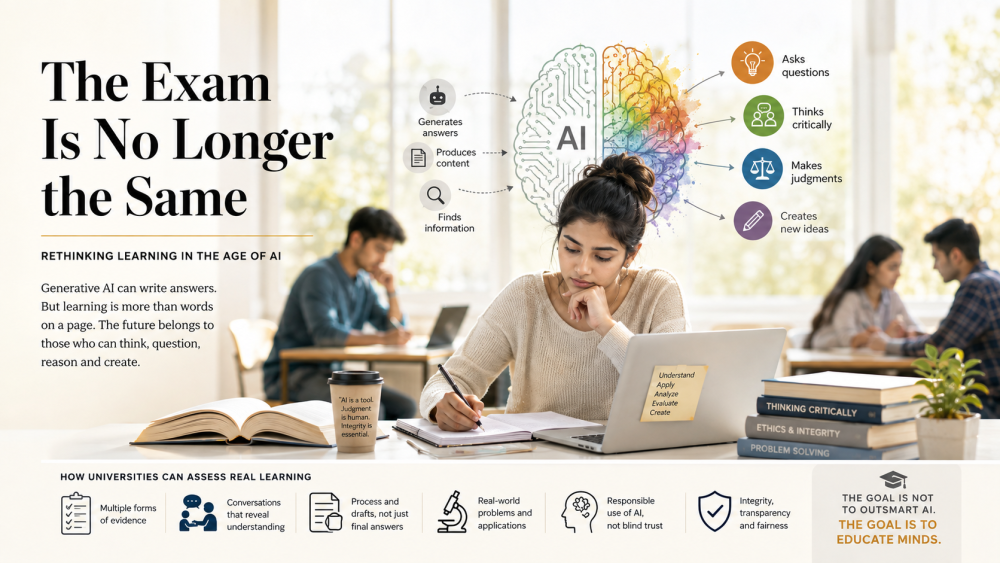
180/2026
Generative AI has not destroyed education. But it has exposed a dangerous weakness in the way universities measure learning.
Prof. Dr. Muhammad Mukhtar, Rector, University of Southern Punjab, Multan, Pakistan
For generations, universities have relied on a relatively simple bargain: students study, take an examination or submit an assignment, and their work provides evidence of what they have learned.
That bargain is now under extraordinary pressure.
Generative artificial intelligence can write essays, solve math problems, summarize books, generate computer programs, and produce remarkably convincing answers in seconds. Technology can be a powerful tutor and an extraordinary tool for discovery. But when a student submits AI-generated work as evidence of personal learning, something fundamental is lost.
The question universities now face is not simply “How do we stop students from using AI?”
It is a more consequential question:
“How do we design education so that learning remains visible even when AI is everywhere?”
A recent episode at Brown University, reported in the journal Nature, offers a warning.
When the numbers stopped making sense
An economics professor at Brown University allowed students in his advanced Welfare Economics and Social Choice Theory course to take the midterm exam at home. The decision was made under unusual and difficult circumstances.
The results were extraordinary.
The class average on the take-home midterm was about 96 percent, compared with historical averages of roughly 65 - 80 percent. Forty of the 86 students reportedly earned perfect scores. Serrano became suspicious when some answers exhibited reasoning that closely mirrored the unusual, convoluted approaches typical of an AI chatbot.
He then changed the final examination to an in-person assessment.
The difference was dramatic. The reported average fell to 48.6 percent. A substantial number of students dropped the course or did not take the final, while only a small number of students performed similarly on both exams.
But it exposes something universities cannot ignore:
A student's ability to produce an impressive answer and to understand the material are no longer necessarily the same thing.
AI is not the enemy
From a historical perspective, we must remember that calculators never destroyed mathematics. Search engines did not destroy knowledge. Spell-checkers did not eliminate writing. Likewise, AI can be a legitimate instrument of learning.
A student can ask an AI system to explain a difficult concept in simpler language, generate practice questions, compare competing theories, or identify weaknesses in an argument. A researcher can use AI to explore a large body of information. A programmer can use it as a coding assistant.
The problem begins when the tool replaces the intellectual work that education was supposed to develop.
A university graduate should not merely be able to produce an answer. The graduate should be able to explain why the answer is correct, recognize when it is wrong, defend a decision, solve an unfamiliar problem, and apply knowledge to a new situation.
Those abilities cannot safely be outsourced.
The end of the “one-shot” examination
For universities, the most important lesson is that assessment must evolve.
The traditional model of studying for weeks, taking a three-hour examination, and receiving a grade was never a perfect measure of learning. Generative AI has made its weaknesses much more visible. Universities should increasingly use multiple forms of evidence to substantiate student competence
- A student might submit a written assignment but then explain it briefly to the teacher.
- A student might develop a research project but also submit drafts showing how the argument evolved.
- A programming student might present the code and then modify it in response to a new problem.
- A biology student might analyze a dataset and defend the interpretation orally.
- A business student might be given a new case and asked to decide under pressure.
In each situation, the objective is the same:
Measure the student's thinking, not merely the final product.
There is a growing temptation to seek the perfect AI-proof examination. Such an examination may not exist. Instead, universities should design AI-aware assessments.
If AI is permitted, students should be required to disclose how they used it. They might be asked to critique an AI-generated answer, identify its errors, improve its reasoning, and explain why their final answer is superior.
Universities need a new assessment ecosystem.
The response to AI should not rest entirely on individual teachers.
Universities need institutional policies that answer basic questions clearly:
- When is AI permitted?
- When is it prohibited?
- What constitutes unauthorized assistance?
- How should students disclose AI use?
- What evidence is required when misconduct is suspected?
- How will students be allowed to respond?
- How will legitimate AI-assisted learning be distinguished from academic dishonesty?
These rules should be understandable to students and faculty alike.
Just as importantly, universities should avoid making AI-detection software the judge and jury.
AI detectors can produce false positives and false negatives. A statistical prediction that a piece of writing “looks AI-generated” is not the same as proof of misconduct.
Academic integrity requires evidence, due process, and human judgment.
Bring back the human conversation.
There is another surprisingly old-fashioned solution:
Talk to the student.
A five-minute conversation can sometimes reveal more about learning than a five-page essay.
Ask a student:
“Why did you choose this method?”
“What would happen if this assumption changed?”
“Explain this concept without looking at your notes.”
“What is the weakest part of your argument?”
“If I gave you a different example, could you apply the same principle?”
These questions are difficult for a student who has merely copied an answer, as they require understanding rather than mere reproduction.
They also have an important educational benefit: they transform assessment into another opportunity to learn.
The classroom itself must change.
The AI revolution should also prompt universities to reconsider how teaching is conducted. If students can obtain a conventional explanation from an AI system instantly, the teacher's value cannot be limited to delivering information. Teachers must increasingly become designers of learning experiences. They should create situations in which students debate, experiment, investigate, collaborate, question evidence, and solve unfamiliar problems.
The university of the future should therefore be less concerned with asking:
“What information did the student memorize?”
and more concerned with asking:
“What can the student do with knowledge?”
That distinction lies at the heart of modern education.
Assessment should follow the hierarchy of learning
Bloom's taxonomy provides a useful way to think about this transition.
Remembering information is important, but it represents only the beginning.
Students should progressively learn to:
Remember → Understand → Apply → Analyze → Evaluate → Create.
AI can perform parts of several of these tasks remarkably well.
That makes the higher levels even more important.
A university graduate should be able to examine competing claims, evaluate evidence, identify flawed reasoning, make informed judgments, and create something new. The purpose of education cannot be reduced to producing text that looks intelligent. It must produce people who can think intelligently.
A practical model for universities
Universities could adopt a simple five-part assessment model.
1. Knowledge checks
Use supervised quizzes, tests, and examinations to determine whether students possess essential knowledge.
2. Application
Give students unfamiliar problems that require them to apply what they have learned.
3. Process
Evaluate drafts, laboratory notebooks, research logs, design iterations, code development, and other evidence showing how students reached their conclusions.
4. Conversation
Introduce short oral examinations, presentations, demonstrations, and question-and-answer sessions where appropriate.
5. Creation
Ask students to develop projects, research proposals, designs, experiments, or solutions to real-world problems.
These approaches provide a much richer picture of learning than a single take-home examination.
The real danger is not cheating.
Academic dishonesty is serious. But there is an even greater danger. Suppose a student spends four years at university allowing AI to write assignments, solve problems, and prepare answers. The student may graduate with an impressive transcript.
- But what happens when the AI is unavailable?
- What happens when the graduate must decide in a hospital, design a bridge, teach a classroom, manage an organization, conduct scientific research, or advise a government?
A degree is ultimately a promise in the eyes of job places. It signals to society that the person holding it has acquired a certain level of knowledge, judgment, and competence. If universities cannot reliably measure those abilities, the credibility of the degree itself begins to weaken.
Universities should choose learning over surveillance.
There is a danger that the AI era could trigger an educational gadget race: students use increasingly sophisticated AI tools, universities deploy increasingly sophisticated detection systems, and both sides continually try to outsmart each other. That is not the future education should pursue. A better response is an architectural rather than a technological change to the assessment system.
- Make learning visible.
- Require students to demonstrate understanding in different ways.
- Teach responsible AI use.
- Reward originality, reasoning and judgment.
- And preserve meaningful human interaction between teacher and student.
AI may ultimately improve education.
There is an encouraging possibility hidden inside this crisis. For decades, universities have known that grades do not perfectly capture learning. They know that students can memorize without understanding and write without thinking. Generative AI has made those limitations impossible to ignore.
What exactly does it mean to be educated?
If the answer is merely “to know information,” machines are rapidly becoming formidable competitors. If the answer is “to understand, question, reason, judge, create and act responsibly,” then AI may become something much more useful: a powerful tool that amplifies human learning rather than replacing it.
The future of education will not belong to institutions that successfully prevent students from touching AI. It will belong to institutions that teach students how to remain intellectually capable when AI is always within reach.