Skills as Sovereignty: How Japan Uses Education to Sustain Industrial Leadership
Posted 7 months ago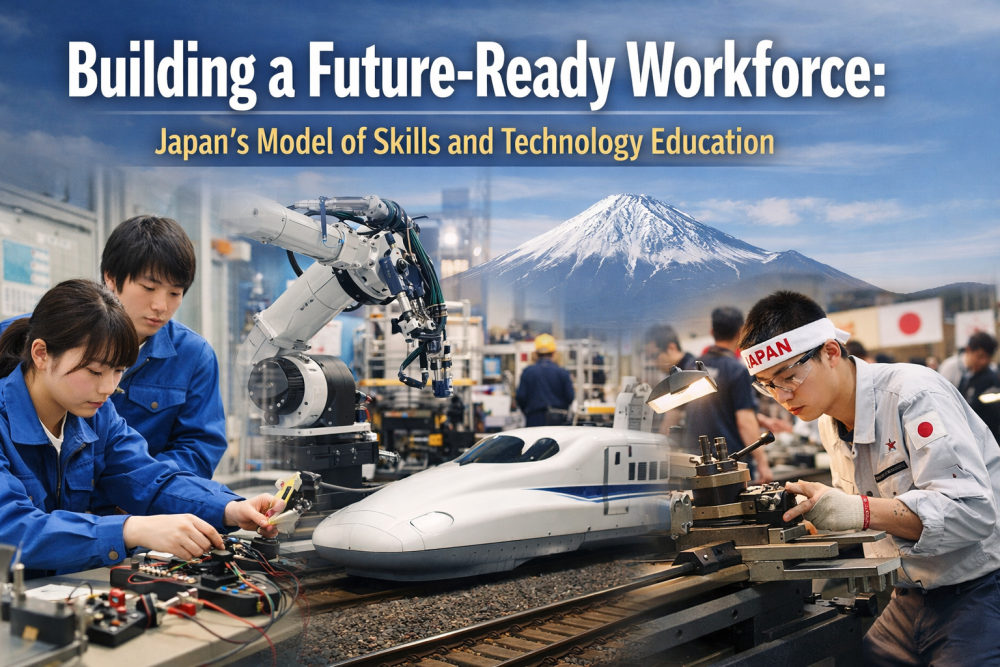
24/2026
Japan advances skills and technology education through a coordinated system that links national policy, educational institutions, industry involvement, and lifelong workforce development, playing a key role in maintaining industrial leadership and economic growth.
At the policy level, the Ministry of Education, Culture, Sports, Science and Technology (MEXT) emphasizes STEM and engineering basics through the KOSEN model, which provides students immediate entry into technology-focused education after lower secondary school, effectively producing industry-ready technicians and engineers.
Complementing MEXT, the Ministry of Economy, Trade, and Industry (METI) ensures that skills education stays aligned with national industrial priorities. METI actively promotes human resource development in manufacturing, robotics, digital technologies, and advanced materials under the philosophy of Monodzukuri the culture of craftsmanship and continuous improvement. By involving industry partners in training programs and skills standards, METI makes industry professionals feel valued and essential to Japan’s global competitiveness.
Workforce training and skills development tied to employment primarily fall under the Ministry of Health, Labour and Welfare (MHLW). This ministry runs extensive public vocational training programs for youth, unemployed adults, and mid-career workers, ensuring skills development continues throughout a person's working life. A main delivery tool is Hello Work, Japan’s nationwide public employment service, which connects job seekers with training opportunities, apprenticeships, and employers, thereby closely linking skills development with labor-market needs.
A key institutional pillar of Japan’s system is the National Institute of Technology (KOSEN) network. These colleges provide a five-year, hands-on engineering education that combines classroom instruction with laboratory work and industry partnerships. Employers highly value KOSEN graduates for their practical skills, problem-solving abilities, and immediate readiness to work in industrial settings. In addition to KOSEN, thousands of private specialized vocational schools (senmon gakkō) offer occupational training in areas ranging from information technology and electronics to healthcare and design, further expanding Japan’s skills pipeline.
Skill standards and assessment are supported by semi-government and non-government organizations, especially the Japan Vocational Ability Development Association (JAVADA). JAVADA conducts national skills tests and professional certifications, and Japan participates in skills competitions, including both national and international events. These competitions and certifications help uphold high occupational standards, inspire young people and educators, and demonstrate competence to employers with confidence.
Japan also emphasizes international skills transfer and cooperation. The Japan International Cooperation Agency (JICA) conducts extensive training and “knowledge co-creation” programs that invite international participants to Japan for technical and managerial training. It also exports Japanese vocational and industrial training models abroad, fostering a sense of global leadership and pride among readers about Japan's influence in shaping international skills standards.
Another internationally recognized mechanism is the Technical Intern Training framework, overseen by the Organization for Technical Intern Training (OTIT) and supported by coordinating organizations such as the Japan International Training Cooperation Organization (JITCO). While mainly designed for skills transfer through on-the-job training, this system also shows Japan’s belief that genuine skills are best gained in real workplace settings under experienced mentors.
Taken together, Japan’s approach to skills and technology education is comprehensive and systematic. Strong ministerial coordination ensures policy consistency; institutions like KOSEN offer in-depth technical skills; industry participation ensures relevance; and certification agencies and competitions maintain quality. The result is a skills ecosystem where education, employment, and innovation support each other one of the main reasons Japan continues to maintain a highly skilled, technologically advanced workforce.
(Title Image developed through ChatGPT5.2)