Sixth Seerat Un Nabiﷺ Conference at Women University Multan Highlights Prophetic Guidance for Youth in the Digital Age
Posted 13 hours ago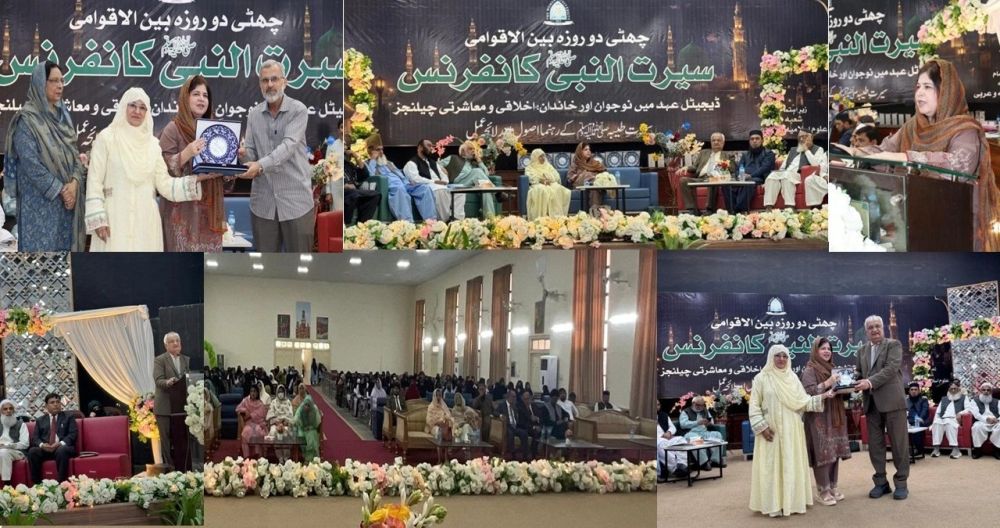
252/2026
The Sixth Seerat Un Nabiﷺ Conference at Women University Multan featured an insightful keynote address by Professor Emeritus Dr. Muhammad Mukhtar, Rector of the University of Southern Punjab (USP), Multan, Pakistan, on the ethical and social challenges facing young people and families in the digital age. He extended heartfelt congratulations to Professor Dr. Syeda Shahid Batool, Vice Chancellor of Women University Multan, and Professor Dr. Kulsoom Paracha, former Vice Chancellor. He appreciated their contributions to academic leadership and the promotion of scholarly activities. He also commended the university for organizing the conference to highlight the enduring relevance of the Prophetic Seerah in contemporary life.
Speaking on “Youth and Family in the Digital Age: Ethical and Social Challenges, Guiding Principles from the Prophetic Hazrat Muhammadﷺ Seerah, and a Practical Framework,” Professor Mukhtar emphasized that technological advancement must go hand in hand with moral development, responsible citizenship, and the preservation of family relationships.
He observed that while social media, artificial intelligence, and digital platforms offer unprecedented opportunities for education, scientific research, skill development, and communication, their irresponsible use can contribute to misinformation, cyberbullying, privacy violations, weakened family bonds, and declining ethical awareness.
Drawing on the Qur’an and Sunnah, Professor Mukhtar presented the Prophetic Seerah as a timeless moral compass for navigating contemporary challenges. He emphasized truthfulness, compassion, justice, accountability, respect for human dignity, and responsible communication. Citing Qur’anic guidance on verifying information, he urged young people to critically assess digital content before sharing it and to refrain from spreading unverified claims or material that could harm others.
Addressing the growing influence of artificial intelligence, he stressed that AI should serve as a tool for learning, creativity, and innovation rather than replace independent thinking, intellectual honesty, or human judgment. He urged educational institutions to integrate digital literacy, academic integrity, online safety, and ethical technology use into their practices.
Professor Mukhtar emphasized the shared responsibility of parents, teachers, universities, religious leaders, technology companies, and policymakers to nurture a generation that combines technological competence with strong moral character. He advocated a family-centered approach grounded in open communication, mutual respect, responsible digital habits, and compassionate guidance for young people.
As a practical contribution, he proposed a “PROPHETIC Digital Ethics Framework” that emphasizes privacy and dignity, information verification, kindness, family relationships, the beneficial use of technology, accountability, self-discipline, digital literacy, and care for vulnerable individuals. He also recommended a structured initiative to promote digital awareness, cultivate responsible online habits, and strengthen institutional safeguards against cyberbullying and online exploitation.
Concluding his address, Professor Mukhtar called for an educational vision that prepares young people not only to operate the technologies of the future but also to use them wisely, ethically, and for the benefit of humanity. He reaffirmed universities' vital role in advancing knowledge, character development, responsible innovation, and a more compassionate society.