Moon Missions and Space Radiation: The Hidden Health Risks for Astronauts
Posted 8 months ago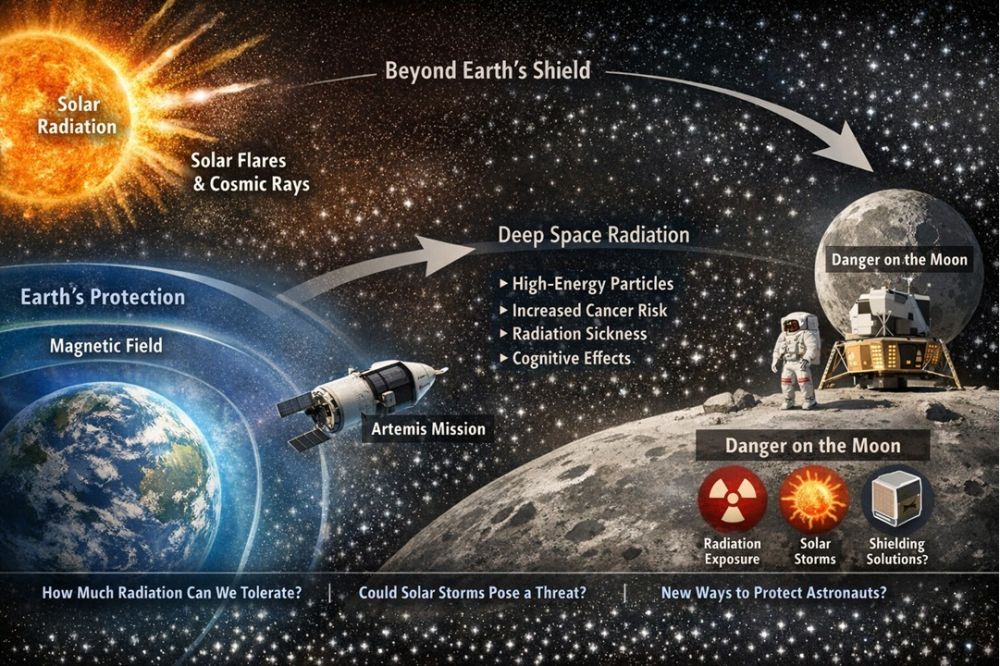
19/2026
When astronauts leave Earth to circle the Moon or someday walk on its surface, they will leave behind more than gravity they’ll leave Earth’s protective bubble. Additionally, an invisible danger exists in radiation from deep space.
On Earth, our atmosphere and magnetic field shield us. These forces block most high-energy particles coming from the Sun and beyond our solar system. But once a spacecraft goes beyond that shield, astronauts face radiation levels much higher than those on Earth.
This isn’t the same kind of radiation you might think of from an X-ray machine; it’s much more intense. Tiny particles traveling close to the speed of light can harm cells and DNA, increasing long-term health risks such as cancer, neurological issues, and heart problems, which are concerns many readers might have about astronaut safety.
The planned Artemis missions, NASA’s effort to send humans back to the Moon, will test how well people can cope with this harsh environment. Early data suggest that a round-trip mission might expose astronauts to roughly the same radiation dose as a full-body CT scan on Earth. However, unlike a quick medical scan, space radiation exposure would be continuous over days or weeks, and its long-term biological effects are still being studied, which helps readers grasp the ongoing uncertainty.
NASA’s Artemis II mission marks the first time astronauts will travel back toward the Moon since the Apollo era. Four astronauts will fly aboard the Orion spacecraft, orbit the Moon, and return to Earth without landing. It serves as a full rehearsal to test spacecraft systems, life support, navigation, and communication with humans onboard, well beyond Earth’s protective atmosphere and magnetic field.
Led by NASA, Artemis II is a vital step toward returning astronauts to the Moon and ultimately sending humans to Mars. By exposing astronauts to deep-space conditions, including higher radiation levels, the mission will help scientists understand the risks of long-duration space travel and ensure future lunar landings are safe.
Scientists are actively exploring how dangerous this radiation truly is, which can reassure the audience that progress is being made in understanding and managing risks.
Despite those efforts, many questions remain unanswered.
• How much radiation can the human body safely withstand during a long mission?
• Could a solar storm suddenly expose astronauts to dangerous levels?
• Are there materials or spacecraft designs that could improve protection for crews from harm?
These uncertainties have led engineers to rethink spacecraft design, investigate new shielding technologies, and examine how the lunar landscape might naturally protect against radiation, showing ongoing innovation and teamwork.
For now, scientists say, space radiation is one of the biggest challenges to human life beyond Earth. It’s invisible, hard to shield against, and potentially harmful in ways we’re still trying to understand fully. But with careful study and smart engineering, they hope the next generation of explorers will reach the Moon safely and return.
Additional Reading