IdeaLens: A New Way to Tell Whether Scientific Ideas Come from Humans or AI
Posted 1 day ago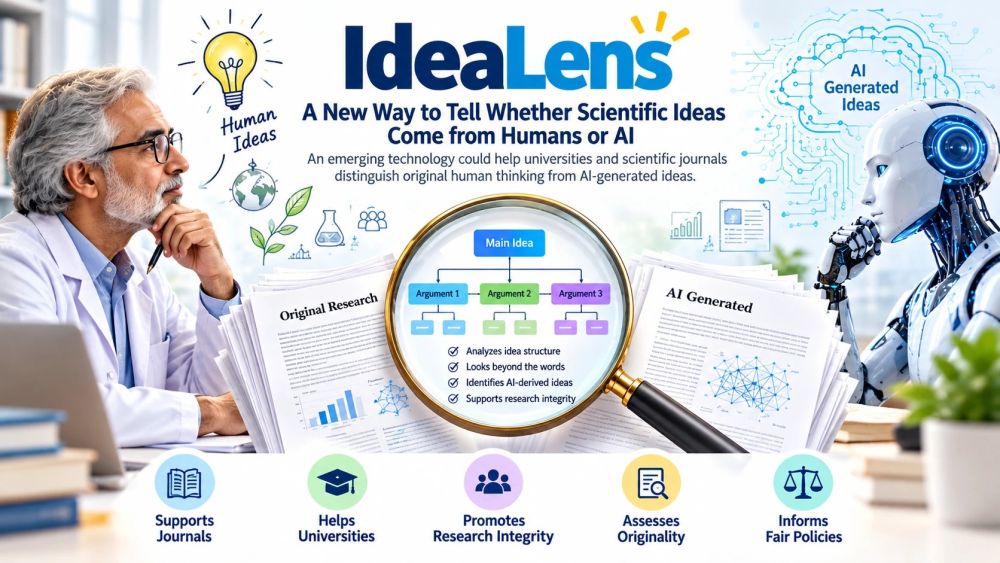
242/2026
An emerging technology could help universities and scientific journals distinguish original human thinking from AI-generated ideas.
Artificial intelligence (AI) is transforming scientific research, helping researchers analyze complex data, write papers, and explore new questions. As AI-generated scientific content becomes more common, a key question emerges: Who developed the idea behind a research paper, the human researcher or an AI system?
A new tool called IdeaLens aims to help answer that question. Reported by Nature Journal on October 13, 2026, the technology marks a shift in AI detection: instead of focusing on the words people write, it examines the underlying structure of their ideas and arguments.
Looking Beyond the Words
Traditional AI detectors look for writing patterns associated with machine-generated text. IdeaLens takes a different approach. It converts a document, such as a scientific paper, into an outline that captures its main arguments and their relationships. By stripping away much of the original writing style, the system attempts to determine whether the ideas themselves resemble those produced by AI.
In a controlled evaluation reported in a research preprint, IdeaLens identified AI-derived ideas in approximately 92% of cases. The researchers also found that its results could distinguish between work developed from human-created plans and work based on AI-generated plans. These findings are promising, although they do not establish that the tool will perform equally well in every discipline or real-world setting.
Potential Benefits for Science and Education
IdeaLens could prove useful to scientific journals and conference organizers facing growing submission volumes. It may help editors assess whether a paper's central contribution reflects independent intellectual work, particularly when authors use AI to improve language, organize material, or refine presentation.
Universities could also explore its use in research-integrity training, doctoral education, and the assessment of student projects. Funding agencies might eventually investigate whether similar tools can support the evaluation of originality in research proposals.
Importantly, the technology could promote a more balanced approach to AI in academia. Using AI to improve grammar or clarify scientific communication is not the same as relying on it to generate the central research idea. Distinguishing these activities could help institutions develop clearer, fairer policies for responsible AI use.
A Promising Tool, Not a Final Judge
Despite its potential, IdeaLens has important limitations. Human researchers can independently arrive at similar ideas, while human investigators can substantially develop AI-generated suggestions. Detection errors could therefore unfairly raise questions about a researcher's integrity.
The real value of IdeaLens may lie in supporting human judgment rather than replacing it. Researchers should consider its findings alongside research records, authors' explanations, transparent AI-use declarations, and established academic review procedures.
Professor Emeritus Dr. Muhammad Mukhtar, Rector of the University of Southern Punjab, Multan, Pakistan, has appreciated IdeaLens as a promising innovation at the intersection of artificial intelligence, scientific research, and academic integrity. He emphasized that as AI reshapes higher education and scientific discovery, technologies that can examine the origins and structure of ideas could help promote originality, transparency, and responsible research practices. He noted that IdeaLens could help universities, researchers, and scientific journals distinguish independent intellectual contributions from AI-generated ideas while encouraging the ethical use of AI as a research partner. He observed that such innovations could strengthen public trust in scientific knowledge and help build a more transparent, accountable, and intellectually rigorous academic environment.
As AI becomes an increasingly powerful research partner, science must protect the originality of human thought without discouraging legitimate technological assistance. IdeaLens offers a promising step toward that goal, but responsible implementation and independent validation will determine how useful it proves to be.