From SEO to GEO: How Artificial Intelligence Is Reshaping the Future of Search and the Internet
Posted 1 month ago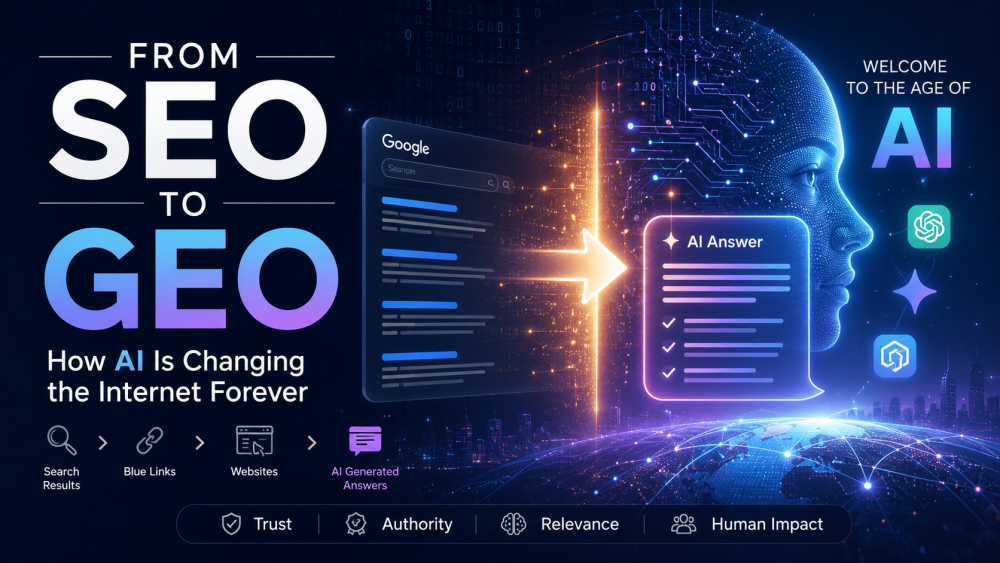
98/2026
The New Battle for Online Visibility in the Age of AI
For more than two decades, the internet revolved around a simple principle: to be discovered online, you had to rank high on Google. Businesses spent billions of dollars optimizing websites, selecting keywords, building backlinks, and competing for the coveted first page of search results. This practice became known as Search Engine Optimization (SEO).
Today, however, a profound transformation is underway.
Millions of people are increasingly asking AI systems such as ChatGPT, Gemini, Claude, Perplexity, and Microsoft's Copilot questions directly. Rather than presenting a list of websites, these platforms generate complete answers in seconds, often summarizing information from multiple sources. This shift is giving rise to a new discipline called Generative Engine Optimization (GEO), which may fundamentally reshape the future of the internet.
The End of the Blue-Link Era
Traditional search engines function like librarians. They locate relevant pages and present users with a ranked list of links. Users then choose which source to visit.
Generative AI works differently.
Instead of directing users to websites, AI systems analyze vast amounts of information and produce a synthesized answer. The user may never click on a website.
In 2023, researchers at Princeton University and other institutions formally introduced the concept of Generative Engine Optimization, describing it as a framework to improve content visibility in AI-generated responses. Their studies showed that GEO strategies could increase content visibility by up to 40 percent in generative search environments.
This seemingly minor change represents one of the most significant disruptions in the history of digital communication.
What Is GEO?
Generative Engine Optimization is the process of creating and structuring content so that AI systems can easily discover, understand, trust, and cite it when generating answers. Unlike SEO, which focuses on ranking webpages, GEO focuses on becoming part of the answer itself.
In the SEO era, success meant appearing at the top of Google search results.
In the GEO era, success meant becoming the source that AI chooses to reference.
The difference may seem subtle, but its implications are enormous.
Why This Matters
Imagine a student asking:
"What are the best skills to learn for future jobs?"
Ten years ago, Google might have returned millions of search results.
Today, ChatGPT or Gemini can generate a detailed answer instantly, often citing only a handful of trusted sources.
If your university, organization, or publication is not among the sources, you may effectively become invisible to a growing segment of internet users.
Industry analysts now argue that visibility in AI-generated answers may become as important as Google rankings were in the previous decade.
The New Rules of Digital Influence
The rise of GEO is reshaping how content is created.
AI systems tend to favor information that is:
- Accurate and evidence-based
- Clearly structured
- Supported by credible references
- Written in a straightforward manner
- Consistent across multiple trusted sources
In other words, AI rewards expertise more than keyword stuffing.
Google recently emphasized that success in AI-powered search experiences still depends on creating useful, trustworthy, people-first content. The company advises publishers to focus on quality, expertise, and clear information architecture rather than trying to manipulate AI systems.
Why Universities Have an Advantage
Universities may become some of the biggest winners in the GEO revolution.
Academic institutions possess exactly the type of information AI systems seek:
- Research-backed knowledge
- Expert authors
- Original data
- Educational resources
- High credibility
As AI increasingly prioritizes authoritative content, universities that publish accessible, well-structured information may achieve unprecedented global visibility.
For institutions focused on skills development, innovation, and research, GEO offers an opportunity to reach audiences beyond traditional search traffic.
The Future of Journalism
The GEO revolution is equally important to media organizations.
For decades, news outlets relied on clicks from search engines. Now, AI systems can summarize news stories before readers even visit a website.
This presents both a challenge and an opportunity.
Media organizations that consistently produce original, trustworthy reporting are more likely to be cited by AI systems. Those that rely on recycled content may struggle to stay visible. Experts warn that publishers must adapt to a future in which being cited by AI is as valuable as attracting website visitors.
A New Digital Divide
The GEO era also raises important concerns.
Researchers warn that AI systems often favor information from well-established institutions and highly connected sources. This could make it harder for smaller organizations, local voices, and developing countries to gain visibility.
There is also concern that AI systems may amplify existing biases by repeatedly citing the same sources, thereby reducing the diversity of perspectives online.
The challenge for society will be to ensure that the AI-driven internet remains open, inclusive, and representative of diverse knowledge systems.
What GEO Means for Pakistan
Pakistan stands at a unique crossroads.
The country has a young population, expanding digital infrastructure, and a growing ecosystem of universities, startups, researchers, and skills-development institutions.
If Pakistani organizations learn to produce AI-friendly content today, they can position themselves as trusted sources for the next generation of global information systems.
This is especially important for technical and vocational education, where high-quality content on skills, entrepreneurship, innovation, and workforce development can reach an international audience through AI-powered search.
The Internet's Next Chapter
The transition from SEO to GEO is not merely a marketing trend.
It marks a fundamental shift in how knowledge is discovered, consumed, and shared.
For the first time in internet history, the primary gateway to information may no longer be a search engine that displays links. Instead, it may be an AI assistant that generates answers.
The organizations that thrive in this new environment will not necessarily be those with the largest advertising budgets. They will be those who produce trustworthy, authoritative, and genuinely useful knowledge.
The future belongs not simply to those who can be found online.
It belongs to those whom artificial intelligence chooses to remember.