Career guidance in TVET for lifelong learners
Posted 1 day ago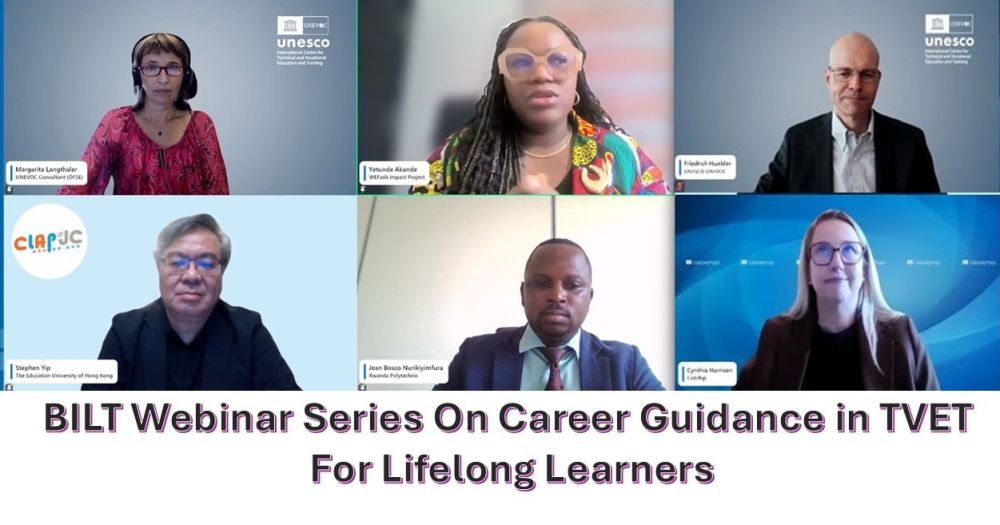
234/2026
Global TVET experts call for career guidance to move beyond job matching and become a continuous system of learning, employability and personal development.
Experts said during a UNESCO-UNEVOC BILT webinar on “Career Guidance for Resilient, Inclusive and Sustainable Career Pathways” that career guidance must evolve from a service offered at a few educational or employment crossroads into a lifelong support system that enables people to navigate rapidly changing labor markets.
The webinar, part of the 2026 Bridging Innovation and Learning in TVET (BILT) series, brought together policymakers, researchers, practitioners, social partners, and representatives of technical and vocational education and training institutions worldwide.
Opening the session, Friedrich Huebler, Head of UNESCO-UNEVOC, said that technological innovation, climate change, demographic shifts, migration, and new forms of work were fundamentally changing the skills people need and the pathways they follow throughout their working lives.
Against this backdrop, he said, career guidance could no longer be viewed simply as a service for young people entering their first jobs. It was increasingly an essential component of lifelong learning, helping individuals understand learning opportunities, strengthen their employability, and avoid exclusion.
The webinar examined how career guidance can contribute to more inclusive, resilient, sustainable, learner-centered, and responsive TVET systems that meet changing labor-market demands.
From job matching to career management
Pedro Moreno da Fonseca, a lifelong learning specialist at the International Labor Organization, argued that career guidance is often misunderstood as merely matching an individual's abilities to an available occupation. He suggested that this approach is increasingly inadequate in fluid labor markets, where occupations, technologies, and individual circumstances constantly change.
Instead, effective guidance should help people develop the capabilities to make informed, strategic decisions and navigate evolving career environments. It should enable individuals not only to adapt to change but also to understand emerging opportunities and exercise greater agency over their careers.
Career guidance should therefore include information, counseling, skills development, workplace exposure, and opportunities to reassess one's direction as circumstances evolve. Experts also stressed the importance of beginning career guidance early. Schools and TVET institutions should expose learners to real workplaces, employers, entrepreneurs and professionals rather than restricting career decisions to conventional academic or occupational pathways.
A lifelong and “life-wide” approach
Cynthia Harrison (Villalba), a policy officer at the European Center for the Development of Vocational Training working on lifelong guidance, emphasized that career development should be understood from both lifelong and life-wide perspectives.
People move among education, employment, unemployment, further training, family responsibilities, and other life circumstances. Career guidance systems therefore need to support individuals across these settings rather than appearing only at moments of transition. She stressed that career-management skills must be continually developed and updated as societies, workplaces, and technologies change.
Inclusion means removing barriers.
The webinar presented practical examples showing how inclusive career guidance can yield measurable employment outcomes.
Yetunde Akande, founder of the Lagos-based sustainable fashion enterprise and convener of the WeFash Impact Project, described an initiative connecting young Nigerians ages 18–35 with trainers, mentors, employers, entrepreneurs, and industry partners.
The project operates through three pathways, match, create, and improve, designed to translate skills into employment, entrepreneurship, and sustainable livelihoods.
Over three years, the initiative reported creating 1,492 decent jobs across 29 Nigerian states. Of these, 166 participants created their own jobs, 475 were matched to employment, and 707 existing jobs were improved. About 90 percent of participants were women.
Akande emphasized that inclusion requires more than simply opening programs to everyone. It also requires removing practical barriers that prevent disadvantaged groups from participating. The project therefore brought training directly to underserved communities, established local training centers, introduced stipends where necessary, developed online learning options, and created an online portal where participants could revisit missed lessons.
The initiative also integrates employers into the training ecosystem and uses disaggregated data to assess outcomes across factors such as gender, disability, and income.
Career guidance embedded in Hong Kong schools
Dr. Stephen Yip of the Education University of Hong Kong presented an alternative model. His work focuses on the Hong Kong Benchmarks for Career and Life Development, a framework that helps schools establish systematic career guidance through 10 standards.
The framework emphasizes leadership, multiple pathways, inclusiveness, student agency, personal guidance, and meaningful engagement with the world of work. Career guidance is also integrated into subject curricula rather than treated as an isolated activity.
A total of 195 schools have adopted the approach, with reported improvements in students' career readiness.
Yip identified several key factors behind successful implementation, including senior management support, strong career teams, effective personal interview systems, data support, enhanced student agency, broader exposure to higher education and workplaces, and meaningful engagement with parents.
Rwanda links soft skills with employment.
Jean Bosco Nurikiyimfura presented the Soft Skills and Career Development program at Rwanda Polytechnic, which integrates career guidance with communication, teamwork, adaptability, time management, problem-solving, and other employability skills. The program features career fairs, industry speakers, company visits, mentorship, and employer engagement.
Since its introduction, 284 trainers have been trained, 4,340 graduates have completed the program, and 5,999 first-year students have received foundational training.
A 2024 survey found that 84.24 percent of participating graduates secured employment within 12 months of graduation. The program has also developed industry partnerships, including formal employer agreements. Employer feedback has highlighted graduates' communication, critical thinking, time management, honesty, integrity, proactivity, and ability to respond to feedback. The program is now being further institutionalized and expanded through additional trainer development and digital learning resources.
Prof. Emeritus Dr. Muhammad Mukhtar, Rector of the University of Southern Punjab, Multan, Pakistan, appreciated the discussion and highlighted an often-overlooked dimension of lifelong career guidance: opportunities for healthy older adults after retirement. He noted that many people retire while remaining physically and intellectually capable of productive work, bringing decades of valuable knowledge and experience. He called for greater opportunities for such individuals through part-time employment, consulting, mentoring, teaching, and other flexible forms of engagement, enabling them to continue contributing to society while promoting healthy and purposeful aging.
Preparing people for a changing future
A recurring theme throughout the webinar was that the future of career guidance will be inseparable from digital transformation, artificial intelligence, and the green transition.
Participants raised important questions about whether AI could make career guidance more accessible or deepen the digital divide. They also questioned how much people should trust AI-generated career advice and how to ensure ethical, equitable, and culturally appropriate AI-based guidance.
The discussions pointed to a broader conclusion: career guidance is no longer simply about choosing a job; it is about developing the capacity to understand oneself, interpret changing opportunities, acquire new skills, and navigate an uncertain working life.
As labor markets continue to evolve, the strongest TVET systems will be those that connect learning to real-world experience, employers to education, and individual aspirations to evolving economic and social opportunities.
The BILT webinar series will continue to examine career guidance in relation to migration, mobility, and skills recognition, followed by a session exploring the opportunities and disruptions created by artificial intelligence and digital transformation.