Can Micro-Credentials Deliver Real Employability?
Posted 2 months ago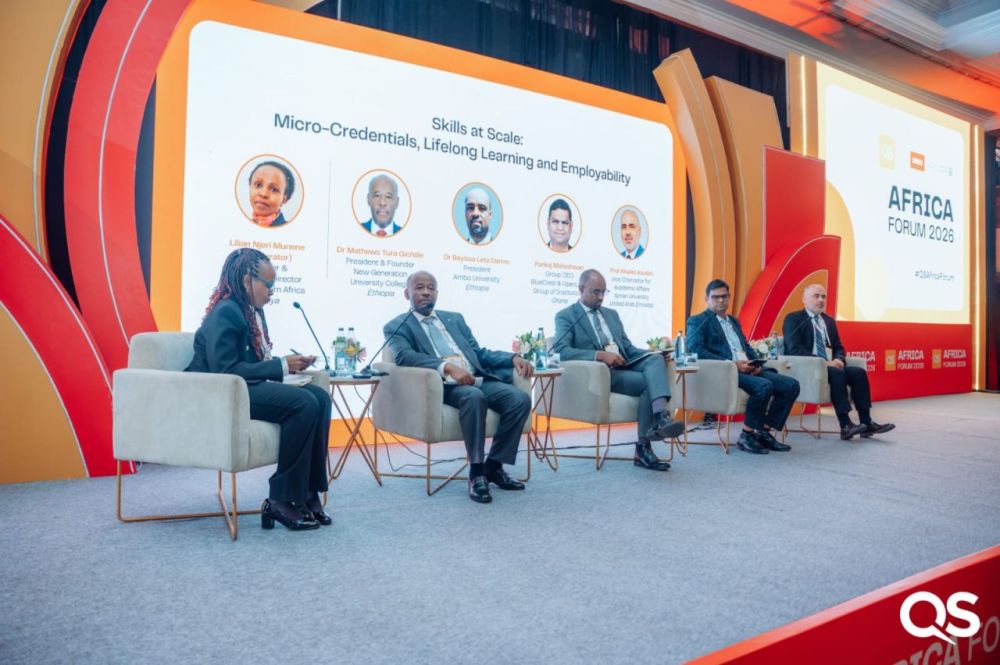
124/2026
At the QS Quacquarelli Symonds Africa Forum, educators and policy leaders from across Africa and beyond gathered to debate one of the most consequential questions facing universities today: how can institutions prepare graduates for an economy in which skills evolve faster than traditional degree programs?
Representing Ajman University, a senior academic joined the high-profile panel discussion, "Skills at Scale: Micro-Credentials, Lifelong Learning and Employability," highlighting the global shift away from degree-centric education toward more agile, skills-based learning pathways.
Moderated by Lilian Njeri Munene, Founder and Executive Director of Ayenit Alolom Africa, the discussion convened an influential group of university and industry leaders, including Dr. Bayissa Leta, President of Ambo University; Dr. Mathews Tura Gichille, President and Founder of New Generation University College; and Pankaj Maheshwari, Group CEO of BlueCrest and OpenLabs Group of Institutions.
The panel reflected a broader transformation underway in global higher education. While micro-credentials were once viewed as experimental innovations, participants agreed that they are rapidly becoming a strategic component of university education. The challenge, however, is no longer creating these credentials; it is ensuring they hold meaningful value in the labor market.
A central argument in the discussion was that universities must move beyond institution-defined qualifications toward employer-validated credentials that demonstrate genuine workplace readiness. Rather than remaining isolated certificates, micro-credentials should be integrated into coherent learning pathways, developed in partnership with industry, embedded within work-integrated learning experiences, and designed to stack toward larger academic qualifications.
The discussion also emphasized the importance of expanding educational opportunities, particularly through microcredentials. Well-designed micro-credentials can provide affordable, flexible entry points into higher education while enabling continuous upskilling throughout an individual's career.
Yet significant barriers remain. Participants noted that quality assurance frameworks and international recognition mechanisms have not kept pace with the rapid growth of alternative credentials. A micro-credential earned in one country should hold value across borders, enabling employers to recognize competencies regardless of where they were acquired. Achieving that level of trust will require stronger regional cooperation, common standards, and greater alignment among universities, accreditation agencies, and industry.
Prof. Emeritus Dr. Muhammad Mukhtar, Rector of the University of Southern Punjab, Multan, Pakistan, and Founding Vice Chancellor of National Skills University Islamabad, commented on this conference, saying that micro-credentials are redefining the future of higher education by making learning more flexible, affordable, and directly aligned with industry needs. He emphasized that universities should integrate micro-credentials into formal degree pathways, ensuring they are quality-assured, internationally recognized, and co-designed with employers. "The future belongs to lifelong learners," he remarked. "Micro-credentials should not replace degrees but complement them, enabling students and professionals to continuously upgrade their skills in response to rapidly evolving technologies and labor market demands."
The conversation concluded with a shared recognition that the success of micro-credentials will ultimately be measured not by the number of universities that issue them, but by their ability to close the persistent gap between higher education and employment. Institutions that integrate lifelong learning, industry collaboration, and flexible credentialing into their academic ecosystems are likely to lead the next generation of higher education.
As universities worldwide confront accelerating technological change and evolving workforce demands, discussions at the QS Africa Forum underscored a simple yet profound reality: the future belongs not merely to institutions that award degrees but to those that continually equip learners with skills employers recognize, value, and trust.