Beyond Degrees and Publications: Universities Must Prepare Graduates to Transform Society
Posted 1 day ago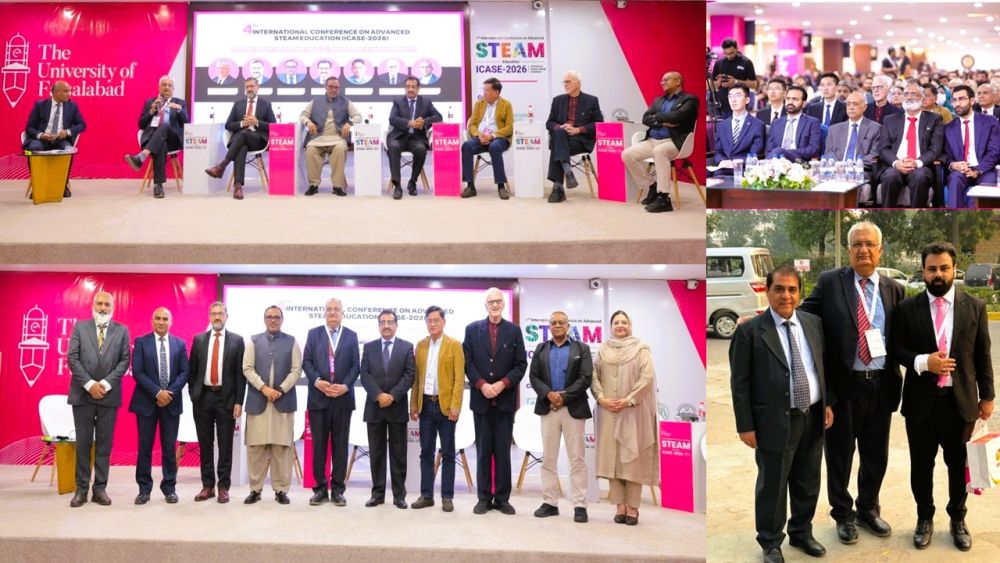
265/2026
An international dialogue on skills, artificial intelligence, innovation, and sustainability at ICASE-2026 challenges universities to rethink their purpose, priorities, and performance.
The world is changing faster than its educational institutions. Artificial intelligence is transforming professions, industries are redefining workforce requirements, environmental challenges are threatening development, and technological innovation is reshaping the relationship between knowledge and economic prosperity. Yet universities worldwide are adapting more slowly.
This provided the intellectual foundation for a Plenary Session - Panel Discussion at the 4th International Conference on Advanced STEAM Education (ICASE-2026), organized by the University of Faisalabad under the theme “STEAM for Future-Ready Societies: Skills, Innovation and Sustainability.”
The Panel Discussion major theme was “Future – Ready Societies: Skills, Innovation and Sustainability” moderated by Prof. Dr. Majid Hussain, Dean, Faculty of Information Technology, The University of Faisalabad. The panelists included:
1. Prof. Emeritus Dr. Muhammad Mukhtar, Rector, University of Southern Punjab, Multan, Pakistan
2. Prof. Dr. Adnan Noor Mian, Vice Chancellor, Information Technology University (ITU), Lahore, Pakistan
3. Prof. Dr. Yasir Nawab, Vice Chancellor, University of Kamalia, Pakistan
4. Prof. Dr. Mubbasher Munawar Khan, Rector, Green International University, Lahore, Pakistan
5. Prof. Dr. Florencio C. Ballesteros Jr., Department of Chemical Engineering, University of the Philippines, Diliman, Quezon, City, Philippines
6. Prof. Dr. Herman Roborgh, School of Religion and Philosophy, Minhaj University, Lahore, Pakistan
7. Dr. Mohan Rathakrishnan, School of Education, Universiti Utara Malaysia, Malaysia
Bringing together university leaders, academics, and international experts, the panel moved beyond conventional conversations about curriculum reform and technological advancement. It raised a more fundamental question: What should a university accomplish in an age when information is abundant, artificial intelligence is increasingly accessible, and the real measure of human progress lies in transforming knowledge into meaningful solutions?
The discussion delivered a clear message: The future of higher education will depend less on how much knowledge universities deliver and more effectively they develop human competence, stimulate innovation, and serve society.
The AI Revolution: From Access to Intelligence
Artificial intelligence occupied a central position in the discussion. One key observation was that AI should not be reduced to ChatGPT or other conversational systems. It also encompasses computer vision, natural language processing, autonomous systems, pattern recognition, machine learning, and deep learning.
This distinction matters for universities. While students may use conversational AI for writing and information retrieval, scientific disciplines increasingly depend on sophisticated computational systems to interpret large datasets, identify patterns, and generate discoveries.
The discussion highlighted a paradox: AI can increase human capability without necessarily developing human competence. It can enable people to perform tasks previously beyond their abilities, yet greater technological assistance does not automatically produce deeper understanding, independent judgment, or professional expertise.
The implications for education are immediate and profound.
Universities must teach students to work with AI, function without it when necessary, and exercise sound judgment even when its outputs are inaccurate, biased, or misleading.
This three-dimensional approach provides a practical philosophy for education in the AI era. Curricula must incorporate discipline-specific AI applications, while students and faculty must develop critical AI literacy. They should understand algorithmic bias, hallucinations, privacy, cybersecurity, human oversight, and the environmental and financial costs of emerging technologies. Equally important is encouraging philosophical and ethical discussions about intelligence, human judgment, creativity, and the limits of artificial intelligence.
University must remain a place where students learn not merely how to use technology, but how to question it.
Reimagining the University: Interdisciplinary Knowledge and Experiential Learning
An important dimension of the discussion concerned the traditional separation of academic disciplines. The challenges confronting humanity do not respect departmental boundaries. Climate change requires scientific, technological, economic, political, and social understanding. Healthcare increasingly depends on collaboration between medical professionals, engineers, data scientists, and biotechnology researchers. Agriculture requires integration of environmental science, artificial intelligence, engineering, and business innovation.
Universities must therefore move beyond rigid disciplinary structures and create opportunities for interdisciplinary learning and research.
Faculty members themselves must become continuous learners. Exposure to research and professional development outside their immediate disciplines can stimulate discoveries that conventional departmental arrangements might never produce. The emerging university should be less concerned with protecting disciplinary territories and more interested in bringing together different forms of knowledge to solve complex problems.
Experiential learning was another recurring theme. Internships, cooperative education, apprenticeships, industry projects, capstone assignments, and community-based research should become integral to academic programs rather than supplementary activities. The concept of a 'missing semester' was particularly interesting. Inspired by an initiative at MIT, the suggestion was to introduce a dedicated learning component across academic programs that equips students with practical competencies often overlooked in conventional curricula.
Employability Is a Reflection of Educational Quality
Perhaps the most challenging contribution concerned how universities measure success. For decades, higher education institutions have celebrated increasing enrolments, graduate numbers, research publications, and institutional rankings. Although these indicators have their place, they do not necessarily show whether universities produce competent professionals or contribute to economic and social development. The discussion strongly questioned this traditional understanding of institutional performance.
If graduates cannot solve problems, demonstrate professional competence, or meet workplace requirements, the problem may not lie with the graduates themselves. It may lie within the educational process that produced them.
The proposed solution was a decisive transition towards outcome-based education. Universities must evaluate whether students are learning, rather than simply whether teachers have completed the prescribed curriculum. Research must also shift toward solving industrial, economic, and societal problems.
An especially thought-provoking illustration was the well-known 'cobra effect'. During British colonial rule in India, an incentive was reportedly introduced to reduce the cobra population by rewarding people for killing snakes. Instead, people began breeding snakes to collect the rewards. When the incentive was withdrawn, the situation worsened.
The lesson is relevant to higher education. Incentives can produce unintended consequences when institutions reward the wrong outcomes.
If academics are rewarded predominantly for publication numbers, the system may encourage publication-oriented behavior rather than meaningful research. Universities must therefore recognize problem-solving, innovation, technology transfer, commercialization, and measurable societal impact. The message was unmistakable: research should not end with a published paper; it should help solve a problem.
Industry and Academia: Ending the Town-Gown Divide
The traditional distance between universities and industry emerged as another major concern. Employers frequently express dissatisfaction with graduates' practical abilities, while universities continue to produce qualifications that do not always correspond to changing workplace requirements.
The panel therefore advocated a more integrated relationship between academia and industry.
Instead of arranging internships only at the end of a degree, universities should introduce sustained industry engagement throughout the educational journey. Apprenticeships, industrial placements, collaborative projects, and professional mentoring should enable students to understand workplace expectations while they are still studying.
Industry professionals should contribute to curriculum development, and faculty members should have opportunities for industrial visits, exchanges, and professional exposure.
An interesting observation concerned the role of universities in attracting industrial investment. Industries are unlikely to invest simply because universities possess laboratories, qualified faculty, or research publications. They invest when they recognize value. Universities must demonstrate their capacity to solve industrial problems, develop useful technologies, provide professional expertise, and accelerate innovation.
The discussion also emphasized institutional responsiveness. Universities must develop mechanisms that allow promising innovations and collaborative projects to progress without unnecessary administrative delays. This requires a new institutional culture in which academia becomes an active partner in economic development rather than an isolated provider of academic qualifications.
Sustainability Must Become a University-Wide Responsibility
Environmental sustainability was not treated as a separate academic subject but as an essential principle of future-ready education. The international contribution to the panel highlighted that climate change is simultaneously a technological, economic, political, and social challenge. Engineering solutions alone cannot address environmental problems if they ignore communities, human behavior, and socioeconomic realities.
Therefore, every professional must understand the environmental implications of their work.
Engineers should consider energy efficiency and pollution prevention. Architects should incorporate sustainable design. Technologists should develop climate-resilient solutions. Educators should promote environmental awareness, while business graduates should understand the sustainability implications of economic decisions.
Universities themselves must demonstrate these principles through energy-efficient buildings, environmentally responsible operations, green campus development, and institutional climate resilience. Equally important is integrating community engagement into environmental education.
Students must have opportunities to work with industries and local communities on practical challenges. The ultimate measure of successful sustainability education is not simply the number of graduates or research publications, but the contribution those graduates make towards creating resilient and environmentally responsible societies.
Education Must Ultimately Be About Serving Humanity
One of the panel's most reflective contributions shifted the discussion from professional competence to education's fundamental purpose.
Why do we educate ourselves?
Is education primarily a pathway to personal wealth, professional recognition, and individual advancement, or does it carry a larger responsibility to humanity? The argument was that education loses much of its purpose when it becomes exclusively self-centered. University graduates make up a relatively small proportion of society and therefore have a responsibility to use their knowledge and professional abilities for others' benefit.
Universities must develop social intelligence alongside technical competence.
Students should move beyond the academic environment, interact with communities, understand social realities and develop empathy for people whose experiences differ from their own. A graduate's success should therefore be measured not only by professional achievements but also by the positive difference that individuals make in society. This perspective provides an important ethical foundation for the technological and economic transformation discussed throughout the session.
The Next Three Years: From Discussion to Implementation
The panel also addressed the urgency of translating these ideas into institutional and national action. Three priorities emerged: curriculum transformation, institutional reform and appropriate incentives.
Higher education institutions must regularly update their academic programs to incorporate artificial intelligence, digitalization, emerging technologies, soft skills and industry requirements. At the same time, regulatory frameworks should give universities sufficient institutional flexibility to develop their own identities, respond to regional needs, and pursue distinctive academic priorities. Higher education regulators should balance quality assurance with facilitation, innovation, and institutional autonomy.
Universities must also invest in modern infrastructure, strengthen industry partnerships, track graduate employability, and engage their alumni in academic development.
Above all, institutional performance indicators must evolve. Graduate competence, employment outcomes, innovation, commercialization, research translation and measurable societal contributions deserve greater recognition.
These priorities require commitment from university leadership, faculty, policymakers, industry and students alike.
The University of the Future: An Institution That Creates Solutions
The ICASE-2026 plenary discussion offered a valuable reminder that the future of higher education is not simply a technological question. It is simultaneously a question of institutional purpose, educational philosophy, professional competence, economic relevance, environmental responsibility, and human values.
Artificial intelligence will continue to expand what individuals can accomplish. However, universities must ensure that technological capabilities are accompanied by intellectual maturity, independent judgment, professional competence, and social responsibility.
The challenge is not to produce graduates who merely know more, but individuals who can do more, think critically, innovate responsibly and contribute meaningfully.
Perhaps the most important conclusion is that universities must stop measuring their success mainly by what they produce internally and start measuring it by the difference they make externally.
The future-ready university will not be the one that produces the most degrees or publications. It will be the one that transforms knowledge into competence, competence into innovation, innovation into economic opportunity, and education into service to humanity. That is the transformation higher education must now embrace.