9. The Cognitive Domain of Bloom's Taxonomy: From Remembering to Critical Evaluation
Posted 3 months ago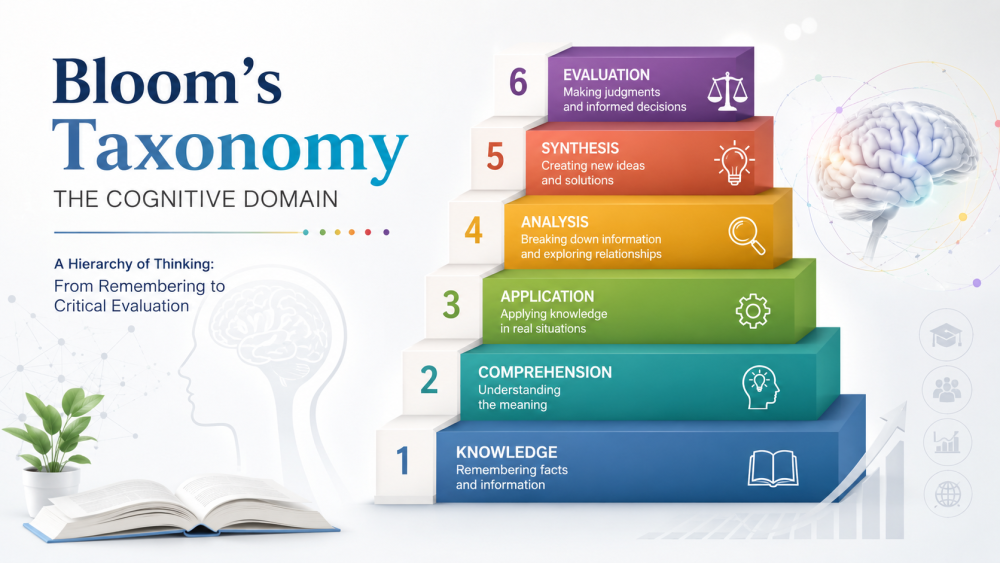
138/2026
Among the three domains of Bloom's Taxonomy, cognitive, affective, and psychomotor, the cognitive domain has received the most recognition. It remains the most widely used framework in education across schools, colleges, universities, and professional training institutions. It offers a systematic model for understanding how learners acquire, process, organize, apply, and evaluate knowledge. More importantly, it helps educators design meaningful learning experiences that move beyond memorization toward higher-order thinking and lifelong learning.
The cognitive domain represents the intellectual dimension of learning. It describes how the human mind develops from simple recall of information to more sophisticated levels of reasoning, creativity, and critical judgment. Rather than treating learning as a single event, Bloom viewed intellectual development as a hierarchy in which each successive level builds on mastery of the previous one.
In its original form, the cognitive domain comprises six hierarchical levels:
- Knowledge
- Comprehension
- Application
- Analysis
- Synthesis
- Evaluation
These levels reflect increasing cognitive complexity. A learner who merely remembers information demonstrates a fundamentally different level of intellectual achievement than one who can critically evaluate competing theories or generate innovative solutions to real-world problems. Understanding these distinctions is essential for curriculum developers, teachers, assessment specialists, and educational leaders who aim to develop graduates capable of independent thinking and professional excellence.
9.1 The Hierarchical Nature of Cognitive Learning
Bloom proposed that learning is cumulative. Students cannot effectively analyze a concept without first understanding it, nor can they create innovative solutions without adequate knowledge and analytical skills. Consequently, each level of the cognitive domain serves as a foundation for the next.
The progression may be visualized as a ladder of intellectual development.
Knowledge → Comprehension → Application → Analysis → Synthesis → Evaluation
As learners progress through this hierarchy, cognitive demands increase significantly. The emphasis gradually shifts from recalling facts to understanding relationships, solving authentic problems, generating new ideas, and making evidence-based judgments.
9.1.1. Level 1: Knowledge
The first and most fundamental level of the cognitive domain is Knowledge. At this stage, learning involves recognizing, recalling, and reproducing previously learned information. It represents memory-based learning and is often achieved through repetition or rote memorization.
Knowledge does not necessarily imply understanding. A student may memorize definitions, formulas, dates, names, or classifications without grasping their significance or underlying principles.
Typical learning activities at this level include:
- Memorizing mathematical formulas
- Learning scientific terminology
- Remembering names of medicines
- Recalling the capitals of countries
- Listing historical events
- Defining technical concepts
For example, a student may memorize the formula for standard deviation or Newton's Second Law without understanding when or why to apply them. Similarly, a medical student may remember the names of antibiotics without understanding their mechanisms of action.
Assessment questions at the knowledge level generally begin with verbs such as:
- Define
- List
- Name
- Identify
- Recall
- State
- Describe
Typical examination questions include:
- What is leadership?
- Define photosynthesis.
- List the components of a computer.
- Name the parts of a plant cell.
Although knowledge represents the lowest level of cognitive achievement, it remains indispensable because higher-order thinking depends on an adequate knowledge base.
9.1.2 Level 2: Comprehension
The second level is Comprehension, sometimes called understanding. At this level, learners move beyond simple memorization to grasp the meaning, logic, and relationships underlying the information.
Comprehension answers the question:
Why does this happen?
Instead of merely recalling facts, learners explain concepts in their own words, interpret information, and apply logical reasoning.
For instance, students studying biology may memorize the names of cell organelles at the knowledge level. However, genuine comprehension occurs when they understand why mitochondria are called the "powerhouse of the cell," how ribosomes synthesize proteins, and why each organelle performs a specific biological function.
Similarly, students studying leadership may memorize various leadership styles. At the comprehension level, they understand why leadership influences organizational performance and how different leadership approaches affect employee motivation.
Assessment at this level commonly uses verbs like:
- Explain
- Interpret
- Discuss
- Summarize
- Illustrate
- Compare
- Clarify
Representative questions include:
- Why is leadership important in organizational success?
- Explain how photosynthesis supports life on Earth.
- Why is standard deviation useful in statistics?
- Discuss the role of mitochondria in cellular metabolism.
Comprehension marks a significant advancement because students begin to construct meaningful mental models rather than merely storing isolated facts.
9.1.3 Level 3: Application
The third cognitive level is Application, which involves applying learned knowledge to practical situations.
Knowledge becomes meaningful only when learners can use it to solve authentic problems.
Application requires students to answer the question:
How can this knowledge be used?
This stage bridges classroom learning and professional practice.
For example, an engineering student who understands differential equations should be able to apply them to model engineering systems. Likewise, a statistics student should be able to use measures such as variance and standard deviation to analyze business performance, industrial quality control, or financial risk.
Leadership education also demonstrates effective application. Knowing leadership theories is insufficient unless learners can apply them during organizational crises, team management, or emergencies.
Consider the following scenario:
A passenger aboard an aircraft suddenly suffers a heart attack. If you are asked to coordinate assistance until medical personnel arrive, how would you apply leadership principles to manage the situation?
Answering such a question requires applying theoretical knowledge to an unfamiliar real-world context.
Typical action verbs include:
- Apply
- Solve
- Demonstrate
- Use
- Calculate
- Implement
- Perform
Representative assessment questions include:
- Apply statistical techniques to analyze company sales data.
- Demonstrate how conflict management principles resolve workplace disputes.
- Use differential equations to model engineering systems.
- Calculate production efficiency using appropriate formulas.
Application is one of the most valuable educational outcomes because it prepares learners for professional practice.
9.1.4 Level 4: Analysis
The fourth level is Analysis, in which learners examine complex systems by breaking them down into components and investigating the relationships among them.
Analysis emphasizes inquiry, investigation, and critical thinking.
Learners seek answers to questions such as:
- What are the causes?
- How are different components connected?
- Which factors determine success or failure?
- What patterns or relationships exist?
Analytical thinking is fundamental to scientific research, business strategy, engineering design, public policy, and evidence-based decision-making.
For example, instead of merely discussing leadership, students may analyze:
- Critical success factors of leadership within the textile industry
- Leadership failures in corporate organizations
- Causes of organizational decline
- Leadership characteristics associated with innovation
Similarly, economics students may investigate:
- Factors responsible for China's rapid economic growth
- Causes of inflation
- Determinants of unemployment
- Drivers of technological innovation
In scientific disciplines, analytical thinking enables students to investigate causal relationships rather than merely describing observable phenomena.
Common assessment verbs include:
- Analyze
- Examine
- Investigate
- Differentiate
- Compare
- Categorize
- Interpret
Sample questions include:
- Analyze the causes of China's rapid economic development.
- Examine the critical success factors of leadership in manufacturing industries.
- Investigate the causes of declining biodiversity.
- Compare factors contributing to organizational success and failure.
Analysis transforms learners from passive recipients of information into independent investigators.
9.1.5 Level 5: Synthesis
The fifth cognitive level is Synthesis, which represents creativity and innovation.
At this stage, learners synthesize existing knowledge, understanding, application, and analytical insights to generate something new.
Synthesis requires originality.
Rather than asking students to reproduce existing ideas, educators encourage them to design innovative solutions, propose alternative strategies, develop new models, or integrate knowledge across disciplines.
Creativity is increasingly recognized as one of the most essential competencies of the twenty-first century.
For example, after studying leadership principles, students might be asked:
- Design a leadership model suitable for schools.
- Develop a strategy to improve teamwork within a hospital.
- Create a community leadership program for youth.
- Propose innovative approaches for managing environmental disasters.
Students are not merely recalling information; they are constructing original ideas based on prior learning.
Typical action verbs include:
- Design
- Develop
- Construct
- Formulate
- Create
- Invent
- Propose
Example assessment questions include:
- Design an innovative leadership framework for higher education institutions.
- Develop a strategy for improving environmental sustainability on your campus.
- Create a business model that promotes green entrepreneurship.
- Formulate a new approach to classroom management.
Synthesis represents the transition from knowledge consumers to knowledge creators.
9.1.6 Level 6: Evaluation
The highest level of Bloom's original cognitive domain is evaluation.
Evaluation involves making informed judgments based on logical reasoning, objective evidence, ethical considerations, and established criteria.
Students at this level critically evaluate ideas, theories, policies, systems, or competing alternatives.
Evaluation requires intellectual maturity because learners must justify their conclusions with evidence rather than opinion.
Typical evaluation questions include:
- Compare different educational systems.
- Evaluate competing economic policies.
- Assess alternative leadership approaches.
- Judge the effectiveness of healthcare interventions.
Examples include:
- Compare Western and Eastern family systems.
- Evaluate the effectiveness of transformational leadership compared with transactional leadership.
- Assess the strengths and weaknesses of renewable energy technologies.
- Critically examine different healthcare delivery models.
Common action verbs include:
- Evaluate
- Judge
- Critique
- Defend
- Justify
- Recommend
- Assess
Evaluation represents the highest intellectual achievement because it integrates knowledge, understanding, application, analysis, and creativity into informed decision-making.
Illustrative Progression Across the Six Cognitive Levels
The topic of leadership offers an excellent illustration of the cognitive hierarchy.
|
Cognitive Level |
Example Learning Task |
|
Knowledge |
Define leadership. |
|
Comprehension |
Explain why leadership contributes to organizational success. |
|
Application |
Demonstrate how leadership principles would be applied during an emergency. |
|
Analysis |
Analyze the factors that contribute to successful leadership in the textile industry. |
|
Synthesis |
Design an innovative leadership model for university students. |
|
Evaluation |
Critically evaluate transformational and transactional leadership approaches in higher education. |
This progression demonstrates how a single topic can be taught and assessed at increasingly sophisticated cognitive levels.
9.2 A Critical Observation from Educational Practice
Educational assessments across schools, colleges, and universities frequently reveal an imbalance in teaching and assessment practices. Most instructional activities emphasize the first-level knowledge recall and, to a lesser extent, the second-level comprehension. A smaller proportion of students are challenged to apply their learning, while opportunities for analysis, synthesis, and evaluation remain relatively rare.
This imbalance has significant consequences. Graduates may possess substantial factual knowledge yet struggle to solve real-world problems, conduct independent research, innovate, or make evidence-based decisions. These limitations are especially significant in professions that require adaptability, creativity, and critical thinking.
Outcome-based education therefore encourages educators to design curricula, learning experiences, and assessments that intentionally promote higher-order cognitive development. By engaging students in authentic tasks, case studies, projects, simulations, research activities, and reflective inquiry, institutions can cultivate graduates who are not only knowledgeable but also capable of applying, analyzing, creating, and evaluating knowledge in complex professional and societal contexts.
9.3 Practical Implications for Teachers
Understanding the cognitive domain has profound implications for educational practice. Effective teachers should strive to do the following:
- Balance instruction across all six cognitive levels rather than relying primarily on memorization.
- Design learning outcomes that progressively develop higher-order thinking skills.
- Align classroom activities and assessments with the intended cognitive level.
- Use authentic, real-world problems to encourage application and analysis.
- Foster creativity through open-ended projects and inquiry-based learning.
- Encourage evidence-based reasoning and critical evaluation in classroom discussions and assignments.
When teaching, learning, and assessment are intentionally aligned with Bloom's cognitive hierarchy, education becomes a process of intellectual transformation rather than mere information transfer.
9.4 Summary
Bloom's Taxonomy's cognitive domain remains one of the most influential frameworks in educational theory and practice. Its six hierarchical levels, Knowledge, Comprehension, Application, Analysis, Synthesis, and Evaluation, describe the progression of intellectual abilities from simple recall to sophisticated critical judgment. While knowledge forms the essential foundation of learning, meaningful education requires students to understand concepts, apply them in authentic contexts, analyze complex relationships, generate innovative ideas, and evaluate evidence to make informed decisions. By designing curricula and assessments that deliberately engage learners at all six levels, educators can cultivate graduates who possess not only disciplinary knowledge but also the analytical, creative, and evaluative capacities needed to address the complex challenges of the twenty-first century.