8. Bloom's Taxonomy: A Foundational Framework for Learning, Teaching, and Assessment
Posted 3 months ago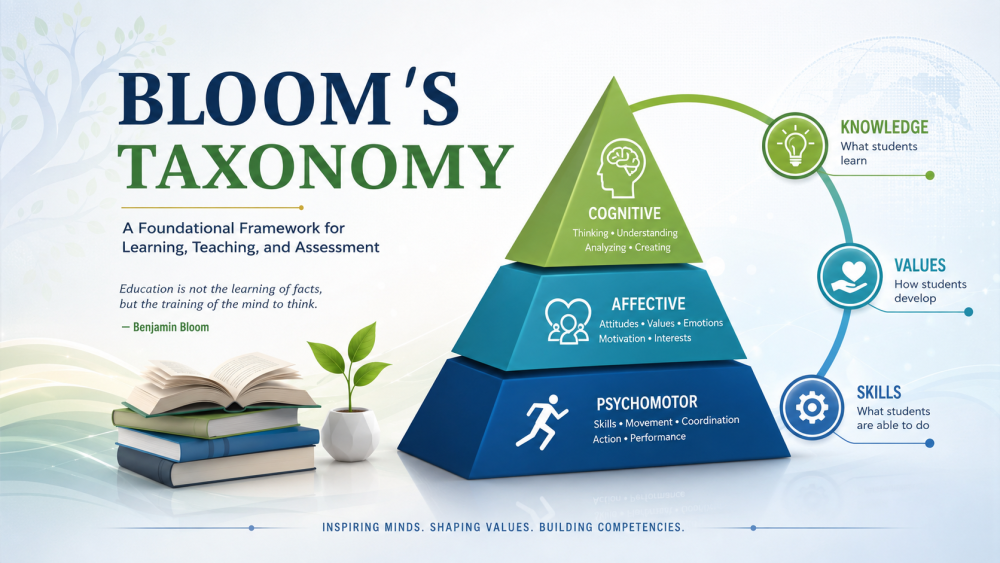
137/2026
Introduction
Among the many frameworks for understanding how people learn, Bloom's Taxonomy remains one of the most influential and enduring contributions to educational theory. Since its introduction by Benjamin S. Bloom and his colleagues in 1956, the taxonomy has shaped curriculum design, teaching methods, assessment strategies, and educational policy around the world. It provides educators with a systematic framework for organizing learning objectives by increasing levels of complexity and depth.
The significance of Bloom's Taxonomy extends far beyond conventional classroom instruction. It has become a cornerstone of Outcome-Based Education (OBE), competency-based learning, curriculum mapping, accreditation systems, and quality assurance practices adopted by schools, colleges, universities, and professional training institutions worldwide. By emphasizing what learners should know, understand, value, and be able to do after instruction, Bloom's Taxonomy has fundamentally transformed educational planning from a teacher-centered approach to a learner-centered paradigm.
This chapter introduces the philosophy underlying Bloom's Taxonomy, explains its three domains of learning, and discusses its practical applications in contemporary education.
8.1 Historical Background
Bloom recognized that effective education extends beyond the acquisition of factual knowledge. Students also develop values, attitudes, emotions, practical skills, and professional competencies. Consequently, learning was classified into three complementary domains, each representing a distinct dimension of human development:
- Cognitive Domain
- Affective Domain
- Psychomotor Domain
Together, these domains offer a comprehensive framework for designing educational experiences that promote intellectual growth, emotional development, and practical competence.
8.2 The Three Domains of Learning
Bloom's Taxonomy emphasizes that meaningful education should cultivate learners holistically rather than focusing solely on academic knowledge. Each learning domain addresses distinct aspects of human capability.
8.3 The Cognitive Domain
The cognitive domain concerns intellectual development and the acquisition of knowledge. It encompasses the mental processes involved in remembering information, understanding concepts, solving problems, analyzing relationships, synthesizing ideas, and making informed judgments.
This domain forms the intellectual foundation of nearly every educational program. Students progressively develop the ability to manipulate information, connect concepts, interpret evidence, and generate innovative solutions. Rather than encouraging simple memorization, Bloom emphasized higher-order thinking that enables learners to apply knowledge in unfamiliar contexts.
Typical cognitive activities include:
- remembering scientific facts
- explaining theories
- interpreting data
- solving mathematical problems
- analyzing research findings
- designing engineering solutions
- evaluating alternative approaches
- creating original ideas and innovations
In Outcome-Based Education, the cognitive domain is particularly valuable because it enables educators to formulate measurable learning outcomes that specify the expected level of intellectual achievement.
8.4 The Affective Domain
While intellectual ability is essential, Bloom recognized that successful learning also depends on students' emotions, attitudes, beliefs, interests, motivations, and values. These characteristics constitute the affective domain.
The affective domain focuses on learners' emotional responses to educational experiences and how those experiences shape their personal and professional development. Students who value ethical conduct, environmental sustainability, teamwork, empathy, and lifelong learning demonstrate achievement in this domain.
Teachers play a critical role in fostering positive attitudes toward learning by creating supportive classroom environments, encouraging curiosity, promoting respect for diversity, and instilling confidence.
Learning outcomes within the affective domain may include:
- developing professional ethics
- demonstrating respect for others
- appreciating cultural diversity
- showing responsibility toward society
- valuing environmental conservation
- exhibiting teamwork and leadership
- maintaining academic integrity
- developing lifelong learning habits
In professional education, including medicine, engineering, nursing, business, and teacher education, the affective domain is indispensable because technical competence alone is insufficient without ethical responsibility and professional attitudes.
8.5 The Psychomotor Domain
The psychomotor domain encompasses the development of physical, technical, and motor skills that require coordination between cognitive processes and muscular activity. It involves performing tasks with greater precision, efficiency, and confidence.
Psychomotor learning is particularly important in vocational education, technical training, laboratory sciences, medicine, sports, performing arts, and engineering technology.
Examples of psychomotor skills include:
- operating machinery
- welding
- driving vehicles
- swimming
- performing surgical procedures
- conducting laboratory experiments
- typing and computer operations
- repairing equipment
- handwriting
- public speaking
- pronunciation and language articulation
- listening with comprehension
- participating in sports
- performing religious practices requiring coordinated physical movements
Unlike purely theoretical knowledge, psychomotor competencies develop through repeated practice, demonstration, observation, feedback, and ongoing refinement. Mastery requires both technical accuracy and procedural fluency.
8.6 Relationship Among the Three Domains
Although Bloom categorized learning into separate domains, effective education integrates all three. Consider medical education as an example.
A medical student must:
- understand human anatomy and disease mechanisms (cognitive domain),
- demonstrate compassion, empathy, and professional ethics (affective domain),
- perform clinical procedures safely and accurately (psychomotor domain).
Similarly, an engineering graduate should possess scientific knowledge, professional responsibility, and technical competence in the operation of instruments and machinery.
This integration illustrates that true educational excellence cannot be achieved by developing only one dimension of learning.
8.7 Bloom's Taxonomy in Outcome-Based Education
Outcome-Based Education (OBE) emphasizes clearly defined learning outcomes that specify what learners should know, value, and be able to do upon completing a course or program. Bloom's Taxonomy provides the conceptual foundation for articulating these outcomes.
Educational institutions use Bloom's framework to:
- develop measurable Course Learning Outcomes (CLOs)
- formulate Program Learning Outcomes (PLOs)
- align teaching strategies with intended outcomes
- design appropriate assessment methods
- ensure constructive alignment between curriculum, instruction, and evaluation
- satisfy accreditation requirements
The taxonomy enables educators to distinguish between lower-order learning outcomes, such as recalling facts, and higher-order outcomes, such as evaluating evidence or designing innovative solutions. This distinction supports progressive learning experiences that prepare students for professional practice rather than rote memorization.
8.8 Practical Applications in Schools, Colleges, and Universities
Bloom's Taxonomy has extensive applications across educational settings.
8.8.1 Curriculum Development
Curriculum designers use taxonomy to sequence learning experiences from basic concepts to advanced applications, ensuring a logical progression throughout an academic program.
Lesson Planning
Teachers select instructional strategies appropriate to the intended learning level. Introductory lessons may focus on conceptual understanding, while advanced sessions emphasize analysis, evaluation, and problem-solving.
8.8.2 Assessment Design
Examinations, assignments, laboratory exercises, presentations, projects, and portfolios are designed to align with the desired learning outcomes. This approach ensures that assessments measure meaningful competencies rather than simple factual recall.
8.8.3 Student Engagement
Educators encourage learners to actively participate in discussions, collaborative projects, simulations, case studies, practical exercises, and reflective activities that address all three learning domains.
8.8.4 Professional Education
Disciplines such as engineering, medicine, nursing, agriculture, business, information technology, and vocational education extensively apply Bloom's Taxonomy to integrate theoretical knowledge with practical competence and professional attitudes.
8.9 Strengths of Bloom's Taxonomy
Bloom's Taxonomy remains highly influential because it:
- provides a clear structure for educational planning;
- promotes learner-centered instruction;
- supports higher-order thinking and creativity;
- facilitates measurable learning outcomes;
- aligns curriculum, teaching, and assessment;
- enhances educational quality assurance;
- supports accreditation and international educational standards; and
- applies across virtually all academic disciplines and educational levels.
Its adaptability has enabled it to remain relevant despite significant changes in educational technologies and pedagogical approaches.
8.10 Conclusion
Bloom's Taxonomy is one of the most significant milestones in educational theory and practice. By recognizing that learning encompasses intellectual achievement, emotional development, and practical skill acquisition, Benjamin Bloom established a comprehensive framework that continues to influence educational systems around the globe. The taxonomy provides educators with a common language for defining learning objectives, designing curricula, selecting instructional strategies, and developing meaningful assessments.
In the era of Outcome-Based Education, Bloom's Taxonomy has become even more valuable because it supports the development of measurable learning outcomes that reflect knowledge, professional attitudes, and practical competencies. Whether implemented in schools, colleges, universities, or vocational institutions, the taxonomy remains an indispensable guide for designing educational experiences that prepare learners not only to acquire knowledge but also to apply it ethically, skillfully, and creatively to address real-world challenges.