7. Global Adoption of Outcome-Based Education: A Worldwide Transformation in Higher Education
Posted 3 months ago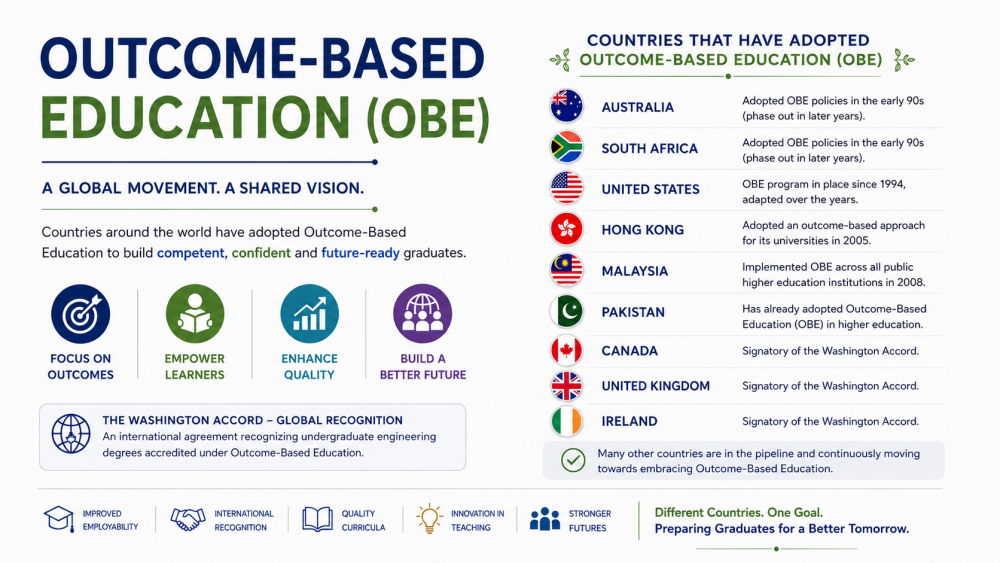
136/2026
Outcome-Based Education (OBE) has evolved from an educational concept into a global movement that is reshaping how schools, colleges, and universities design curricula, assess learning, and prepare graduates for the demands of the twenty-first century. As nations seek to improve educational quality, strengthen workforce readiness, and enhance the international recognition of qualifications, OBE has emerged as a powerful framework for aligning education with societal and professional needs.
Over the past three decades, countries around the world have experimented with, adopted, refined, and adapted Outcome-Based Education to fit their unique educational contexts. Although implementation strategies vary, the central philosophy remains consistent: educational success should be measured by what learners can know, understand, and demonstrate, rather than merely by the amount of content they have been taught.
7.1 Early Adoption of Outcome-Based Education
Australia and South Africa were among the pioneers of Outcome-Based Education, both introducing OBE reforms in the early 1990s. Their experiences offered valuable insights into the strengths and implementation challenges of competency-based educational systems. Although aspects of their original national models were later revised or replaced, these early initiatives significantly influenced the global conversation on educational reform and underscored the importance of aligning learning outcomes with curriculum and assessment.
The United States has also played an important role in the evolution of OBE. Since the mid-1990s, outcome-oriented approaches have been widely adopted across professional education, particularly in engineering, medicine, nursing, teacher education, and business programs. Rather than being a single national policy, OBE in the United States has evolved through accreditation agencies that require institutions to demonstrate measurable evidence of student learning and continuous quality improvement.
7.2 Expansion Across Asia
Several Asian countries have embraced Outcome-Based Education as part of broader higher education reforms.
In 2005, Hong Kong formally adopted an outcome-based approach for its universities, emphasizing clearly defined learning outcomes, learner-centered teaching, and transparent assessment practices. The reform strengthened curriculum alignment, improved graduate employability, and supported international academic recognition.
Similarly, Malaysia implemented Outcome-Based Education across its public higher education institutions and professional programs as part of a comprehensive strategy to improve educational quality and global competitiveness. OBE has since become an integral component of curriculum development, accreditation, and quality assurance throughout Malaysia's higher education system.
These reforms have encouraged institutions to move beyond traditional examination-oriented education toward producing graduates equipped with practical skills, professional competence, and lifelong learning abilities.
7.3 The European Shift Toward Learning Outcomes
Within Europe, Outcome-Based Education has gained prominence through the educational reforms associated with the European Higher Education Area (EHEA) and the Bologna Process. Rather than emphasizing teaching inputs, European universities increasingly focus on clearly articulated learning outcomes, competency-based curricula, student-centered learning, and transparent assessment.
This outcome-oriented approach has enhanced comparability of academic qualifications across European countries, facilitated student mobility, strengthened international collaboration, and improved mutual recognition of degrees. By placing learning outcomes at the center of educational design, European institutions have created a common language for academic quality while preserving institutional diversity.
7.4 The Washington Accord: International Recognition of Engineering Education
One of the most significant milestones in the global acceptance of Outcome-Based Education was the establishment of the Washington Accord in 1989.
The Washington Accord is an international agreement among accreditation bodies that recognizes the substantial equivalence of undergraduate engineering programs accredited under outcome-based quality standards. Rather than comparing curricula alone, the Accord assesses whether engineering graduates achieve the competencies expected of professional engineers.
Membership in the Washington Accord provides graduates with greater international recognition of their engineering qualifications, facilitates professional mobility, and strengthens global confidence in engineering education.
Over the years, the Accord has expanded to include numerous countries across regions worldwide, reflecting the growing international acceptance of competency-based education and outcomes-based accreditation.
7.5 Emerging Nations and Future Directions
Many developing countries are integrating Outcome-Based Education into their national education systems as part of broader efforts to modernize higher education and improve graduate employability.
Countries such as Pakistan have initiated significant reforms by incorporating OBE into engineering, technology, computing, medical, and other professional disciplines through national accreditation councils and higher education quality assurance frameworks. As institutions continue to strengthen curriculum design, faculty development, assessment practices, and quality assurance mechanisms, OBE is expected to become increasingly embedded across higher education.
Similar reforms are also underway across the Middle East, Africa, and other parts of Asia, where governments recognize that educational quality is fundamental to economic development, innovation, and global competitiveness.
7.6 A Global Philosophy for the Future
Although implementation models vary across countries, the global experience shows that Outcome-Based Education is far more than an educational trend. It represents a fundamental transformation in how educational quality is defined and measured.
Today, universities are increasingly evaluated not only by the number of students they graduate but also by the competencies those graduates possess, their employability, professional performance, ethical conduct, and contributions to society. This global shift reflects a shared recognition that education must prepare learners not only to pass examinations but also to solve complex problems, think critically, innovate continuously, and thrive in rapidly changing environments.
As international collaboration in education continues to expand, Outcome-Based Education is expected to play an increasingly important role in harmonizing academic standards, facilitating global mobility, and ensuring that graduates possess the knowledge, skills, attitudes, and competencies needed to meet the challenges of an interconnected world.
Ultimately, the worldwide adoption of Outcome-Based Education reflects a shared educational vision: the true measure of learning is not what students have been taught, but what they can achieve.